TL;DR:The Make 10 strategy converts a hard addition fact into an easy one. 8 + 6 becomes 10 + 4 by moving 2 counters from the 6 to fill the 8 up to 10. Teaching the move is the tricky part. This guide explains what the strategy is, why it matters for fact fluency, how to teach every step using our free Make 10 Strategy Visualizer, and why the ten-frame is specifically the right visual tool for the job.
Ask a first-grader to solve 8 + 6 and watch what happens. Most will count up from 8 - "nine, ten, eleven, twelve, thirteen, fourteen" - raising a finger with each number. It gets to the right answer. It also places six sequential working-memory demands on a child at once, with nothing to catch them if they lose count at eleven.
There is a better way, and it has a name. Instead of counting up from 8, a student who has internalized the Make 10 strategy thinks: "I need 2 to make 10. I take 2 from the 6. That leaves 4. Ten and four is fourteen." Three steps, each simple. The challenge is that without a visual to hold the steps in place, three simple steps can still be three steps too many for a six-year-old. That is what the ten-frame is for.
Wait - What Is a "Strategy" in Math?
In math education, a strategy is a structured way of thinking through a problem that uses known relationships between numbers rather than counting or rote recall. Doubles, near-doubles, counting on from the larger number, and Make 10 are all examples. They are sometimes called derived fact strategies, because the student derives the answer from facts they already know - instead of counting up to it, or trying to remember a memorized result that may or may not surface.
The shift from counting-based methods to strategy-based ones is one of the most important transitions in early math development. A quasi-experimental study, found that struggling students who received direct training in derived fact strategies - including decomposition methods like Make 10 - made significantly larger gains in calculation fluency than peers who did not, and crucially began using efficient strategies more often and counting-based ones less often. Fluent fact recall rarely appears overnight. For many children, efficient strategies are the stepping stones that get them there.
What Is the Make 10 Strategy?
The Make 10 strategy - also called "bridging to 10" or "bridge through 10" - is a mental addition method that turns any addition problem into one involving 10. The idea: if one addend is close to 10, decompose the other addend to fill the gap.
For 8 + 6: the 8 needs 2 more to reach 10. Split the 6 into 2 and 4. The 2 joins the 8 to make 10. The problem becomes 10 + 4 = 14. For 9 + 7: the 9 needs 1. Split the 7 into 1 and 6. The problem becomes 10 + 6 = 16. In every case, a fact that requires retrieval becomes one that requires no calculation at all - because adding any single digit to 10 just places a 1 in front of it.
The strategy rests on two prerequisites: knowing how far each number is from 10 (the combinations of 10), and being able to split a number into two parts (part–whole thinking). Both are trainable, and both are exactly what consistent ten-frame work builds.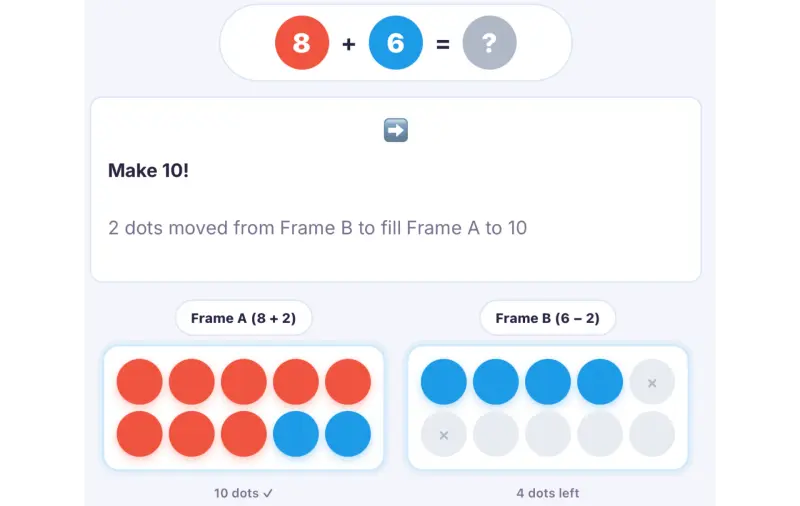
Why the Make 10 Strategy Matters
Addition facts within 20 are the foundation of every calculation that follows - and rote memorization alone is a fragile way to build that foundation.
A child who has memorized 8 + 6 = 14 as a sound pattern has no framework for checking whether the answer is reasonable. A child who understands the Make 10 strategy has a procedure that works for any near-10 combination and that builds the number-sense scaffolding multi-digit arithmetic will later require.
Research on fact fluency consistently distinguishes between students who retrieve facts automatically and students who derive them efficiently from known number relationships.
(More on this distinction in what math fact fluency really is.)
In Adding It Up, the authors note that mathematical proficiency involves more than memorizing answers; it requires understanding the relationships between numbers well enough to use known facts to solve unfamiliar ones. The Make 10 strategy is one of the first places where that shift - from counting to reasoning - can happen. A child who has internalized it is no longer asking “what comes next?” but “what do I already know that makes this easier?
The practical downstream benefits are substantial:
Mental addition with two-digit numbers uses exactly this move - 47 + 6 becomes 47 + 3 + 3 = 50 + 3 = 53, which is Make 10 applied to the nearest ten.
Regrouping in column addition is the written form of the same exchange: combining ones to make a ten is Make 10 in vertical format.
Composing and decomposing numbers is a foundational competency that underpins multi-digit arithmetic, fractions, and algebraic thinking. Make 10 is where that skill first becomes a reliable, practised procedure rather than an occasional strategy.
Teaching the Make 10 Strategy with the Free Visualizer
The hardest part of teaching Make 10 is making the move visible. Students can arrive at the right answer without seeing the procedure - they might count up, or recall the fact, or guess. The free Make 10 Strategy Visualizer steps through the move counter by counter, so the decomposition is not described but seen. Here is what each teaching moment looks like.
Two Frames, One Problem
The tool opens with two ten-frames side by side: Frame A holds the first addend, Frame B holds the second. For 8 + 6, Frame A shows 8 purple counters with two empty cells visible at the bottom right, and Frame B shows 6 orange counters. Before anything moves, students can see the key question in the empty cells: "How many spaces are still open in Frame A?" Two. That is exactly how many counters need to cross over. The visual turns "how many to make 10?" from a recall question into a perception question.
The Move - How Many to Make 10?
Pressing Next Step moves exactly the right number of counters from Frame B to Frame A. For 8 + 6, two counters shift across - they appear in a distinct colour to show where they came from - filling Frame A completely and leaving Frame B with 4. Students can see the decomposition: the 6 is now visibly split into 2 (which crossed over) and 4 (which stayed). This is the critical cognitive moment. Counting-on never makes the split visible; the ten-frame makes it unavoidable.
10 + Something Is Always Easy
With Frame A full and Frame B showing 4, the equation reads: 10 + 4 = 14. There is nothing to calculate. Any child who recognises a full ten-frame as 10 and can count Frame B's remaining dots can produce the answer. The strategy has turned a retrieval problem (8 + 6 = ?) into a perception problem (a full frame plus 4 dots). That change - from memory to structure - is what makes Make 10 worth the instructional investment.
That instant recognition of a full frame is subitizing at work. Ideally the child doesn't even need to count the remaining dots if they are good at subitizing.
A Step-by-Step Lesson Sequence
You can run the full Make 10 lesson with nothing but a projector and the Visualizer. Each step maps to a feature of the tool.
Build the prerequisite: combos of 10. Before Make 10 can work, students need fluency with which pairs bond to 10: 1+9, 2+8, 3+7, 4+6, 5+5. Use the Number Bonds Visualizer with the whole set to 10 to show all five pairs side by side. Students who hesitate on "how far is 8 from 10?" will stumble at step 1 of every Make 10 problem.
Load the first problem. Enter 8 + 6. Ask: "Look at Frame A. How many empty cells do you count?" Wait for students to answer. Do not tell them. This question - "how many to make 10?" - is the entire first step of the strategy, and building the habit of asking it is more important than any single answer.
Make the move. Press Next Step. Watch 2 counters move from Frame B to Frame A. Ask: "What happened to the 6? How many moved across? How many stayed?" Name the split explicitly: 6 = 2 + 4. This is the decomposition step, and saying it aloud is as important as seeing it.
Read the result. Frame A is now full - that is 10. Frame B has 4. Ask: "So what is 10 + 4?" This should require no thought. If it does, pause and practise 10 + n facts before continuing - they are the foundation the final step rests on.
Try a smaller gap. Enter 9 + 4. The 9 is only 1 away from 10. Ask students to predict before pressing Next Step: "How many will move this time? What will be left?" One moves; 3 stay. 10 + 3 = 13. The smaller gap makes the strategy feel fast - because it is.
Fade to mental. Give a problem without the Visualizer - say it aloud: "7 + 5." Ask students to use the strategy in their heads: "How many does 7 need to make 10? How many are left from the 5?" A student who answers both questions without counting has internalized the strategy.
This concrete-to-mental fade is the CRA method in action.
Open the Make 10 Strategy Visualizer and try it with your next addition lesson.
Make 10 and Neurodivergent Learners
For children with dyscalculia, counting-on strategies are particularly unreliable - tracking "how many I have counted so far" and "how many more to go" simultaneously is exactly the kind of dual-tracking that dyscalculic working memory struggles with. The Make 10 strategy, taught with a ten-frame, offloads both demands onto the visual: the empty cells in Frame A show exactly how many to move, and a full frame is immediately readable as 10 without any counting at all. The calculation happens in the image, not inside the child's head.
For children with ADHD, multi-step mental procedures are vulnerable to the very thing ADHD affects most - holding an intermediate result in working memory while carrying out the next step. The ten-frame externalizes every intermediate result: students can see both addends, see the move, and see the final state without holding any of it mentally. The step-through format of the Visualizer also means each sub-step is paced separately, preventing the executive-function cost of managing multiple steps at once.
For autistic learners, the Make 10 strategy offers a predictable, rule-governed procedure that works for every near-10 addition fact: always find the gap, always move that many, always read the full frame as 10. The consistency - the same three-step procedure every time - suits the pattern-based reasoning and preference for explicit, reliable rules that many autistic students display. The fact that the answer is always derivable from structure, rather than recalled from memory, also removes the anxiety that comes with retrieval failure.
FAQs:
What is the Make 10 strategy?
The Make 10 strategy is a mental addition method for facts where one addend is close to 10 (typically 7, 8, or 9). The student decomposes the other addend to fill the near-10 number up to 10, then adds the remainder to get a 10 + n fact. 8 + 6 becomes 10 + 4; 9 + 5 becomes 10 + 4; 7 + 8 becomes 10 + 5.When should children learn the Make 10 strategy?
Most curricula introduce Make 10 in Grade 1, after students have fluency with combinations of 10 (which pairs of numbers sum to 10) and basic part–whole thinking. It typically follows doubles and near-doubles in the teaching sequence, and precedes multi-digit addition.What is a ten-frame and why is it used for this strategy?
A ten-frame is a 2×5 grid of cells that holds up to 10 counters. It is specifically suited to Make 10 because it makes the gap to 10 visually explicit - empty cells in Frame A are exactly the number of counters that need to move. A full frame is immediately recognisable as 10 without counting.How does Make 10 connect to later mathematics?
Make 10 directly prepares students for mental addition with two-digit numbers (bridging to the nearest ten: 47 + 6 = 50 + 3 = 53) and for regrouping in column addition. A student who understands the move conceptually will find regrouping far more meaningful than one who has learned it as a mechanical procedure.
References:
National Research Council. (2001). Adding It Up: Helping Children Learn Mathematics. National Academies Press. https://www.nationalacademies.org/read/9822/chapter/7
Koponen, T., Sorvo, R., Dowker, A., Räikkönen, E., Viholainen, H., Aro, M., & Aro, T. (2018). Does multi-component strategy training improve calculation fluency among poor performing elementary school children? Frontiers in Psychology, 9, 1187. https://pmc.ncbi.nlm.nih.gov/articles/PMC6050482/