TL;DR: Parents can ask their child's school for an evaluation if they suspect a math learning disability. Under IDEA, a parent may request an initial evaluation at any time; if the school agrees to evaluate, the federal timeline is generally 60 days after parental consent unless the state has established a different timeframe. Section 504 does not set a fixed federal deadline, although schools must evaluate when they have reason to believe a student needs services because of a disability. School evaluations are provided at no cost to parents. Families can also pursue a private evaluation, although cost, timing, and insurance coverage vary.
If you've spent months watching your child melt down over math homework, or noticed they still count on their fingers well past when classmates stopped, you've probably already looked up what dyscalculia is and recognized some of the signs. The next step, actually asking for an evaluation, is the part that trips people up. It can feel like there's a secret process you're supposed to know, or that you need a teacher or doctor to bring it up first.
You don't. As a parent, you have the right to start this process yourself, in writing, today. Here's exactly how.
Why It's Worth Requesting an Evaluation, Not Just Waiting
It's tempting to wait and see if things improve, especially if your child is otherwise doing fine in school. But dyscalculia doesn't tend to resolve on its own with more practice, and an evaluation is the only way to get a clear answer, along with access to formal accommodations if your child qualifies for them. If you're still weighing whether what you're seeing matches up, our guide on signs your child may have dyscalculia walks through the specific patterns worth watching for, separate from ordinary math struggles.
An evaluation also isn't an all-or-nothing bet. Even if the results come back inconclusive or your child doesn't meet the threshold for a formal diagnosis, you'll walk away with a much clearer picture of exactly where the gaps are, which is useful information no matter what.
Two Paths to an Evaluation: School or Private
There are two main routes, and they're not mutually exclusive.
A school evaluation is free and is the route most parents start with. In the U.S., two key federal laws govern support for students with disabilities: the Individuals with Disabilities Education Act (IDEA), which can lead to an Individualized Education Program (IEP), or Section 504 of the Rehabilitation Act, which can lead to a 504 Plan with classroom accommodations. Schools evaluate for a broader category called "specific learning disability," and its regulatory definition doesn't name dyscalculia specifically. It's still relevant, though: the U.S. Department of Education has clarified that there is nothing in IDEA that prohibits schools from using the terms dyslexia, dyscalculia, and dysgraphia in evaluations, eligibility determinations, or IEP documents when a child's evaluation results support it, so it's worth asking that the specific term be used in your child's paperwork if it applies.
A private evaluation is conducted by a neuropsychologist, clinical psychologist, or educational psychologist outside the school system. It costs money, sometimes partially covered by insurance, but it tends to be more thorough and can specifically name dyscalculia as a diagnosis, which a school evaluation may not do. Many families end up doing both: a private evaluation for a detailed, formal diagnosis, and a school evaluation (using the private report as supporting evidence) to secure accommodations.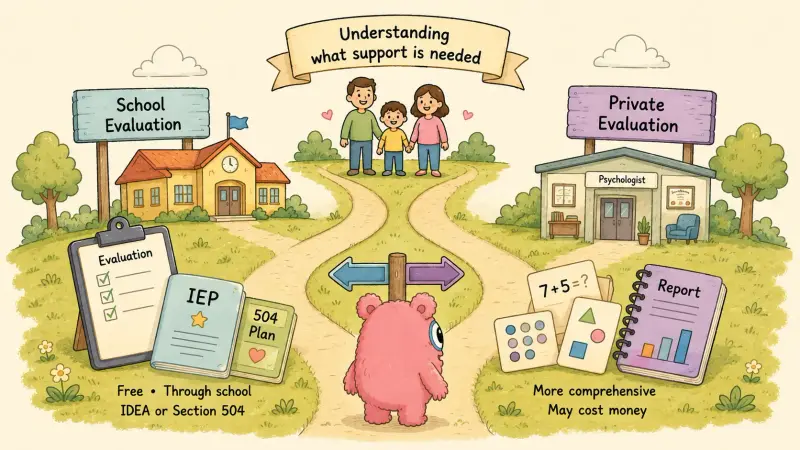
Step-by-Step: Requesting a School Evaluation
Step 1: Write Down What You're Seeing
Before you contact the school, spend a week or two writing down specific examples: the math tasks that trip your child up, how long homework takes, what they say about how math makes them feel, and any patterns a teacher has mentioned. Specific examples carry far more weight than a general "they're struggling in math," both with the school and with any evaluator down the line. You want concrete details like "still uses fingers to add single-digit numbers in third grade" or "cried during a timed multiplication quiz three times this month," not just an overall impression. This documentation becomes the backbone of your written request and, later, useful context for whoever conducts the evaluation.
Step 2: Submit a Written Request
Put your request in writing, addressed to your child's teacher, the school counselor, or the special education coordinator, and ask specifically for an evaluation for a suspected specific learning disability in math. Under Section 504, a school must evaluate a student once it has reason to believe the student has a disability that affects their access to education, and while the law doesn't specify an exact form the consent has to take, the U.S. Department of Education's Office for Civil Rights has said that it has accepted written consent as sufficient to meet Section 504's requirement, and a written request in general creates a paper trail that protects you if there's ever a dispute about what was asked for and when.
Keep it simple and factual. State that you're requesting an evaluation, briefly mention the specific concerns you documented in Step 1, and ask what the next steps and timeline will be. Send it by email if possible, so you automatically have a timestamped record.
Step 3: Give Consent and Track the Clock
Once you request an evaluation, the school will typically send you a consent form to sign before testing can begin. Sign and return it promptly, since the legal clock doesn't start until the school has your consent in hand. Under federal special education law, the initial evaluation must be completed within 60 days of receiving parental consent, unless your state has set its own timeframe, so mark that date on your calendar and follow up if you haven't heard anything as it approaches. Section 504 itself doesn't set a hard deadline the way IDEA does, but the Office for Civil Rights generally uses that same 60-day IDEA timeline as the benchmark for what counts as a reasonable amount of time for a school to complete a Section 504 evaluation.
Step 4: Know What a School Evaluation Involves
A school evaluation should be comprehensive rather than relying on a single test. Under IDEA, schools must use a variety of assessment tools and strategies, consider information from parents, and assess the child in all areas related to the suspected disability, rather than using any single measure as the sole basis for a decision. Depending on the child's needs and the school's evaluation process, this can include academic achievement testing, classroom and teacher information, records, observations, and other assessments appropriate to the areas of concern.
It's worth keeping in mind that this school evaluation process is separate from a clinical diagnosis of dyscalculia specifically. A school evaluation determines whether your child qualifies for services under IDEA or Section 504, using the criteria described above. A clinical diagnosis of dyscalculia, which is a different question, typically comes from a psychologist or neuropsychologist following clinical diagnostic guidelines, covered in the next section.
Step 5: Attend the Eligibility Meeting
Once testing is complete, the school will hold a meeting, sometimes called an eligibility meeting or an IEP meeting, to go over the results with you. You're a full member of this meeting, not just an observer, and you can ask questions, request clarification on any score you don't understand, and share your own perspective before any decision is finalized. If your child qualifies, the team will move into writing an IEP or 504 Plan.
If You Disagree With the School's Evaluation
If your child doesn't qualify and you disagree with the school’s evaluation, or you otherwise believe the evaluation was inadequate, you have options under IDEA. If you disagree with an evaluation conducted by the school under IDEA, you may request an independent educational evaluation (IEE) at public expense. The school must then, without unnecessary delay, either provide the IEE at public expense or initiate a due process hearing to show that its own evaluation was appropriate. You can also obtain a private evaluation at your own expense, and qualifying private evaluation results must be considered by the school when making decisions under IDEA.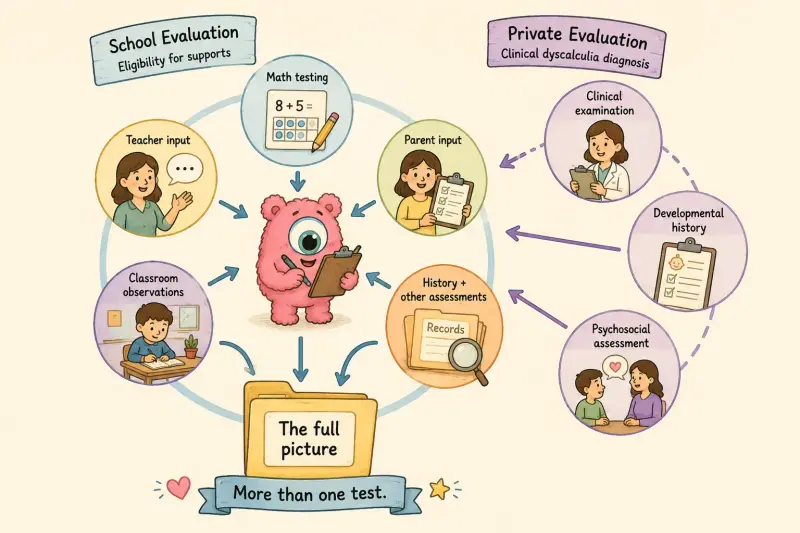
What a Private Evaluation Adds
If you want a diagnosis that specifically names dyscalculia, rather than the broader "specific learning disability" category schools typically use, a private evaluation with a neuropsychologist or educational psychologist is usually the more direct route. This is a different process from a school's IDEA or Section 504 evaluation: a school evaluation determines eligibility for educational services, while a clinical evaluation is aimed at reaching an actual diagnosis. Clinical guidelines for diagnosing dyscalculia describe combining three separate sources of information: standardized testing of math performance, a clinical examination, and a detailed history and psychosocial assessment, with the diagnosis only established once findings from all three sources are considered together, not from test scores alone. The same guidelines note that a valid diagnosis also has to rule out low intelligence, undetected vision or hearing problems, and other conditions that could otherwise explain the same math difficulties.
A private evaluation's written report and specific diagnosis can also strengthen a school evaluation request if you bring the results to the school afterward, since the school must consider qualifying private evaluation results in its own decision-making. The tradeoff is cost: private evaluations often run into the hundreds or low thousands of dollars depending on where you live and what's covered by insurance, so it's worth calling your insurance provider first to ask what portion, if any, is reimbursable under your plan's mental health or developmental testing benefits.
Getting the Results, Whatever They Show
Whichever path you take, try to hold the outcome loosely going in. A confirmed diagnosis opens the door to formal accommodations and a clearer treatment plan, but an inconclusive result isn't a dead end either; it usually still tells you which specific skills need the most support, which is information you can act on immediately regardless of what label ends up attached to it. Understanding what dyscalculia actually is, and isn't, makes the whole process easier to navigate. Our parent's guide to dyscalculia is a good place to start if you want the fuller picture of what an evaluation is actually screening for before you request one.
FAQs
1. Can I request a dyscalculia evaluation directly, or does a teacher have to suggest it first?
You can request it directly. As a parent, you have the right to request an evaluation in writing at any time, without needing a teacher, pediatrician, or anyone else to recommend it first.
2. How long does a school have to complete the evaluation once I request it?
Under federal special education law (IDEA), the evaluation must be completed within 60 days of the school receiving your written consent, unless your state has set a different timeframe. Section 504 doesn't set its own strict deadline, but federal guidance points to that same 60-day window as the reasonable benchmark.
3. Is a school evaluation free?
Yes. A school-based evaluation for a suspected disability must be conducted at no cost to the parent under both IDEA and Section 504.
4. Will the school evaluation specifically say "dyscalculia" on the paperwork?
Not automatically. Schools evaluate and qualify students under the broader category of "specific learning disability" in math, which doesn't name dyscalculia by default. Federal guidance confirms schools are allowed to use the term dyscalculia in evaluation and IEP documents when the results support it, so it's worth asking. A private evaluation with a neuropsychologist or educational psychologist is more likely to use the specific diagnostic label without you having to ask.
5. What if the school evaluation doesn't find anything?
You have options. Under IDEA, if you disagree with the school's evaluation, you can request an independent educational evaluation (IEE) at public expense, and the school must then either provide it or initiate a due process hearing to defend its own evaluation. You can also pursue a private evaluation at your own expense; an inconclusive school result doesn't necessarily mean nothing is going on, especially if a private evaluator uses more specialized clinical testing.
6. What happens during the actual evaluation?
A school evaluation under IDEA uses a mix of academic testing, teacher and parent input, records, and observations, rather than a single test. A private clinical evaluation aimed at a specific dyscalculia diagnosis typically goes further, combining standardized math testing, cognitive testing, and a detailed history to reach a diagnosis, since a reliable diagnosis is based on all of these together rather than a single test score.
References:
U.S. Department of Education, Office for Civil Rights. (2016). Parent and Educator Resource Guide to Section 504 in Public Elementary and Secondary Schools. https://www.ed.gov/sites/ed/files/about/offices/list/ocr/docs/504-resource-guide-201612.pdf
U.S. Department of Education. 34 CFR § 300.301 - Initial evaluations. https://www.ecfr.gov/current/title-34/subtitle-B/chapter-III/part-300/subpart-D/subject-group-ECFRcdd53b28839f370/section-300.301
U.S. Department of Education. 34 CFR § 300.304 - Evaluation procedures. https://www.ecfr.gov/current/title-34/section-300.304
U.S. Department of Education. 34 CFR § 300.502 - Independent educational evaluation. https://www.ecfr.gov/current/title-34/section-300.502
Yudin, M. K. (2015). OSEP Dear Colleague Letter on IDEA/IEP Terms. U.S. Department of Education, Office of Special Education and Rehabilitative Services. https://sites.ed.gov/idea/idea-files/osep-dear-colleague-letter-on-ideaiep-terms/
Haberstroh, S., & Schulte-Körne, G. (2019). The diagnosis and treatment of dyscalculia. Deutsches Ärzteblatt International, 116(7), 107–114. https://di.aerzteblatt.de/int/archive/article/205469