TL;DR: Regrouping goes wrong when a child has learned the steps without understanding that a ten and ten ones are the same amount. Show the trade with physical materials before you show it on paper, describe out loud what actually happened, and save problems with zeros for last. The specific wrong answer your child gives tells you exactly which part broke.
You've explained it four times. You've said "borrow from the tens" in three different voices. Your child nods, does the next problem, and gets it wrong the same way again.
The frustrating part is that they're usually not being careless. Regrouping asks a child to accept something that written numbers actively hide: that the 4 in 43 isn't four, it's forty - and that a whole ten can be broken open into ten ones whenever you need them. If that idea hasn't landed, the steps are just a sequence of moves to memorise, and memorised moves fall apart under pressure.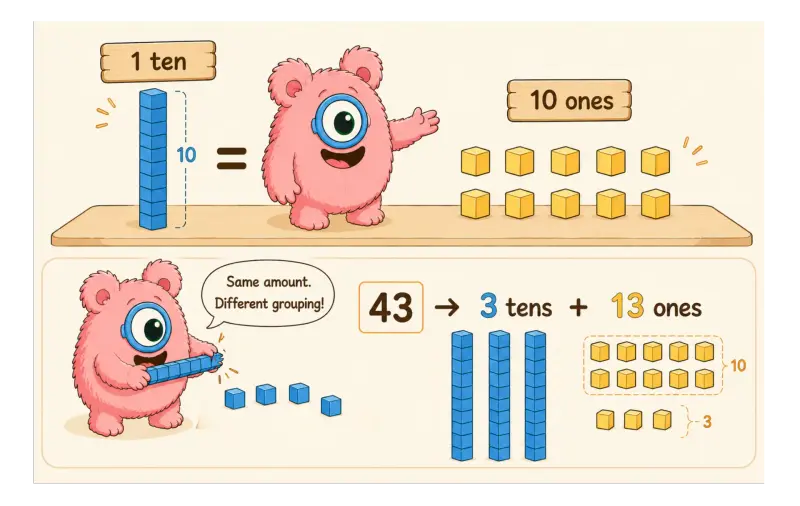
Why it goes wrong
Subtraction with regrouping sits on top of place value, and place value takes years to build. A child who still reads the 4 in 43 as "four" rather than "forty" has no reason to believe that a ten can be turned into ten ones, because they haven't fully accepted that the ten is there in the first place.
When Dutch researchers looked closely at 264 third graders working through subtraction problems, they explain that persistent regrouping errors can indicate that students have made the procedural transition to decomposition strategies but do not yet fully grasp the base-ten place-value concept. The child has the steps. What's missing is the reason.
If your child still reads the 6 in 65 as "six" rather than "sixty," start there rather than with subtraction - our guide to teaching place value with base-ten blocks covers that ground properly.
Read the wrong answer before you re-explain
This is the most useful thing in this article. Children make a small number of very consistent errors, and each one points somewhere different. Before you explain anything again, look at what they actually wrote.
Take 43 − 17.
They answer 34. They did 40 − 10 = 30, then hit 3 − 7, flipped it to 7 − 3 = 4, and added. This is the classic one, sometimes called the smaller-from-larger bug. Your child has decided that you always take the little digit from the big one, which is a perfectly sensible rule that happens to be wrong. They're avoiding the exchange entirely, usually because they don't know it's available.
They answer 36. They did the exchange properly, 13 − 7 = 6 and then forgot to knock the tens column down from 40 to 30. This is a different problem with a different fix. They understand the trade; they lost track of it halfway through. That's a working memory issue, not a conceptual one.
They answer 24. They knew a trade was needed, decremented the tens, and then still flipped 3 − 7 into 7 − 3. Half the idea is there.
Three answers, three different conversations. Re-explaining the whole procedure to a child who only lost track of one column wastes both your evenings.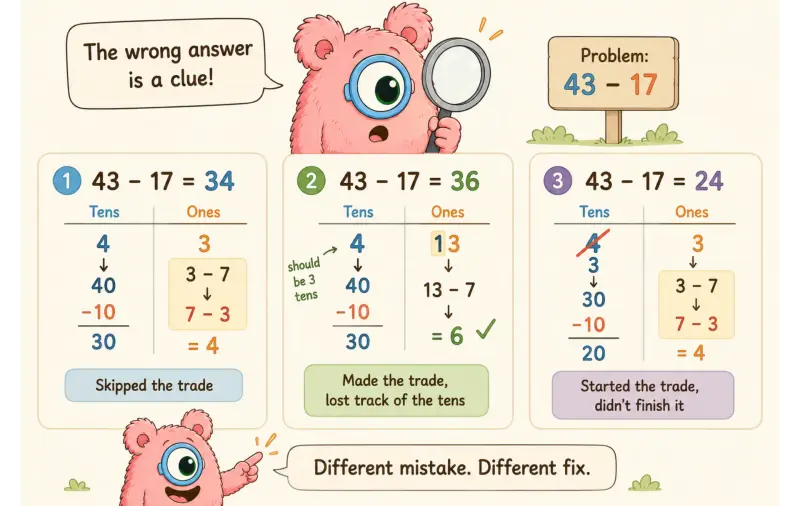
A sequence that works
1. Prove the trade is fair before you use it
Put out one ten-rod and ten loose ones. Ask which pile is worth more. Most children who struggle with regrouping will say the ten loose ones, because there are more objects. Count them together until it's obvious they're the same. Then do it the other way: hand over the rod, take back ten ones, and say "same amount, different shape." Do this on its own, several times, with no subtraction anywhere near it. You're establishing that the exchange is legal, which is the belief the whole procedure rests on.
2. Choose materials where a ten looks like a ten
Not all manipulatives work equally well. When researchers gave 123 second graders different materials to build numbers with, materials that made ones, tens and hundreds physically distinct produced more accurate representations than individual beads that required children to create those groupings themselves. Among children at risk for math difficulties, 69% of responses were correct with the proportional materials, compared with 39% with the individual beads.
The practical version: use base-ten rods, a bundled straw, or a stick of ten linking cubes. Avoid anything where ten looks like a scattered handful. The child needs to see a ten as one thing that contains ten things, because that's precisely what they'll be trading.
3. Build the problem, then get stuck on purpose
Lay out 43 as four rods and three ones. Ask them to take away seven ones. Let them discover there aren't enough. Don't rescue this moment - the stuck feeling is what makes the trade feel necessary rather than arbitrary. Then ask what they could do about it. Many children work out the answer themselves once they're holding the materials, and a solution a child invents is one they remember.
4. Watch your words
"Borrow" is doing you no favours. Borrowing implies you'll give it back, and nothing is ever given back here. The ten becomes ten ones and stays that way. A child who takes the word literally is being perfectly logical and will still end up confused.
"Regroup" has a quieter problem: it's used for both addition and subtraction, so it doesn't tell your child whether they're building a bigger unit or breaking one down. It names the category without naming the action.
What works is describing the physical event: "We're trading one ten for ten ones." It's longer than "borrow," and it's what actually happened
5. Write it down beside the blocks, not instead of them
Do the trade with materials and record it on paper in the same breath. Cross out the 4, write 3, and say "we traded one of the tens away, so now there are three." Put the small 1 next to the 3 and say "and here they are, ten more ones, so now we have thirteen." Every written mark should name something the child just physically did. This is the bridge most kids fall through, and the concrete-representational-abstract approach exists mostly to stop that happening.
Leave zeros until the rest is solid
Problems like 300 − 142 are a different animal, and they're genuinely harder. In that Dutch study, 1000 − 680 was the hardest item tested, with only 54% of children getting it right, and a recurring wrong answer was 1000 − 20 = 800.
Teach these separately and physically. Trade the hundred for ten tens first, look at the board, then trade one of those tens for ten ones. Two visible steps, done slowly. Children who've only ever seen zeros handled as a paper trick tend to produce something confident and wrong.
What good progress actually looks like
Fluency is not the first goal here. The first goal is that your child can explain, without materials in front of them, why crossing out the 4 and writing 3 is allowed. A child who can say "because I turned one ten into ten ones, and that's the same amount" has the concept, and speed will follow. A child who's fast but can't explain it is one distraction away from answering 34 again.
If a session is going badly, stop it. Getting three problems right with blocks and a calm parent beats twenty problems in tears, and the second one teaches your child something about maths that's much harder to undo later.
FAQs
What age do kids learn regrouping in subtraction?
Most curricula introduce two-digit subtraction with regrouping in Grade 2, around ages 7 to 8, and extend it to three-digit numbers in Grade 3. Children who are still shaky on place value often need longer, and that's normal rather than a sign of a problem.
Should I say "borrowing" or "regrouping"?
Either is fine as a label, but neither describes what happens. The clearest thing to say is what the child is physically doing: trading one ten for ten ones. "Borrowing" is particularly misleading because nothing is ever returned.
My child gets 34 when subtracting 43 − 17. What does that mean?
They're subtracting the smaller digit from the larger one in each column, regardless of position. It's a common and well-documented error pattern. It usually means they don't yet realise that trading is an option, so go back to proving the exchange with physical materials before practising more problems.
Why does my child do the trade but still get the answer wrong?
If the answer is ten too high - 36 instead of 26 - they made the exchange but forgot to reduce the tens column. That's a tracking problem rather than a conceptual one. Having them say the reduction out loud as they cross the digit out usually fixes it faster than more practice.
Do we have to use blocks, or can we just use pictures?
Pictures work well, but usually after physical materials rather than instead of them. The useful sequence is doing the trade with objects, then drawing it, then writing it. Skipping straight to drawings tends to work for children who already half-understand and to confuse the ones who don't.
How long should this take?
Longer than most parents expect. Regrouping rests on place value, which develops over years, not weeks. Short, calm sessions of ten minutes are more effective than long ones, and staying at the concrete stage until it's genuinely easy is not falling behind.
References
Vermeulen, J. A., Béguin, A., Scheltens, F., & Eggen, T. J. H. M. (2020). Evaluating the characteristics of diagnostic items for bridging errors in multi-digit subtraction. Frontiers in Education, 5, 537531. https://www.frontiersin.org/journals/education/articles/10.3389/feduc.2020.537531/full
Lafay, A., Osana, H. P., & Levin, J. R. (2023). Does conceptual transparency in manipulatives afford place-value understanding in children at risk for mathematics learning disabilities? Learning Disability Quarterly, 46(2), 92–105. https://pmc.ncbi.nlm.nih.gov/articles/PMC10164236/