TL;DR: Lead with the fact that dyscalculia is about how the brain processes numbers, not about how clever a child is. Keep the explanation short, name the specific thing that's hard, and give everyone in the family the same sentence to use.
You've got a diagnosis, or a strong suspicion, and now three different conversations to have. Your child wants to know why math feels impossible when it doesn't for their friends. A sibling wants to know why the rules seem different. A grandparent wants to know why anyone needs a label for being bad at sums.
Each one needs a different version. All three go better if you've decided in advance what you're going to say.
Start with one sentence you can reuse
Before any of these conversations, settle on a single plain description you're happy repeating. Something like: her brain handles numbers differently, so things like remembering times tables take much more effort than they should - it has nothing to do with how clever she is.
That sentence does a lot of work. It names the mechanism, it names a concrete example, and it closes off the intelligence question before anyone raises it.
That last part matters, and it's the single most important thing to get across to everyone. Across the research, the difficulties that define dyscalculia cannot be attributed to intelligence. The same review notes that around 7% of children have a mathematical learning disability, with another 10% showing persistent low achievement in math. Your child is not unusual, and they're not slow.
Telling your child
It can be shorter and earlier than you'd expect.
Most children have already worked out that something's different. By the time a diagnosis arrives, they've often spent a year or two watching classmates finish first and quietly concluded that they must be the slow one. So the conversation isn't breaking news to them. It's offering a kinder explanation than the one they've come up with on their own.
With a younger child, three things are usually enough. Name what's hard: "remembering number facts quickly is really tough for your brain." Separate it from how clever they are: "that's got nothing to do with being smart, and you're not behind because you're not trying." Then make it feel ordinary: "lots of kids have this, it has a name, and there are things that help."
Lead with something specific rather than the label. "You find it hard to remember that 7 + 8 is 15, even though you understand what adding means" is much easier to hear than "you have a math learning disability." A specific thing sounds recognisable. A label can sound frightening.
Name what they're good at in the same conversation, and be specific. Not "you're great at lots of things," which every child discounts, but something they'd recognise: "you remember every word of a story after hearing it once," or "you spotted what was wrong with the bike before I did."
And it's worth knowing you'll say all this more than once. After a hard math lesson a few weeks from now, the old explanation tends to creep back, and that's normal rather than a sign it didn't land.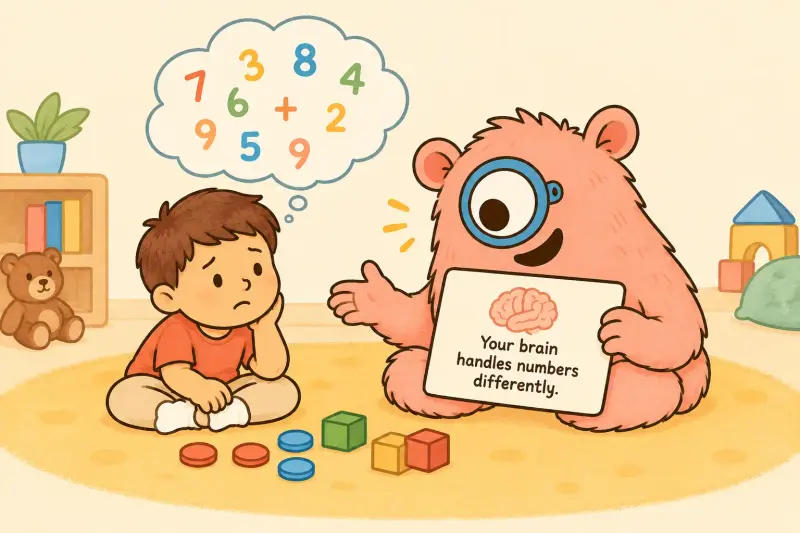
Telling siblings
With siblings, the question is usually about fairness, even when it sounds like curiosity. Why does she get a calculator? Why does she get extra time? Why doesn't she have to do the timed sheet?
The glasses comparison tends to land well, because children already accept it. Someone who wears glasses isn't getting an advantage, they're just getting to see what everyone else can see anyway. A calculator on a word-problem test is doing the same job.
A couple of things are worth mentioning gently. It helps if they don't jump in with the answer when their sister is stuck, because the slow working-out is where the learning happens. And it's kind to let her decide who she tells, rather than bringing it up in front of her friends.
One thing that's easy to miss: siblings of a child getting a lot of parental attention often stop mentioning their own struggles. Worth checking in with them now and then.
Telling grandparents and other sceptical adults
This one is often the hardest, because "in my day we just learned it" and "she needs to try harder" usually aren't questions. They're worry, dressed up as doubt.
Three things tend to help more than arguing.
Share the mechanism, briefly. One of the most consistently observed signs of dyscalculia is difficulty pulling number facts out of memory, and typically developing children recall around three times as many arithmetic facts as children with dyscalculia. Hearing it described as a memory difficulty rather than an attitude usually shifts something.
Talk about where she's heading, not what she's been called. New Jersey's education department puts it warmly in its guidance for families: with early identification and the right support, children with dyscalculia can still perform grade-level math, graduate from high school, go to college, and have the career they desire. That's usually the reassurance a worried grandparent is actually after.
Give them something to do. Doubt tends to soften when someone has a part to play. Cooking together, counting out change, a card game, anything with numbers in it and no pressure attached.
And if someone still doesn't quite believe you, that's survivable. What matters is that they don't say "you're just not trying" where your child can hear it, and it's fair enough to ask for that directly.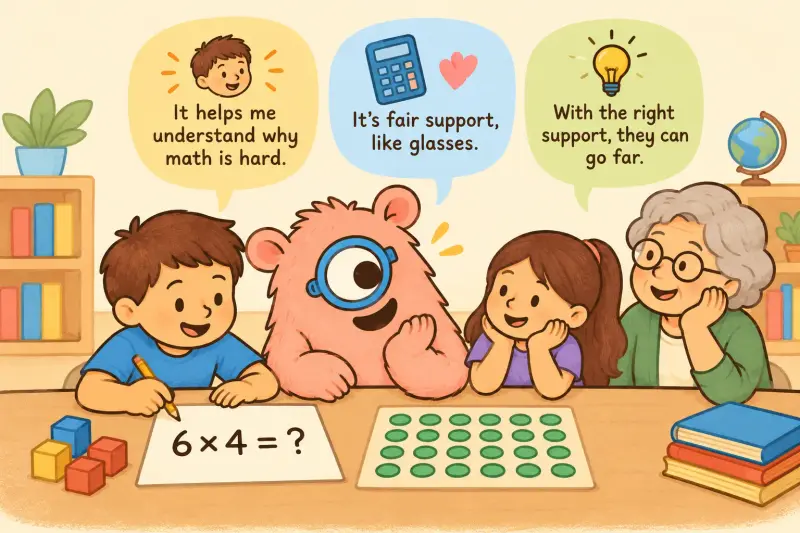
A few things worth avoiding
"I was terrible at math too." Meant kindly, but a child can hear it as a life sentence. If you want to share it, add where you ended up: "I was too, and I still use a calculator for tips, and it's absolutely fine."
"You're just not a math person." It sounds like letting them off the hook, and it quietly sets a limit.
Saying nothing. It's tempting to think a young child doesn't need to know. They usually notice anyway, and silence can start to look like something too awkward to mention.
Everything at once. A nine-year-old doesn't need the neuroscience. Answering the question they actually asked is usually plenty.
Where to start
If you only do one thing, write your sentence down somewhere.
"Her brain handles numbers differently, so things like remembering times tables take much more effort than they should - it has nothing to do with how clever she is."
Not for your child to read, just so you have it ready when the question arrives in the car or at bedtime, which is usually when it does.
Then share it with the people who'll be asked too: the sibling, the grandparent who handles homework pickup. A family that says the same thing is far more reassuring to a child than one parent saying it well once.
And if you're still working out whether dyscalculia is what you're dealing with, our parent's guide to dyscalculia walks through the signs, and our guide to requesting a math evaluation covers how to get it properly looked at.
FAQs
At what age should I tell my child they have dyscalculia?
As soon as they're asking why math is harder for them than for their classmates, which is often around seven or eight. Most children have already noticed and formed a worse explanation on their own, so an honest one is a replacement rather than new information.
How do I explain dyscalculia in simple words?
Try: "Your brain handles numbers differently, so things like remembering number facts take much more effort than they should. It has nothing to do with how clever you are." Name a specific difficulty your child will recognise rather than leading with the word disability.
Will knowing they have dyscalculia make my child give up?
More often the opposite. Children who struggle without an explanation tend to conclude they're stupid, which is far more discouraging than a named difficulty with known supports. The research is clear that the difficulties involved cannot be attributed to intelligence, and that's a genuinely useful thing for a child to be told.
What do I say to a grandparent who thinks it's just laziness?
Give them the mechanism rather than the label: children with dyscalculia recall roughly a third as many arithmetic facts as their peers, which is a memory difficulty rather than an effort problem. Then give them something practical to do, like counting change or playing card games. Scepticism usually fades once someone is helping.
Should I tell my child's siblings?
Yes, because they'll notice the different arrangements and draw their own conclusions anyway. Frame it as fairness rather than privilege: a calculator does the same job glasses do. Ask them not to supply answers when their sibling is stuck, and not to raise it in front of friends.
References
Geary, D. C. (2011). Consequences, characteristics, and causes of mathematical learning disabilities and persistent low achievement in mathematics. Journal of Developmental and Behavioral Pediatrics, 32(3), 250–263. https://pmc.ncbi.nlm.nih.gov/articles/PMC3131082/
Price, G. R., & Ansari, D. (2013). Dyscalculia: Characteristics, causes, and treatments. Numeracy, 6(1), Article 2. https://digitalcommons.usf.edu/cgi/viewcontent.cgi?article=1112&context=numeracy
New Jersey Department of Education, Office of Special Education. Dyscalculia: A family-centered approach. https://www.nj.gov/education/specialed/programs/additionalsupports/mathsupports/docs/DyscalculiaOne-Pagers_Family.pdf