
TL;DR
There's no single magic number anymore. The big health authorities have moved away from one universal limit. If you want a rough target for K–3 kids, aim for about 1 hour of recreational (fun, non-school) screen time on school days and up to 2 hours on weekend days — adjusted to your child.
What your child does on screens matters more than the minutes. A well-designed educational math game that you play together is a completely different thing from two hours of passive video.
Most kids get more than the guidelines suggest. Children ages 5–8 average about 3.5 hours of screen media a day — well above the recommended range.
Protect three things first: sleep, outdoor time, and unstructured play. Those are where the strongest evidence lives.
You can make limits stick with the built-in tools on your child's device (steps below for iPhone, iPad, Android, Fire tablet, and more).
If you've ever stared at the clock during your child's "ten more minutes" and wondered how much screen time is actually okay — you are in very good company. It's one of the most common questions parents of kindergarten through third-grade kids ask, and the honest answer has changed a lot in the last few years. Here's what the research really says, minus the guilt.
The short answer: the "magic number" is gone
For years, parents memorized one rule: no more than two hours a day. That rule has officially been retired. The American Academy of Pediatrics (AAP) now encourages families to build a personalized Family Media Plan rather than following a single cap, because it concluded that one blanket number across all ages was too blunt to be useful. In its 2025 policy statement, the AAP instead frames media decisions around the whole child - their age, temperament, and what they're actually watching or doing.
This isn't the experts dodging the question. It's a recognition that "two hours of a math game played with a parent" and "two hours of autoplay videos alone at bedtime" shouldn't count the same way.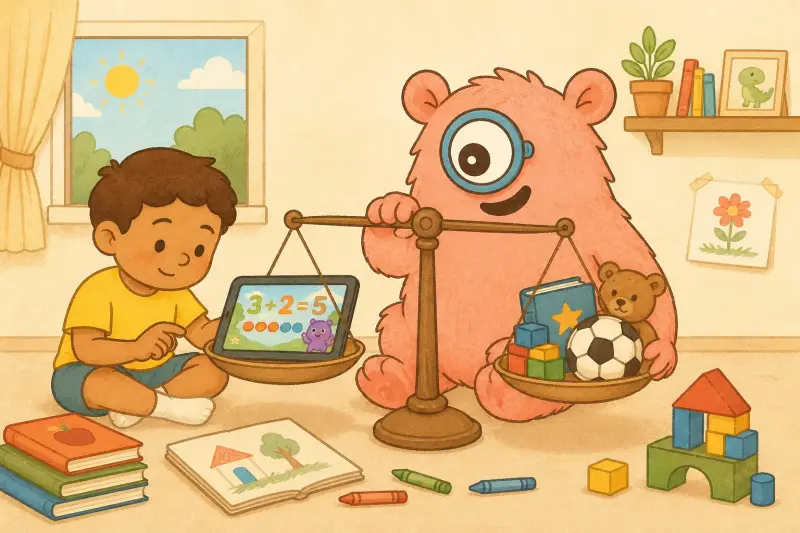
So what number should I aim for?
If you'd still like a target — and most of us would — here's where the major guidelines land for early-elementary kids:
The AAP suggests that for school-age children, entertainment screen time in the range of 1 to 2 hours a day is a reasonable starting point, with the strong caveat that high-quality content and protected sleep, play, and reading matter most.
The World Health Organization, whose formal guidance covers children under 5, recommends no more than 1 hour of sedentary screen time a day for that age group (lesser the better) - relevant for your younger kindergartners. Under 1 year of age, sedentary screen time is not recommended at all.
The Canadian 24-Hour Movement Guidelines, the most-cited evidence-based framework for ages 5–17, recommend no more than 2 hours of recreational screen time per day, alongside at least 60 minutes of active play and 9–11 hours of sleep.
A simple way many families split the difference: about an hour on school days and a bit more on weekends. The American Academy of Child & Adolescent Psychiatry offers a similar everyday structure of roughly an hour on school days and two to three hours on weekend days.
One reality check worth knowing: meeting all of these targets is genuinely hard. In a large national study, researchers found that only a tiny fraction of kids met all three daily recommendations for movement, sleep, and screen time at once - and screen time was the hardest one to hit. So if your family isn't perfectly on target, you're normal and not failing.
Not minutes - it's the "3 Cs"
Child-development researchers have a friendlier way to think about screens than counting minutes. They call it the 3 Cs: Content, Context, and Child.
Content — What is on the screen? Is it age-appropriate, interactive, and actually teaching something?
Context — How is it being used? Is it shared with you, connected to real life, and kept away from bedtime and meals?
Child — Who is watching? A sensitive 5-year-old and a confident 8-year-old don't need the same rules.
This framework holds up in the research. Recent systematic reviews — including a 2024 scoping review in Frontiers in Developmental Psychology and a 2025 review of 46 studies in the journal Children — both conclude that outcomes depend far more on the type of screen use and the context around it than on a raw time total.
Educational games vs. passive scrolling
Here's the distinction that matters most for families using learning apps. Not all screen time pulls in the same direction.
On the positive side, a 2024 meta-analysis in Frontiers in Psychology found that game-based learning has a moderate-to-large positive effect on young children's thinking, motivation, and engagement. Of course "game-based learning" includes both digital and non-digital games, but the evidence is strong for digital educational games as well.
When it comes to math specifically, a 2026 meta-analysis of more than 52,000 learners found that passive activities like TV were tied to weaker math performance, while using digital tools for genuine educational purposes helped offset that effect - with the steepest declines showing up past about three hours of screen time a day.
That same pattern appears in academic outcomes more broadly: a large analysis in JAMA Pediatrics linked television and video-game time to poorer school performance, but did not find the same effect for overall screen time. The lesson isn't "screens are bad" - it's that "what's on the screen, and who's beside your child, changes everything."
This is exactly why choosing the right app matters. If you're weighing options, our guide to the best online math programs for neurodivergent kids walks through how to tell low-pressure, understanding-first apps apart from the ones that just pile on timers and rewards.
The three biggest reasons to keep limits
When researchers find real downsides to screen time, they usually cluster around three things. Protect these and you've handled most of the risk.
1. Sleep. This is the most consistent finding in the whole field. A foundational review of 67 studies found that more screen time was linked to worse sleep in the vast majority of them, mostly through later bedtimes and shorter sleep — and newer 2025 evidence continues to connect heavier screen use with shorter sleep and a higher risk of insomnia. The simplest, most evidence-backed move you can make is keeping screens out of the bedroom and switching them off 30–60 minutes before bed.
2. Eyes and the great outdoors. Childhood nearsightedness is climbing worldwide — researchers project that roughly half the global population could be nearsighted by 2050. Studies link more screen time and less time outdoors to higher myopia risk, and the protective ingredient seems to be daily time outside in bright light. Aim for 90 minutes or so of outdoor play when you can — it helps regardless of the screen.
3. Crowding out play. Think of your child's day as a pie with a fixed number of slices. Time on a screen is time not spent doing something else. One longitudinal study of nearly 3,900 children found that screen time displaced peer play — the hands-on, imaginative, social play that builds so much in these early years. The AAP's advice is to deliberately "crowd in" the good stuff (sports, art, music, reading) so there's simply less room for excess media.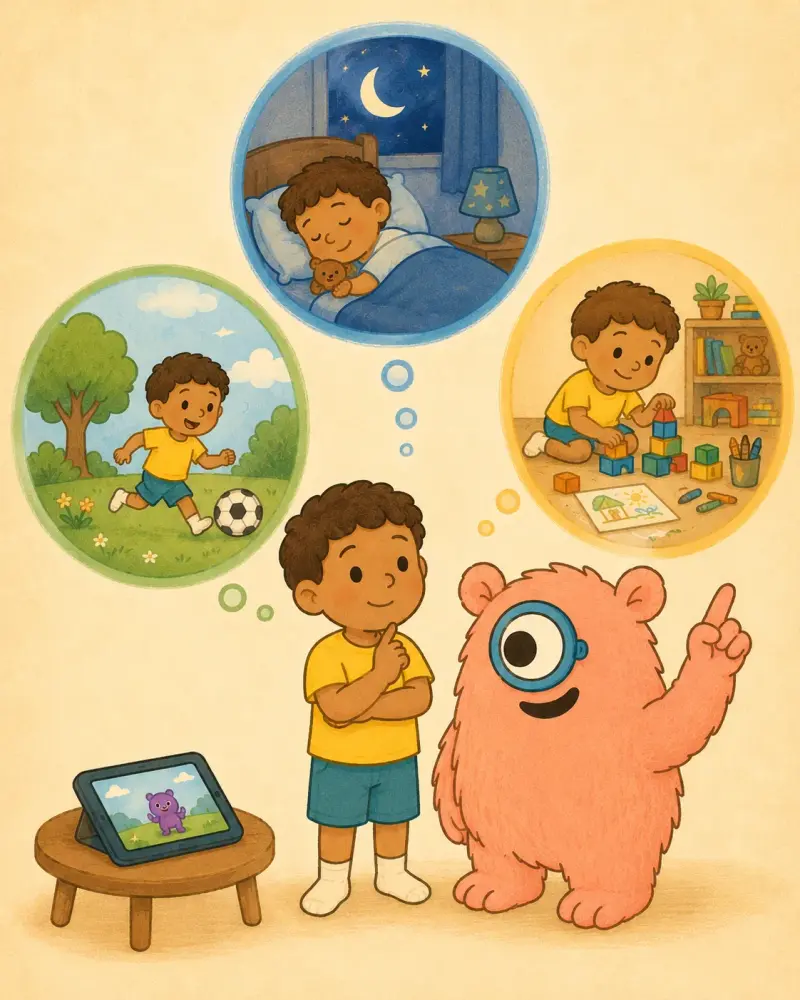
Watching with your child beats watching alone
Who's in the room changes the value of the screen. Researchers call it "joint media engagement" - a fancy term for sitting with your child, talking about what's happening, and connecting it to real life. A systematic review found that this kind of shared, conversational screen use supports children's learning and interaction in ways that solo passive viewing doesn't.
The catch? Parents tend to co-watch shows but rarely co-play apps and games. That makes joint play one of the highest-leverage habits you can build: a few minutes sitting beside your child while they tackle a tricky math level turns "screen time" into "learning time."
A note for parents of neurodivergent kids
If your child has ADHD, autism, or any other neurodivergence, you've probably noticed two things at once: screens can be a lifeline for regulation and learning, and the worry about "too much" feels heavier. The research deserves a careful read here.
It's true that children with autism and ADHD tend to use more screen time than their peers. But "more screen time" is not the same as "screens caused this." When researchers corrected for publication bias, a major JAMA Pediatrics analysis found the link between screen time and autism was no longer statistically significant - and these studies are correlational, meaning kids who are drawn to screens may simply find them calming, not be harmed by them.
The balanced takeaway: neurodivergent kids may be a little more vulnerable to screens displacing sleep and movement, so structure and content quality matter even more - but you do not need to read "screens cause autism or ADHD" into the data. For practical, strengths-based approaches, our guide on neurodivergent math learning strategies that actually work is a good next step.
Recommended vs. reality: how much screen time kids actually get
Here's where guidelines meet the living room. Against a target of roughly 1–2 hours, the latest national data (the Common Sense Census, the leading US survey) shows that kids ages 5–8 average about 3 hours 28 minutes of screen media every day — and use is sharply higher in lower-income households. In other words, the typical early-elementary child is running well past the recommended range, with the gap widest where budgets are tightest.
We dug into these numbers in detail in our companion piece on how much screen time kids are actually getting in the US. The short version: there's a real distance between what's recommended and what's happening — which makes the device tools below genuinely useful, not just nice-to-have.
How to set up screen time limits on your child's devices
The good news: every major device now has built-in controls that make limits automatic, so you're not the bad guy every afternoon. Here's how to set them up. (These are practical how-to links, current as of 2026 — paths can shift slightly with software updates.)
iPhone & iPad (Apple Screen Time)
First, set up Family Sharing so you can manage your child's device from your own phone: Settings → [your name] → Family. Then follow Apple's steps to turn on Screen Time for a family member and:
Set a Screen Time passcode that's different from the device passcode, so your child can't quietly turn limits off.
Downtime - schedule hours (bedtime, school) when only the apps you allow will work.
App Limits - cap daily time for a category (like Games) or a specific app, and switch on "Block at End of Limit."
Always Allowed - let learning apps or Messages stay open even during Downtime. (but ideally keep the tablet itself away 30-60 minutes before sleep time).
Content & Privacy Restrictions - block mature content and purchases.
Screen Distance - prompts your child to hold the device farther from their face (handy for eye strain). Apple's full Screen Time overview has the rest.
Android (Google Family Link + Digital Wellbeing)
Install the Family Link app on your phone and sign your child's Google Account into their device. Then use Google's guide to set daily limits and a school-day schedule:
Time limits / weekly schedule - set a daily cap or different limits per day.
Bedtime - lock the device during sleep hours (calls still come through).
App limits - set per-app timers or block an app entirely.
App approval - require your okay for new downloads and purchases.
Bonus time - grant a one-off extension without changing the whole schedule.
For controls right on the device, Android's Digital Wellbeing settings add app timers, a grayscale Bedtime mode, and Focus mode.
Amazon Fire tablet (Amazon Kids)
Create a child profile under Settings → Profiles & Family Library → Add Child. Then use the Amazon Parent Dashboard to set daily time limits, a bedtime "turn off by" hour, and even separate limits by activity (say, unlimited reading but limited games). The Learn First feature can require educational goals before entertainment unlocks.
Windows PCs and game consoles
Windows - add your child to a family group at family.microsoft.com to set screen time, app limits, and content filters across devices.
Game consoles - PlayStation, Xbox, and Nintendo Switch each have a family app that caps daily play and sets bedtimes; you'll find these in each console's parental or family settings.
Television
Most televisions come with built-in sleep timers, to turn the television off after a set amount of time. Inform your child upfront that the television will turn off after x minutes (say 10 or 15 in one sitting) and then have some other activities lined up after the TV time.
The location for settings for this depends on the respective television brand, so be sure to refer to the help site or manual for your television.
A simple 3-step plan you can start this week
Protect the non-negotiables. Screens out of bedrooms, none in the hour before sleep, and device-free meals. This single step covers the strongest evidence.
Shape quality, then quantity. Lean toward interactive, educational content, sit with your child when you can, and turn on one device control above so limits run themselves.
Check in weekly. Review the Screen Time or Family Link report together and adjust. If sleep dips below 9 hours, screens start crowding out play or homework, or your child is regularly past about two recreational hours on school days, gently tighten things and chat with your pediatrician.
A few honest caveats
Most of this research is correlational, so it can't prove cause and effect — and a large study of nearly 12,000 children found a family's socioeconomic situation was often a stronger predictor of outcomes than screen time itself. Device controls help but aren't foolproof; kids find workarounds, and the real magic is consistent routines and conversation, not perfect settings. The aim isn't zero screens or a perfect number — it's a healthy, sustainable balance you can actually live with.
Frequently Asked Questions
How much screen time is recommended for a 5, 6, 7, or 8 year-old?
There's no longer one official number, but a practical target for K–3 kids is about 1 hour of recreational screen time on school days and up to 2 hours on weekend days. Younger kindergartners sit at the lower end; older second- and third-graders can handle a bit more, especially when content is high quality and shared.
Is educational screen time, like a math app, included in the limit?
The newest guidance treats interactive educational content differently from passive video, and research suggests quality learning apps can support - not hurt - academic skills. Many families count school-related and high-quality educational use separately from entertainment screen time. The key is whether it's interactive and, ideally, shared with you. However, yes, consider all screen time together when you set an overall max limit.
What's the most important screen time rule if I only follow one?
Protect sleep. The link between screen time and poorer sleep is the most consistent finding in the research. Keep screens out of the bedroom and off in the 30–60 minutes before bed.
My child gets way more than the recommended amount. Should I panic?
No. Most kids do — national data shows 5–8 year-olds average around 3.5 hours a day. Rather than aiming for a sudden overhaul, shift gradually toward better content, more co-use, and protected sleep and outdoor time, and use device limits to ease back the total over time.
Does screen time cause ADHD or autism?
The evidence does not support that. Children with ADHD and autism do tend to use more screens, but after accounting for research bias, the link between screen time and autism weakened to non-significance, and these studies can't establish cause. Focus on structure, sleep, and quality content rather than fear.
How do I actually enforce limits without a daily battle?
Use the built-in tools - Apple Screen Time, Google Family Link, or Amazon Kids - to make limits automatic. When the device does the enforcing, you get to be the supportive parent instead of the timekeeper.
References
American Academy of Pediatrics. Digital Ecosystems, Children, and Adolescents: Policy Statement (Munzer T, et al.). Pediatrics, 2025;157(2):e2025075320. https://publications.aap.org/pediatrics/article/157/2/e2025075320/206129/Digital-Ecosystems-Children-and-Adolescents-Policy
American Academy of Pediatrics. The Family Media Plan. Pediatrics, 2024;154(6):e2024067417. https://publications.aap.org/pediatrics/article/154/6/e2024067417/199968/The-Family-Media-Plan
World Health Organization. Guidelines on Physical Activity, Sedentary Behaviour and Sleep for Children Under 5 Years of Age, 2019. https://www.who.int/publications/i/item/9789241550536
Canadian Society for Exercise Physiology. Canadian 24-Hour Movement Guidelines for Children and Youth (Ages 5–17).https://csepguidelines.ca/guidelines/children-youth/
American Academy of Child & Adolescent Psychiatry. Screen Time and Children (Facts for Families).https://www.aacap.org/AACAP/FamiliesandYouth/FactsforFamilies/FFF-Guide/Children-And-Watching-TV-054.aspx
Janssen I, et al. Adherence to the 24-Hour Movement Guidelines among children and youth (analysis). PMC.
https://www.ncbi.nlm.nih.gov/pmc/articles/PMC11884116/Tiwari S. Understanding the 3Cs: Child, Content, and Context in Children's Educational Media. TechTrends, 2020.
https://www.researchgate.net/profile/Sonia-Tiwari/publication/339394457_Understanding_the_3Cs_Child_Content_and_Context_in_Children%27s_Educational_Media/links/607e26a52fb9097c0cf74209/Understanding-the-3Cs-Child-Content-and-Context-in-Childrens-Educational-Media.pdfScreen on = development off? A systematic scoping review. Frontiers in Developmental Psychology, 2024. https://www.frontiersin.org/journals/developmental-psychology/articles/10.3389/fdpys.2024.1439040/full
Impact of Screen Time on the Development of Children: A Systematic Review (46 studies). Children, 2025. https://www.ncbi.nlm.nih.gov/pmc/articles/PMC12563978/
Alotaibi MS. Game-based learning in early childhood education: a systematic review and meta-analysis. Frontiers in Psychology, 2024. https://pmc.ncbi.nlm.nih.gov/articles/PMC11018941/
Ulum H. Screen Handicap in Mathematics: A Meta-Analysis of Mathematics Performance Related to Screen Time and Type. European Journal of Education, 2026. https://onlinelibrary.wiley.com/doi/10.1111/ejed.70400
Adelantado-Renau M, et al. Association Between Screen Media Use and Academic Performance Among Children and Adolescents: A Systematic Review and Meta-analysis. JAMA Pediatrics, 2019. https://pmc.ncbi.nlm.nih.gov/articles/PMC6764013/
Hale L, Guan S. Screen time and sleep among school-aged children and adolescents: a systematic literature review. Sleep Medicine Reviews, 2015. https://pmc.ncbi.nlm.nih.gov/articles/PMC4437561/
The association of screen time and the risk of sleep outcomes: a systematic review and meta-analysis. Frontiers in Psychiatry, 2025. https://pmc.ncbi.nlm.nih.gov/articles/PMC12754674/
Holden BA, et al. Global Prevalence of Myopia and High Myopia and Temporal Trends from 2000 through 2050. Ophthalmology, 2016;123(5):1036–1042. https://www.aaojournal.org/article/s0161-6420(16)00025-7/fulltext
The association between screen time exposure and myopia in children and adolescents: a meta-analysis. PMC. https://www.ncbi.nlm.nih.gov/pmc/articles/PMC11186094/
Displacement of peer play by screen time: associations with toddler development. Pediatric Research, 2022. https://pmc.ncbi.nlm.nih.gov/articles/PMC9390097/
Ewin CA, et al. The impact of joint media engagement on parent–child interactions: A systematic review. Human Behavior and Emerging Technologies, 2021. https://doi.org/10.1002/hbe2.203
Screen Time Among Children and Youth With Disabilities: A Systematic Review and Meta-Analysis. PMC. https://pmc.ncbi.nlm.nih.gov/articles/PMC12264844/
Screen Time and Autism Spectrum Disorder: A Systematic Review and Meta-Analysis. JAMA Pediatrics. https://www.ncbi.nlm.nih.gov/pmc/articles/PMC10709772/
Associations Between Screen Use and Child Outcomes (ABCD Study, n≈11,875). PMC. https://www.ncbi.nlm.nih.gov/pmc/articles/PMC8425530/
This article is for general educational purposes and isn't a substitute for advice from your pediatrician, who can tailor guidance to your individual child.