
TL;DR
Aim for 10–20 minutes total, 3–5 days a week, in 5–10 minute focus blocks with 1–3 minute breaks.
Why short works: sustained attention is still developing at 6–8, children with ADHD spend less time on task in class, and short, spaced practice helps learning stick.
Studies that helped children with ADHD do better at math used computer-based sessions of roughly 10–20 minutes, a few times a week.
Make the minutes count: instant feedback, small rewards, a choice of activity, and a movement break before or between blocks.
There is no magic number. No study gives one exact "ADHD math minute" count. Watch your child's accuracy and mood, and adjust.
For most 6–8 year olds with ADHD, the best math session is 10–20 minutes a day, broken into focused blocks of about 5–10 minutes with short breaks in between. Start at the shorter end (especially at age 6), keep it most days of the week, and stop while your child is still succeeding. A short session they finish happily does more than a long one that ends in tears.
The short answer (and why it's a range, not a number)
If you've searched "how long should my ADHD child do math?", you've probably seen confident numbers like "2–3 minutes per year of age." That formula is a rule of thumb, not a research finding. As far as we can find, no peer-reviewed study backs it.
To be honest, no single study has tested the "perfect" number of minutes for math practice in children with ADHD. What research does give us is:
how attention develops in 6–8 year olds,
how children with ADHD behave during long tasks,
what happens when you add breaks, movement and spacing, and
how long sessions were in math programs that actually helped children with ADHD.
Put together, those findings point clearly to short, frequent sessions of about 10–20 minutes. Here's how we got there.
What the research says
1. Attention span is still growing between 6 and 8
Being able to stay focused on one task is a skill that is still developing in the early school years. A study of children aged 5–12 found that sustained attention improves steadily through childhood, levelling off around age 10, and that harder tasks lowered performance at every age (Betts et al., 2006). So a 6-year-old and an 8-year-old are at different points on that curve, and a tough new math skill drains focus faster than an easy review game.
2. Children with ADHD are off-task more, and stay off-task longer
A meta-analysis of 23 classroom observation studies found that children with ADHD were on task about 75% of the time, compared with 88% for their classroom peers, a large difference (effect size 1.40; Kofler, Rapport & Alderson, 2008). Their attention also varied more. In a 20-minute stretch, that gap adds up to roughly 2–3 extra minutes off task, and often in long chunks rather than quick glances away.
Interestingly, lab studies suggest the problem isn't only that focus "runs out" faster. A meta-analysis of 47 studies found ADHD-related differences in overall attention performance were larger than differences in how fast performance declined over time (Huang-Pollock et al., 2012). In plain terms: attention in ADHD is less steady from the start, so short blocks with fresh starts help more than simply "building stamina."
3. Working memory gets used up fast in math
Math asks kids to hold numbers in mind while doing something with them, and that is working memory. A meta-analysis found large working memory differences between children with and without ADHD (Kasper, Alderson & Hudec, 2012). Long sessions full of multi-step problems pile on that load. (For a parent-friendly explainer, see our post on what working memory is and how it affects math.)
4. Instant feedback and quick rewards matter more with ADHD
A review of 22 studies found that rewards and feedback improved performance and motivation for all children, sometimes more for children with ADHD, who also showed a stronger preference for immediate over delayed rewards (Luman, Oosterlaan & Sergeant, 2005). Researchers describe this as delay aversion, a motivational style built around avoiding waiting (Sonuga-Barke, 2003). A short session with a clear finish line and quick wins suits this; a long worksheet with a reward "at the end" does not.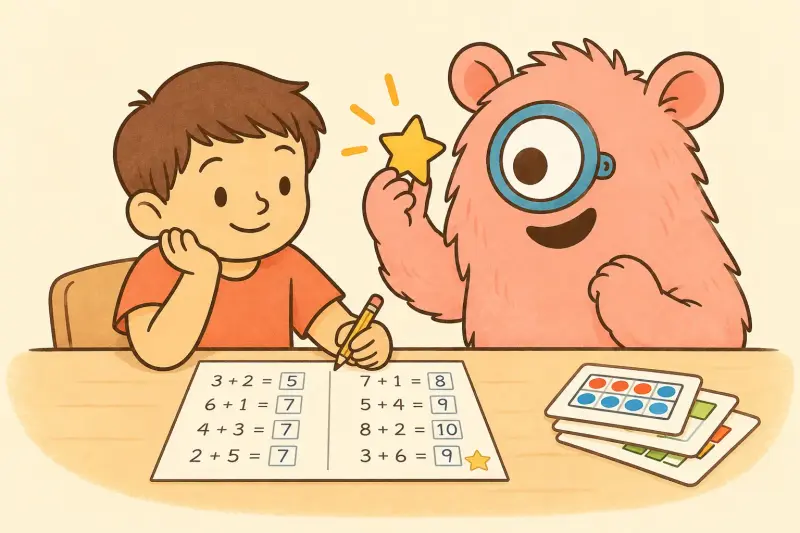
5. Breaks reset attention, and movement breaks can help too
In classroom experiments where recess timing for grades K, 2 and 4 was moved by 30 minutes, children's inattention before recess rose the longer they had gone without a break, and they were more attentive after recess than before (Pellegrini, Huberty & Jones, 1995). In a classroom study of 10-minute activity breaks called Energizers, on-task behaviour among 62 third and fourth graders improved by 8% after the breaks, and by 20% among the least on-task students (Mahar et al., 2006). Another study found that 10-minute physical activity breaks that also made kids think improved attention (Schmidt, Benzing & Kamer, 2016).
For children with ADHD specifically, a single 20-minute bout of moderate exercise led to better attention control and better reading and arithmetic scores in 8–10 year olds with ADHD compared with seated reading (Pontifex et al., 2013). You don't need 20 minutes of jogging before every session. But a few minutes of active play before math is a sensible, low-risk habit. Our post on ADHD-friendly focus hacks has easy ideas.
6. Short and often beats long and rare
The spacing effect means learning sticks better when it's spread out than when it's crammed. In a study of 5–7 year olds, lessons spread out over time led to better generalisation of new concepts than the same lessons given back-to-back (Vlach & Sandhofer, 2012). Fifteen minutes on five days will usually beat one 75-minute weekend marathon.
7. Choice keeps kids engaged
Letting children choose between tasks is a simple, research-backed tool. In a classic study, giving students a choice of academic task increased engagement and reduced disruptive behaviour (Dunlap et al., 1994). A meta-analysis of classroom interventions for children with ADHD symptoms also found that classroom strategies reduce off-task and disruptive behaviour (Gaastra et al., 2016).
How long were sessions in math studies that worked?
This is the closest evidence we have to a direct answer. Computer-assisted, game-style math programs have been tested with children with ADHD, and their session lengths were short:
Session lengths for these three studies come from the table in a peer-reviewed scoping review, Gabriel & Börnert-Ringleb (2023).
What this tells us: the single-case studies that improved both math performance and on-task behaviour in children with ADHD used 10–20 minute individual sessions. The larger trial used much longer, school-based group sessions; its attention benefit disappeared by second grade mainly because the comparison group's attention problems also declined, so it tells us little either way about long sessions at home. These are small studies, so treat them as guidance, not proof. Still, they line up with everything else above.
Recommended math session lengths by age and attention profile
These are practical starting points drawn from the research above, not clinical rules. Adjust them to your child.
When to stop early: more errors in a row, guessing, slumping, rising frustration, or "I hate math." Those are signs the session has done its job for today.
A sample 15-minute ADHD-friendly math session
For more ways to switch between activities without losing focus, see task switching in math for ADHD kids. For setting up a consistent daily rhythm, see how to create a daily math routine that works for ADHD brains.
What about time of day and medication?
There isn't strong peer-reviewed evidence on the best time of day for math practice for children with ADHD. Practically, many families find that practice goes better when a child is fed and rested, and not straight after a long, demanding school day.
If your child takes ADHD medication, ask their prescriber when it is typically most effective during the day. That window may be a good time for harder math. Don't change medication timing yourself to fit homework.
Where Monster Math fits
Short sessions only work if the minutes are engaging. Monster Math is a game-based math app for K–3 learners, built with neurodiverse kids, including children with ADHD, in mind. It fits naturally into the 10–20 minute window: a quick game round can be a whole focus block, and practice feels like play rather than a worksheet. The research above shows that game-format, computer-based math helped engagement in small studies of children with ADHD. Those studies didn't test Monster Math specifically, and no app replaces support from your child's teacher or clinician.
Want to see what an ADHD-friendly app looks like? Read our guide to ADHD-friendly app design, or start a free trial of Monster Math and try a 10-minute session tonight.
FAQs
How long should a 6-year-old with ADHD do math?
About 10 minutes, split into two or three short blocks of 3–5 minutes with quick breaks. Add time slowly only if your child stays accurate and happy.
How long should math homework take a 2nd or 3rd grader with ADHD?
Aim for 10–20 minutes of focused work, with a short break every 5–10 minutes. If homework regularly takes much longer, talk to the teacher about shortening or adapting it. Our list of math accommodations for ADHD can help with that conversation.
Is "2–3 minutes per year of age" a real research rule?
No. It's a popular rule of thumb, but we could not find peer-reviewed research that establishes it. Use your child's accuracy, engagement and mood as your guide instead.
Is daily short practice better than one long session a week?
Yes. Research on the spacing effect shows that learning spread over time sticks better than the same learning crammed together, including in young children.
Can I use timers?
Timers are an excellent way to keep schedule and section your math time into work and breaks. However just be careful that you don't also unintentionally create time pressure ("Let's solve these 20 sums in next 5 minutes"). Use it only to say something like "let's start now, and in after 5 minutes, we'll take a break".
Do breaks really help kids with ADHD focus on math?
Yes. Children are more attentive after a break than before one, and short physical activity breaks have improved on-task behaviour in classrooms. A single bout of moderate exercise improved attention and arithmetic scores in children with ADHD in one study.
What if my child hyperfocuses on a math game?
Enjoy it, within reason. If they're accurate and calm, let the session run a little longer (up to around 20 minutes), then end on a win so they want to come back.
Are math apps or games good for kids with ADHD?
Small studies found that game-format, computer-based math practice increased on-task behaviour and improved math performance in children with ADHD. Choose apps with short rounds, instant feedback and no stressful countdowns.
Should I change my child's ADHD medication timing for math practice?
No, not on your own. Ask your child's prescriber when the medication typically works best, and plan harder math around that if it suits your family.
References
Betts, J., McKay, J., Maruff, P., & Anderson, V. (2006). The development of sustained attention in children: The effect of age and task load. Child Neuropsychology, 12(3), 205–221. https://doi.org/10.1080/09297040500488522
Dunlap, G., dePerczel, M., Clarke, S., Wilson, D., Wright, S., White, R., & Gomez, A. (1994). Choice making to promote adaptive behavior for students with emotional and behavioral challenges. Journal of Applied Behavior Analysis, 27(3), 505–518. Open access: https://pmc.ncbi.nlm.nih.gov/articles/pmid/7928792 (DOI: 10.1901/jaba.1994.27-505)
Gaastra, G. F., Groen, Y., Tucha, L., & Tucha, O. (2016). The effects of classroom interventions on off-task and disruptive classroom behavior in children with symptoms of attention-deficit/hyperactivity disorder: A meta-analytic review. PLoS ONE, 11(2), e0148841. Open access: https://pmc.ncbi.nlm.nih.gov/articles/PMC4757442/
Gabriel, T., & Börnert-Ringleb, M. (2023). The intersection of learning difficulties and behavior problems – a scoping review of intervention research. Frontiers in Education, 8, 1268904. Open access: https://www.frontiersin.org/journals/education/articles/10.3389/feduc.2023.1268904/full
Huang-Pollock, C. L., Karalunas, S. L., Tam, H., & Moore, A. N. (2012). Evaluating vigilance deficits in ADHD: A meta-analysis of CPT performance. Journal of Abnormal Psychology, 121(2), 360–371. https://doi.org/10.1037/a0027205
Kasper, L. J., Alderson, R. M., & Hudec, K. L. (2012). Moderators of working memory deficits in children with attention-deficit/hyperactivity disorder (ADHD): A meta-analytic review. Clinical Psychology Review, 32(7), 605–617. https://doi.org/10.1016/j.cpr.2012.07.001
Kofler, M. J., Rapport, M. D., & Alderson, R. M. (2008). Quantifying ADHD classroom inattentiveness, its moderators, and variability: A meta-analytic review. Journal of Child Psychology and Psychiatry, 49(1), 59–69. Author copy: https://psy.fsu.edu/clc/Publications/Kofler%20Rapport%20Alderson%202008%20-%20ADHD%20Attention%20Meta-analysis.pdf (DOI: 10.1111/j.1469-7610.2007.01809.x)
Luman, M., Oosterlaan, J., & Sergeant, J. A. (2005). The impact of reinforcement contingencies on AD/HD: A review and theoretical appraisal. Clinical Psychology Review, 25(2), 183–213. https://doi.org/10.1016/j.cpr.2004.11.001
Mahar, M. T., Murphy, S. K., Rowe, D. A., Golden, J., Shields, A. T., & Raedeke, T. D. (2006). Effects of a classroom-based program on physical activity and on-task behavior. Medicine & Science in Sports & Exercise, 38(12), 2086–2094. https://doi.org/10.1249/01.mss.0000235359.16685.a3
Mautone, J. A., DuPaul, G. J., & Jitendra, A. K. (2005). The effects of computer-assisted instruction on the mathematics performance and classroom behavior of children with ADHD. Journal of Attention Disorders, 9(1), 301–312. https://doi.org/10.1177/1087054705278832
Ota, K. R., & DuPaul, G. J. (2002). Task engagement and mathematics performance in children with attention-deficit hyperactivity disorder: Effects of supplemental computer instruction. School Psychology Quarterly, 17(3), 242–257. https://doi.org/10.1521/scpq.17.3.242.20881
Pellegrini, A. D., Huberty, P. D., & Jones, I. (1995). The effects of recess timing on children's playground and classroom behaviors. American Educational Research Journal, 32(4), 845–864. https://doi.org/10.3102/00028312032004845
Pontifex, M. B., Saliba, B. J., Raine, L. B., Picchietti, D. L., & Hillman, C. H. (2013). Exercise improves behavioral, neurocognitive, and scholastic performance in children with attention-deficit/hyperactivity disorder. The Journal of Pediatrics, 162(3), 543–551. https://doi.org/10.1016/j.jpeds.2012.08.036
Rabiner, D. L., Murray, D. W., Skinner, A. T., & Malone, P. S. (2010). A randomized trial of two promising computer-based interventions for students with attention difficulties. Journal of Abnormal Child Psychology, 38(1), 131–142. https://doi.org/10.1007/s10802-009-9353-x
Schmidt, M., Benzing, V., & Kamer, M. (2016). Classroom-based physical activity breaks and children's attention: Cognitive engagement works! Frontiers in Psychology, 7, 1474. Open access: https://pmc.ncbi.nlm.nih.gov/articles/PMC5047899/
Sonuga-Barke, E. J. S. (2003). The dual pathway model of AD/HD: An elaboration of neuro-developmental characteristics. Neuroscience & Biobehavioral Reviews, 27(7), 593–604. https://doi.org/10.1016/j.neubiorev.2003.08.005
Vlach, H. A., & Sandhofer, C. M. (2012). Distributing learning over time: The spacing effect in children's acquisition and generalization of science concepts. Child Development, 83(4), 1137–1144. Author copy: https://babytalk.psych.ucla.edu/wp-content/uploads/sites/271/2021/03/Vlach_Sandhofer-CD-2012.pdf (DOI: 10.1111/j.1467-8624.2012.01781.x)