TL;DR: Freckle vs Monster Math mostly comes down to whether your child's school already pays for Freckle. Freckle, from Renaissance, is a classroom practice platform that covers math from kindergarten through Algebra 2, plus reading and language arts, and it gives teachers detailed assignment and reporting tools; it is sold to schools, with only a limited free classroom version and no published home price. Monster Math covers grades K–3 only, teaches strategies for math facts with no timers, and is sold to families: 10 levels a day are free and full access costs $59.99 a year. If your school provides Freckle, use it, and add Monster Math only if your 5- to 9-year-old needs calmer, strategy-first fact practice.
Your child comes home talking about earning coins in Freckle, or a "Freckle" login shows up in a school email, and you start wondering whether it's the right practice for home too. If you're weighing Freckle vs Monster Math, the first thing to know is that they're built on different premises. Freckle is a broad school platform: teachers assign skills and standards, students practice at their own level, and the reports go back to the teacher. Monster Math is a narrow K–3 game that teaches strategies for addition, subtraction and early multiplication, and it's sold to families as well as offered free to teachers.
So the choice comes down mostly to two things: who is buying (your school or you), and whether your child needs broad practice across the curriculum or focused, low-pressure work on early math facts.
Freckle overview
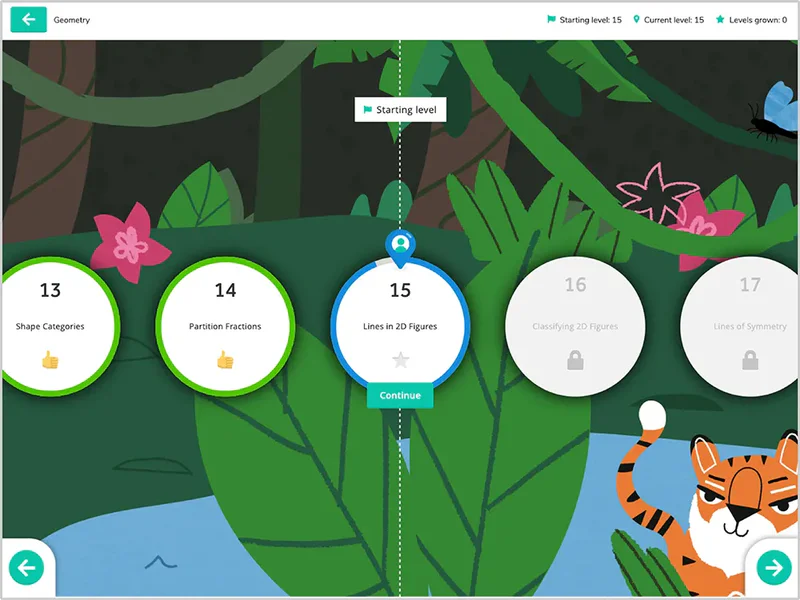
Freckle is made by Renaissance, the company that also makes the Star Assessments tests. It started life as a separate company. When Renaissance bought it in 2019, its announcement said Freckle was "originally founded as Front Row Education in 2013". Today Renaissance calls it "a differentiated practice platform that helps educators deliver standards-aligned math and ELA practice".
The range is wide. For math, Renaissance says "coverage spans kindergarten through Algebra 2, with over 92,000 questions". For reading and language arts, it says Freckle "includes leveled reading content across grades K–12 and ELA skills practice for grades 1–8", and it also has science and social studies content.
The teacher sits at the center. Teachers can "assign skills and standards to individual students, groups, or the whole class", and students can also work through adaptive pathways on their own. In schools that use Star Assessments, Freckle uses Star results to place students into math and ELA practice automatically. Students get hints and guided support while they practice, optional read-aloud audio in ELA, and Spanish-language support in many math practice activities. They earn coins, which a Renaissance-commissioned study's logic model describes children spending to personalize an avatar.
Students log in on the web, and there's a free iPad app. On the US App Store, Freckle by Renaissance is listed as designed for iPad, with a 3.3 rating from 523 ratings (checked November 22, 2026). No iPhone version is listed.
Pricing is the part parents ask about most, and Renaissance doesn't publish it. Freckle's own homepage offers a free sign-up "for classrooms & families" with "unlimited student self-paced practice and a limited number of teacher assignments". The full version, Premium, is aimed "for schools & districts", adding unlimited teacher assignments, rostering and administrator dashboards, and the Renaissance product page's way to buy is a "Request a demo" button rather than a price list. We couldn't find a home subscription or a published price for families on any Renaissance page (checked November 22, 2026). The free sign-up is described as an "intuitive DIY setup for your class", so a parent using it at home is in effect setting themselves up as the teacher.
Monster Math overview
Monster Math is a game-based math fact fluency program for grades K–3, about ages 5 to 9. Solving the problems is how a child plays: the math moves the game forward, so there's no separate worksheet with a reward at the end.
The scope is deliberately narrow: number sense, addition and subtraction facts, and early multiplication and division. Within that range it teaches strategies rather than recall alone. Its curriculum moves from doubles and combinations of 10 in first and second grade to multiplication as repeated addition and the doubling strategy in third, with visual models before bare numbers. The content follows Common Core progressions for K–3 math fact fluency.
It's designed to keep pressure low. There are no timers, and no loud sounds or flashy animations, and the App Store listing describes "no time limits, no penalties, and no distractions" in "a safe, ad-free environment". Parents get periodic emails on skills mastered, gaps and time spent.
At home, kids can play 10 levels a day at no cost. Full access is $59.99 a year after a seven-day free trial, and the trial needs a credit card. For teachers it's free, with sign-in through Clever, ClassLink or Google Classroom, and teachers can assign specific skills to individual students or a whole class. It runs in the browser and as an app on iPad, iPhone and Android.
What Freckle and Monster Math have in common
Both say they follow standards: Freckle aligns to state standards, and Monster Math follows Common Core progressions for K–3.
Both cover kindergarten through third-grade arithmetic, so that's where the choice is a real one.
Both let teachers assign specific skills to one child, a group or the whole class.
Both have a free option for classrooms: Freckle's limited free tier, and Monster Math's free teacher accounts.
Both report progress back to an adult: Freckle to the teacher, Monster Math to the teacher or by email to a parent.
Both run in a web browser and on iPad.
Advantages of Freckle
It covers far more ground. This is the biggest difference. Freckle runs from kindergarten math to Algebra 2, adds reading and language arts, and has science and social studies content. Monster Math stops at third-grade facts. A child can use Freckle for a decade; they'll outgrow Monster Math in a few years.
The teacher tools are deeper, and they connect to school testing. Renaissance says teachers can "use reports to monitor performance, proficiency, and progress by student, skill, or standard", group students, and give administrators district dashboards. If your child's teacher is already running small groups from Freckle data, the practice your child does there feeds straight into classroom decisions. In a Star Assessments school, practice also starts at a level the school has already measured.
It supports more learners in their own language. Spanish support in many math activities and optional read-aloud audio in ELA help children who are learning English or still building reading skills.
The outcome evidence is stronger. Renaissance contracted LearnPlatform, an outside research company, to test whether Freckle users did better on the FastBridge aMath test than similar non-users in 2022–23. The study matched 17,720 users in grades 1–8 with 17,720 non-users from schools that didn't use Freckle in that grade. In grades 1–2, users scored higher at the end of the year (effect size 0.08), which the authors translate as a 50th-percentile student moving to about the 53rd percentile. In grades 3–5 the gain was smaller, an effect size of 0.03, or the 50th to about the 51st percentile, and in grades 6–8 there was no significant difference. Renaissance uses the study to claim ESSA Level II (Moderate Evidence) for Freckle math in grades 1–5. Note that Renaissance commissioned and paid for the study, that children weren't randomly assigned, and that kindergarten wasn't included. The effects are statistically significant but small. Treat it as a genuine positive sign, not proof that Freckle will change your child's scores.
Disadvantages of Freckle
It isn't really sold to families. There's no published home price, and the paid version is sold to schools and districts through a demo request. The free classroom tier gives unlimited self-paced practice but only a limited number of teacher assignments, and the setup is written for a class. A family can use it, but it's a classroom tool that you'd be running from the teacher's seat.
Some of the research can't separate cause from effect. Renaissance also publishes its own analysis of more than 530,000 Freckle math users in grades K–12, which compares student growth percentiles (SGPs, a measure of how much a child grew compared with peers who started at a similar score). Renaissance's page says that "students using Freckle at recommended daily levels reached median SGPs around 51–52 vs. ~47 for non-users in math". That report compares heavier users, lighter users and non-users in the same districts. Nobody was randomly assigned and the groups weren't matched, so it can't say whether Freckle caused the difference or whether schools and students who use it heavily differ in other ways. The LearnPlatform study above is the stronger of the two.
The iPad app gets mixed reviews, and there's no phone app. The 3.3 rating from 523 ratings is lukewarm, and the reviews shown on the listing date from 2019 and 2021, including one complaining that "most of that content is only available for premium members". Reviews that old may not describe the app as it is now.
Advantages of Monster Math
It's built for home, at a known price, on any device. Ten levels a day are free, full access is $59.99 a year after a seven-day trial, no school account is needed, and it runs on iPhone and Android phones as well as iPad and the browser. School access is completely free with no limits.
Strategies before speed. The aim is that a child who can't recall 8 + 7 knows how to get there from 8 + 8, or that a third grader who's stuck on 6 × 4 can get there by doubling 3 × 4. Our explainer on what math fact strategies are and why they help covers the approach in more depth.
No timers and a calm screen. For children with math anxiety, ADHD, autism or dyscalculia, a clock on the screen is often the thing that turns practice into a fight, and here there isn't one. Our guide to math anxiety in autism, ADHD and dyscalculia explains why timed drills are such a common trigger.
Disadvantages of Monster Math
The scope is narrow. K–3 number sense and facts only. No reading, no fractions, no geometry, nothing for a fourth grader who needs to keep going. Some first- and second-grade strategies, including making 10 and near doubles, are listed on the curriculum page as coming soon. Your child will outgrow it. That's by design, and it's still a limit.
No outcome study yet. Monster Math holds ESSA Tier IV, which means its design rests on established research and it has a logic model and a plan to study impact. What's missing is a study measuring results for children using Monster Math specifically. Freckle has a commissioned, matched-comparison study with a Level II claim (these cost significantly more), and Monster Math, being made by a smaller company, doesn't yet have this.
It doesn't plug into school assessments. There's no link to Star or other screeners, and its reports stay within its K–3 skills.
Full access costs money at home. Beyond the 10 free levels a day, it's a subscription. If your school already pays for Freckle Premium, your child may be able to practice at home for nothing, and that's a fair reason not to add another one.
Freckle vs Monster Math: which is better for your child?
Start with the school. Ask your child's teacher one question this week: "Does our school use Freckle Premium, and can my child use it at home?" If the answer is yes, your child has broad, standards-aligned practice for free, linked to what the teacher sees. Use it.
Then look at what's actually hard for your child. If they're past third grade, need reading practice as well as math, or you want one program that lasts into middle and high school, Freckle covers that and Monster Math doesn't.
If they're 5 to 9 and the trouble is basic facts, try a quick check at the kitchen table: ask "What's 8 plus 7?" and then "How did you get it?" If your second or third grader counts up on their fingers from 8 every time, or freezes and guesses, focused strategy practice is the gap, and that's what Monster Math is built for.
Choose Freckle if your school already provides it, your child is past third grade, you want math and reading in one place, or your child's teacher uses Freckle data to plan small groups.
Choose Monster Math if your child is 5 to 9, still counts on their fingers for basic facts, gets anxious under time pressure, mostly uses a phone, or your school doesn't offer Freckle and you want something you can buy for home.
They also work together. A reasonable setup for a second grader whose class uses Freckle is to keep doing the assigned Freckle work, then add ten minutes of untimed fact-strategy practice on Monster Math two or three times a week.
Ready to try Monster Math?
If your child is between 5 and 9, you can start a free trial and watch how they respond before paying for anything. Two or three ten-minute sessions in that first week will show you whether the calm, strategy-first approach suits them.
FAQs
Can parents buy Freckle for home use?
Not as a home subscription, as far as Renaissance's own pages show. Freckle's paid Premium version is sold to schools and districts through a demo request, with no published price. Freckle's homepage does offer a free sign-up for classrooms and families with unlimited self-paced practice and a limited number of teacher assignments, but it is set up as a class with you as the teacher (checked November 22, 2026).
Is Freckle free?
Freckle has a free classroom version with unlimited student self-paced practice and a limited number of teacher assignments. Freckle Premium, which adds unlimited assignments, rostering and administrator dashboards, is sold to schools and districts, and Renaissance doesn't publish its price. If your child's school pays for Premium, ask the teacher whether your child can use it at home.
What grades does Freckle cover compared with Monster Math?
Renaissance says Freckle's math covers kindergarten through Algebra 2, with leveled reading for grades K–12 and ELA skills practice for grades 1–8. Monster Math covers grades K–3, about ages 5 to 9, and focuses on number sense and math fact fluency. A child past third grade will need Freckle or another program with a wider range.
Does Freckle have research showing it works?
Yes, with caveats. A 2022–23 study that Renaissance commissioned from LearnPlatform matched 17,720 Freckle users in grades 1–8 with similar non-users and found small, statistically significant gains in grades 1–2 (effect size 0.08) and grades 3–5 (0.03), with no significant difference in grades 6–8. Renaissance cites it for ESSA Level II in grades 1–5. Renaissance paid for the study and children weren't randomly assigned. Monster Math holds ESSA Tier IV, which reflects research-based design rather than a measured outcome.
Is Freckle the same as Front Row?
Yes. Freckle was founded as Front Row Education in 2013 and later took the Freckle name. Renaissance, the company that makes Star Assessments, bought Freckle Education in 2019 and now sells it as Renaissance Freckle.
Can my child use both Freckle and Monster Math?
Yes, and if your school assigns Freckle it often makes sense. Freckle covers the broader grade-level curriculum and links to the teacher's reports, while Monster Math builds K–3 fact strategies without time pressure. A few short Monster Math sessions a week alongside assigned Freckle work won't duplicate much.