
TL;DR
Dyslexia is defined as a reading difficulty, but it very often affects math too — in one study of children with dyslexia, about two-thirds also showed measurable math difficulties.
The link is mostly indirect. The same sound-processing (phonological) and verbal-memory systems that make reading hard also power the fast recall of math facts like 7 × 8.
Children with dyslexia usually struggle most with memorizing arithmetic facts, timed drills, and word problems — while their intuitive "number sense" (knowing that 8 is more than 5) is often intact.
This is not the same as dyscalculia, a separate difficulty with numbers themselves. The two can overlap, but they have different roots.
What helps: build number sense with visual, hands-on tools; separate reading from math reasoning; keep working-memory load light; practice facts in short, spaced, low-pressure sessions; and actively protect your child from math anxiety.
If your child has dyslexia, you probably expected reading to be hard. What catches many parents off guard is the math. Homework that should take ten minutes stretches to forty. Your child seems to understand a concept on Monday and has completely lost it by Wednesday. They can reason about a problem out loud but freeze the moment it's written down or timed.
You are not imagining the connection. Reading difficulties and arithmetic difficulties frequently travel together, and researchers now understand a good deal about why. The encouraging part: once you understand the mechanism, the strategies that help become much clearer. This guide walks through the science in plain language, then turns to practical, evidence-based ways to help your K–3 learner at home.
Why reading difficulties spill over into math
Dyslexia is a specific difficulty with accurate, fluent word reading, rooted largely in phonological processing - the brain's handling of the sounds inside words. It might seem like that should have nothing to do with numbers. But arithmetic leans on some of the very same machinery.
Math facts are stored as sounds, not just quantities
Here is the key insight. When most of us recall "7 × 8 = 56," we are not computing anything. We are retrieving a memorized verbal string, almost like remembering a line from a song. Research suggests that retrieving arithmetic facts draws on the same phonological system used for language, which is exactly the system that works differently in dyslexia.
This predicts a very specific pattern, and studies bear it out. Because multiplication in particular is stored and recalled as verbal facts, the gap between readers with and without dyslexia tends to be larger for multiplication than for subtraction — subtraction relies more on step-by-step reasoning about quantities, which is a different route. In other words, it is often not "math" in general that trips these children up, but the parts of math that depend on fast verbal recall.
That is why math difficulties are so common alongside dyslexia. A recent study found that within a group of children with dyslexia, 66% had mathematical difficulties, and those difficulties were rarely about number sense itself — they clustered instead in areas like fact retrieval and calculation procedures.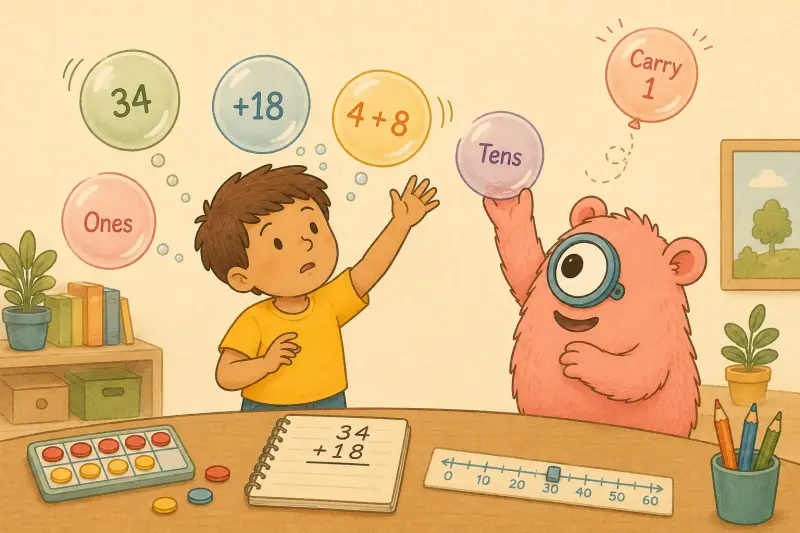
Verbal working memory runs out of room
Multi-step arithmetic asks a child to hold numbers in mind while doing something else: carry the 1, borrow from the tens, keep a running total. That temporary mental storage is verbal working memory, and it is closely tied to phonological skill. Studies of arithmetic show that the strength of a child's fact-retrieval response is linked to their verbal working memory. When that system is already stretched by dyslexia, a two- or three-step problem can collapse partway through — not because the child can't do the math, but because they lost their place holding it all together.
Slow "naming speed" slows math down too
Many children with dyslexia are slower at rapid automatized naming — quickly naming a series of familiar letters, colors, or digits. This is one of the most reliable early markers of reading difficulty, and it turns out to matter for math as well. A longitudinal study of first graders found that rapid naming speed predicts both reading fluency and arithmetic fluency. A child who is slow to retrieve the name of a symbol is often slow to retrieve a math fact attached to it — which shows up as slow, effortful calculation even when the child understands what to do.
Word problems are a double tax
Word problems ask a child to do two hard things at once: decode the sentence and reason mathematically. For a child with dyslexia, the reading step alone can consume most of their mental energy, leaving little left for the actual math. A child who can happily solve "15 − 8" may stall on "Maya had 15 stickers and gave 8 away…" — not because the subtraction changed, but because the reading demand did.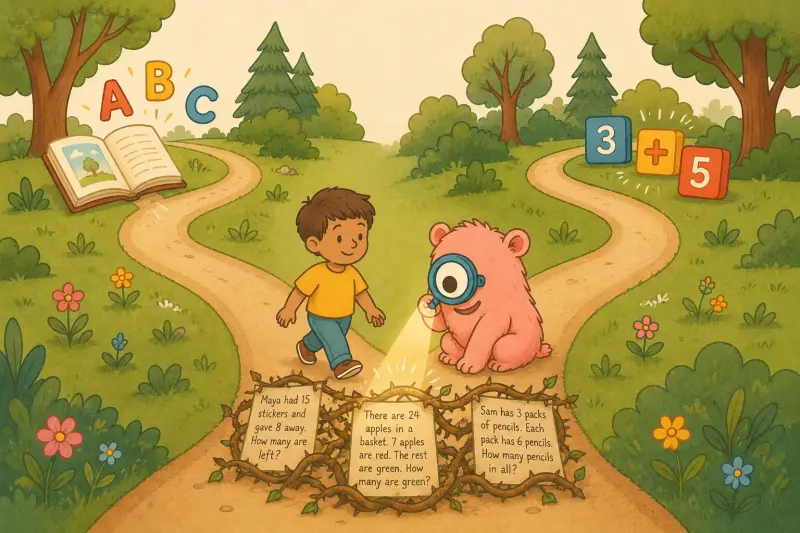
Important: this is not the same as dyscalculia
Here is a distinction worth holding onto, because it changes how you help. Dyscalculia is a distinct learning difference in which the core sense of number and quantity itself is affected. Dyslexia-related math trouble is usually different: the number sense is intact, but the verbal and reading routes into math are compromised.
The two can co-occur — reading and math difficulties overlap two to three times more often than chance would predict — but co-occurring is not the same as identical. If you want to understand where one ends and the other begins, our guide to the differences between dyscalculia and dyslexia breaks it down. Knowing which pattern your child fits helps you target support instead of guessing.
The good news: number sense is often a strength
It's easy to read the section above and feel discouraged. Don't. The flip side of "math facts are hard to memorize" is that the conceptual foundation of math — understanding that quantities can be compared, combined, and broken apart — is frequently solid in children with dyslexia. Because their difficulties tend to sit in the verbal and fact-retrieval side of math rather than in number processing itself, many of these children reason beautifully about numbers when the memorization pressure is removed.
That's the lever you get to pull at home. The goal isn't to drill harder. It's to route around the bottleneck — leaning on visual, hands-on, meaning-based math while giving fact recall the gentler, smarter practice it needs.
How to help your child at home
1. Build number sense first, memorized facts second
Rote fact drilling asks the exact system that dyslexia weakens — verbal recall — to do the heavy lifting. A better starting point is number sense: the intuitive feel for how quantities relate. When a child truly understands that 8 is "two away from 10," they can derive 8 + 5 (think "8 + 2 + 3") instead of retrieving it cold.
A powerful early skill here is subitizing — instantly recognizing small quantities without counting. Our overview of why subitizing matters for neurodivergent learners has simple games to build it, and our guide to building number sense in kids who struggle with math covers the next steps.
2. Make math concrete and visual
Children who find verbal recall hard often thrive when numbers become things they can see and touch. Move from physical objects, to pictures, to symbols — the well-known Concrete–Representational–Abstract sequence. Structured, systematic approaches like this have strong support: a review of interventions for K–6 students at risk of difficulty found that targeted, structured instruction produces meaningful gains, with small-group and peer-assisted formats among the most effective. Ten-frames, counters, and number lines turn invisible ideas into visible ones. Our walkthrough of the CRA method shows how to run it at the kitchen table.
3. Separate the reading from the math
If word problems are a battle, split the two jobs. Read the problem aloud for your child, or let them use a read-aloud tool, so decoding doesn't eat the mental fuel they need for reasoning. You are not "cheating" — you are isolating the skill you're actually trying to practice. A child who can solve a problem once it's read to them doesn't have a math problem; they have a reading-access problem, and removing that barrier lets the math shine through.
4. Protect working memory
Every number a child has to hold in their head is a number that can slip away. Reduce that load. Write down intermediate steps so nothing has to be remembered. Break multi-step problems into one visible step at a time. Use a ten-frame or number line so the "carrying" happens on paper instead of in the mind. The less a child has to juggle mentally, the more capacity they have for actual thinking — this matters because working memory is tightly bound up with arithmetic performance.
5. Practice facts in short, spaced, low-pressure bursts
Fact fluency still matters — it just needs the right delivery. Swap long, high-stakes drill sessions for brief, frequent, spaced practice: five focused minutes several times a week beats a dreaded thirty-minute Sunday marathon. Crucially, favor untimed practice while a child is still building confidence, because timing turns practice into a threat. Game-based practice works well here precisely because it keeps things short, repeated, and emotionally safe.
6. Guard against math anxiety
This one is not optional. Children with learning differences are especially vulnerable to math anxiety, and it does real damage: it emerges as early as first and second grade and is linked to lower math achievement, partly by hijacking the very working memory needed to calculate. The relationship runs both ways — struggle breeds anxiety, and anxiety worsens struggle.
The antidote is confidence built on genuine success. When practice is combined with support for a child's belief in themselves, children with weak calculation fluency benefit more than from skill training alone. Praise strategy and effort over speed. Normalize mistakes. Keep the emotional temperature low, and the thinking will follow.
7. Ask the school for the right accommodations
You don't have to carry this alone. Reasonable, research-aligned supports to discuss with your child's teacher or team include: extra time on math work, problems read aloud, permission to use a multiplication chart or number line so a memory gap doesn't block reasoning, fewer problems that assess the same skill, and untimed assessments. These don't lower the bar — they remove barriers that have nothing to do with mathematical thinking.
The bottom line
Dyslexia affects math mostly through the back door — by taxing the sound-based recall, verbal memory, and reading systems that arithmetic quietly depends on. That means your child's struggle with times tables or word problems is usually a retrieval and access problem, not a sign they "can't do math." Lean into their often-intact number sense, make math visible, take the reading and memory load off their shoulders, keep anxiety at bay, and give fact practice the gentle, spaced approach it needs. With the right support, children with dyslexia can and do become confident, capable mathematicians.
Frequently Asked Questions
Does dyslexia cause dyscalculia?
No. They are separate learning differences with different roots - dyslexia centers on reading and sound processing, dyscalculia on the core sense of number and quantity. They do co-occur more often than chance, but a child can have dyslexia-related math difficulty with completely intact number sense. See our dyslexia vs. dyscalculia guide for the full comparison.
Why is my dyslexic child good at math reasoning but bad at memorizing facts?
Because those two abilities use different systems. Reasoning about quantities relies on number sense, which is often a strength. Memorizing facts like 7 × 8 relies on fast verbal recall - the same phonological system affected by dyslexia - so that's where the difficulty concentrates.
Are word problems especially hard for kids with dyslexia?
Often, yes. A word problem requires decoding the text and doing the math at the same time. The reading step can use up most of a child's mental energy, leaving little for the calculation. Reading the problem aloud usually reveals that the math itself was never the issue.
Should I make my child do timed math drills to build speed?
Go carefully. Timed drills tend to raise anxiety, which itself interferes with performance in young children. Short, frequent, untimed practice builds fluency without the fear. Add gentle timing only once confidence is solid.
Will my child grow out of these math difficulties?
The underlying processing differences are lasting, but their impact can be greatly reduced with the right support. Early, structured, visual instruction in the K–3 window is especially powerful for changing a child's long-term trajectory.
What's the single most helpful thing I can do at home?
Take the pressure off recall and memory. Make numbers visual and hands-on, let your child write down or "see" the steps instead of holding them in their head, and keep practice short and positive. You're routing around the bottleneck instead of hammering on it.
References
Cheng, D., et al. Profiles of mathematical deficits in children with dyslexia.Scientific Reports (2024). https://www.ncbi.nlm.nih.gov/pmc/articles/PMC10869821/
Callens, M., Tops, W., & Brysbaert, M. Cognitive profile of students who enter higher education with an indication of dyslexia.PLOS ONE (2012). https://www.ncbi.nlm.nih.gov/pmc/articles/PMC3374824/
Soltész, F., et al. An ERP study on multiplication and its relationship to phonological processing in children and adults.Developmental Cognitive Neuroscience / Scientific Reports (2024). https://www.ncbi.nlm.nih.gov/pmc/articles/PMC11621157/
Hornung, C., Martin, R., & Fayol, M. General and specific contributions of RAN to reading and arithmetic fluency in first graders: A longitudinal latent variable approach.Frontiers in Psychology (2017). https://www.ncbi.nlm.nih.gov/pmc/articles/PMC5635811/
Prevalence of risk for dyslexia, risk for dyscalculia, and their comorbidity in Spanish primary education.Annals of Dyslexia / Reading and Writing (2025). https://www.ncbi.nlm.nih.gov/pmc/articles/PMC12602533/
Dietrichson, J., et al. Targeted school-based interventions for improving reading and mathematics for students with, or at risk of, academic difficulties in Grades K–6: A systematic review.Review of Educational Research / Campbell Systematic Reviews (2021). https://www.ncbi.nlm.nih.gov/pmc/articles/PMC8356298/
Evaluation of math anxiety and its remediation through a digital training program in mathematics for first and second graders.Brain and Behavior (2022). https://www.ncbi.nlm.nih.gov/pmc/articles/PMC9120910/
Koponen, T., et al. Benefits of integrating an explicit self-efficacy intervention with calculation strategy training for low-performing elementary students.Frontiers in Psychology (2021). https://www.ncbi.nlm.nih.gov/pmc/articles/PMC8377810/
This article is for educational purposes and does not replace individualized assessment or advice from a qualified specialist. If you suspect your child has a learning difference, a psychologist or educational evaluator can provide a formal assessment.