TL;DR: Most research puts dyscalculia at somewhere between 3% and 7% of school-age kids, which makes it about as common as dyslexia. Individual studies report anywhere from 4% to 13%, but that spread comes mostly from where each study drew its cutoff rather than from real differences between populations. Dyscalculia also overlaps heavily with dyslexia and ADHD.
Dyscalculia is a learning difficulty that makes numbers and arithmetic persistently hard. It isn't explained by lack of effort or by low intelligence, and the difficulties tend to persist even with good teaching. People often describe it as dyslexia's equivalent for math.
Go looking for how common it is, though, and the answers scatter. One study lands on 4%, another on 13%, and both are real peer-reviewed research. They're just not measuring quite the same thing.
Here's what the numbers say and why they disagree. For the fuller picture of how dyscalculia actually shows up day to day, our parent's guide to dyscalculia covers that ground.
How common is dyscalculia?
If you want one number to hold onto, take 3–7%. It comes from a German clinical guideline whose authors reviewed the research systematically across eight databases [1]. The individual studies below land above and below that range, largely depending on where each drew its cutoff.
Israeli researchers noted their own 6.5% figure was similar to that of dyslexia and ADHD [2]. Dyscalculia is roughly as common as dyslexia.
One caveat about the field as a whole: dyscalculia doesn't yet have a widely accepted international pooled prevalence estimate the way some other conditions do. The ranges you see quoted come from reviews and individual population studies rather than from pooled data, which is part of why they vary.
Is dyscalculia this common everywhere?
The evidence outside Europe points the same way, which matters given how much of the research comes from a handful of countries.
A Brazilian study assessed 2,893 children across 28 public schools, schools and working through a staged screening process. After excluding children with intellectual disability or reading and writing difficulties, 226 children, or 7.8%, met the criteria for developmental dyscalculia [6]. The researchers also found prevalence varied with the socioeconomic level of the school's neighbourhood and with parental education [6].
Why don't the studies agree?
Math ability runs on a spectrum, and there's no natural dividing line where "struggling with math" turns into "has dyscalculia." Researchers have to pick one, and where they pick it changes the answer.
A German study makes the point cleanly. The researchers tested 1,633 children in grades 3 and 4, then counted how many had a serious arithmetic difficulty using two different cutoffs. The stricter line flagged 4.9%. The looser one flagged 12.9% [3]. Nothing about the children changed between those two numbers.
This isn't a quirk of one study. A meta-analysis of 145 studies set out partly to investigate how selection criteria shape conclusions about mathematical learning disability, and reported that a profile distinguishing people with more serious, persistent, or specific difficulties from those with less severe difficulties was not detected [7]. In other words, the evidence doesn't reveal a neat natural boundary where math difficulty becomes MLD.
Two entries in the table need reading carefully for related reasons. The Spanish study measured children flagged as at risk by a screening test rather than diagnosed, and the researchers stress that clearing a screening cutoff isn't the same as a clinical diagnosis [5].
The Dutch study is a different case, because its main purpose wasn't to estimate population prevalence. The researchers deliberately used cutoffs near the 10th percentile to create similarly sized groups for comparing ADHD, dyslexia, and dyscalculia [4]. Its 10.2% shouldn't be read as an independent estimate of how common dyscalculia is. It's a good study for what it set out to do, which is measure overlap.
How many kids actually get identified?
Here the numbers turn uncomfortable.
A 2026 study examined records for around 540,000 Year 6 students, aged 10 and 11, across 14,800 schools in England. Fewer than 2% were recorded as having a specific learning difficulty, well below international estimates of 5% to 10% [8]. That 5–10% covers specific learning difficulties as a whole, including reading and writing alongside math, so it's a broader category than the dyscalculia-only figures above. The researchers conclude that many children with specific learning difficulties are likely going unidentified [8].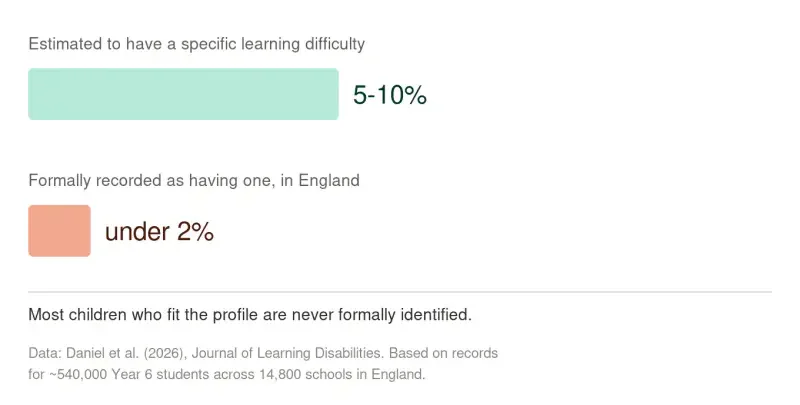
The same study found that identification depends on factors with nothing to do with the child. Children learning English as an additional language were markedly less likely to be identified, as were children at schools serving poorer communities. Two kids with identical math scores can face different odds of being spotted depending on which school they walk into [8].
Does dyscalculia affect boys and girls differently?
Mostly it doesn't, though there's a wrinkle worth understanding.
Researchers tested just over a thousand British primary school children and found that boys and girls were affected at the same rate when dyscalculia was defined by a math score alone, but a gender gap appeared when it was defined by the gap between a child's math and reading scores [9]. That second definition catches a particular kind of child: a strong reader whose math lags well behind. More of those children turn out to be girls, though the researchers noted many of them had perfectly normal math scores that only looked weak beside unusually strong reading [9].
Girls do get overlooked more often, but for a different reason entirely. In the English study of 540,000 students, girls were significantly less likely than boys to be flagged as having a specific learning difficulty [8], and that held even when researchers compared girls and boys with the same test scores and similar backgrounds.
One explanation discussed in that study is behavioural. Boys who struggle are more likely to present with externalising difficulties, which prompt referrals, while girls more often present with internalising ones, which don't attract the same attention [8].
What tends to come with dyscalculia
Dyscalculia overlaps a lot with other conditions.
The Dutch study found children with ADHD were about twice as likely to have dyscalculia, and children with dyslexia about three times as likely [4]. Roughly 1 in 5 kids with ADHD also has dyscalculia; for dyslexia it's closer to 1 in 4 [4].
Run it the other direction and the overlap grows. Around 40% of children with a math learning disorder also have a reading disorder, though estimates across studies range from roughly 14% to 60% depending on how each condition is defined [10]. The Israeli study found a quarter of children with dyscalculia showed ADHD symptoms, and about one in six also had dyslexia [2].
That's why clinical guidelines recommend screening any child assessed for dyscalculia for related conditions too [1]. If your child already has an ADHD or dyslexia diagnosis and math has never made sense, you're looking at a well-documented pattern.
Does it run in families?
In the Israeli prevalence study, 42% of children identified with dyscalculia had a parent or sibling with a learning disability [2].
A follow-up went looking specifically at this, assessing the families of 39 children with dyscalculia. Among their relatives, 66% of mothers, 40% of fathers, and 53% of siblings also had dyscalculia, a rate among siblings roughly ten times higher than you'd expect in the general population [11].
Two details make that more interesting than a bare correlation. IQ and attention problems weren't risk factors for dyscalculia in these families, which strengthens the case that the familial pattern isn't simply explained by those factors. But the sample was small, 39 children and their relatives, so the exact percentages are a strong signal rather than a settled figure.
If math was unusually hard for you as a kid, say so to a teacher or evaluator. Family history counts as evidence here.
What to take from all this
Dyscalculia affects roughly 3–7% of kids, which puts one or two in a typical class of thirty, and studies from India and Brazil land in much the same range as European ones. When estimates swing widely, differences in definitions and cutoffs are often a major reason. A substantial minority of children with dyscalculia also have ADHD or dyslexia, so both are worth screening for. And far fewer children get formally identified than actually have it, which means a school never raising the issue tells you very little.
All of that describes groups, though, and you're probably here about one particular child. If the real question is whether your own kid fits the pattern, our guide to the signs of dyscalculia and how to help is the better place to go next.
FAQs
What percentage of children have dyscalculia?
Clinical guidelines most often cite 3–7%. Individual studies report anywhere from about 4% to 13%, but that spread mostly reflects where each study drew its cutoff rather than real differences between populations. In practical terms, 3–7% works out to roughly one or two children in an average classroom.
Is dyscalculia as common as dyslexia?
Roughly, yes. One large Israeli study found its 6.5% dyscalculia figure was similar to the rates for dyslexia and ADHD in the same population. The difference is in attention rather than numbers: most parents have heard of dyslexia, and far fewer have heard of dyscalculia.
Do more boys than girls have dyscalculia?
No. When dyscalculia is measured by math scores alone, boys and girls are affected at about the same rate. A gender difference only appears when it's defined by the gap between a child's math and reading ability. Girls are, however, less likely to be formally identified, even compared with boys who have similar test scores.
How often do dyscalculia and ADHD occur together?
Roughly 1 in 5 children with ADHD also has dyscalculia, which makes them about twice as likely as other children. Looking the other way, one large study found around a quarter of children with dyscalculia showed ADHD symptoms.
Can a child have both dyscalculia and dyslexia?
Yes. Around 40% of children with a math learning disorder also have a reading disorder, though estimates range from about 14% to 60% across studies depending on how each condition is defined. Children with dyslexia are around three times more likely to have dyscalculia than children without.
Is dyscalculia hereditary?
There's a clear family pattern. One study that assessed the relatives of 39 children with dyscalculia found it in 66% of mothers, 40% of fathers, and 53% of siblings, roughly ten times the rate expected in the general population. A separate large cohort found 42% of children with dyscalculia had a parent or sibling with a learning disability.
Why hasn't my child's school picked this up?
Under-identification is common. A 2026 study of around 540,000 students in England found fewer than 2% were recorded as having a specific learning difficulty, against international estimates of 5% to 10%. Girls, children learning English as an additional language, and children at schools in poorer areas were all less likely to be identified, even at similar attainment levels.
References
Haberstroh, S., & Schulte-Körne, G. (2019). The diagnosis and treatment of dyscalculia. Deutsches Ärzteblatt International, 116(7), 107–114. https://di.aerzteblatt.de/int/archive/article/205469
Gross-Tsur, V., Manor, O., & Shalev, R. S. (1996). Developmental dyscalculia: Prevalence and demographic features. Developmental Medicine & Child Neurology, 38(1), 25–33. https://pubmed.ncbi.nlm.nih.gov/8606013/
Moll, K., Kunze, S., Neuhoff, N., Bruder, J., & Schulte-Körne, G. (2014). Specific learning disorder: Prevalence and gender differences. PLoS ONE, 9(7), e103537. https://journals.plos.org/plosone/article?id=10.1371/journal.pone.0103537
van Bergen, E., de Zeeuw, E. L., Hart, S. A., Boomsma, D. I., de Geus, E. J. C., & Kan, K.-J. (2025). Co-occurrence and causality among ADHD, dyslexia, and dyscalculia. Psychological Science. https://journals.sagepub.com/doi/10.1177/09567976241293999
López-Pérez, P. J., et al. (2025). Prevalence of risk for dyslexia, risk for dyscalculia, and their comorbidity in Spanish primary education. Frontiers in Psychology, 16, 1664437. https://www.frontiersin.org/journals/psychology/articles/10.3389/fpsyg.2025.1664437/full
Bastos, J. A., Cecato, A. M. T., Martins, M. R. I., Grecca, K. R. R., & Pierini, R. (2016). The prevalence of developmental dyscalculia in Brazilian public school system. Arquivos de Neuro-Psiquiatria, 74(3), 201–206. https://www.scielo.br/j/anp/a/97BVZsFCKSkJjcRNFD4XCVd/?lang=en
Kroesbergen, E. H., Huijsmans, M. D. E., & Friso-van den Bos, I. (2023). A meta-analysis on the differences in mathematical and cognitive skills between individuals with and without mathematical learning disabilities. Review of Educational Research, 93(5), 718–755. https://journals.sagepub.com/doi/10.3102/00346543221132773
Daniel, J., Elliott, J., Tymms, P., & Strand, S. (2026). Disparities in the identification of specific learning difficulties in England. Journal of Learning Disabilities. https://journals.sagepub.com/doi/10.1177/00222194261427006
Devine, A., Soltész, F., Nobes, A., Goswami, U., & Szűcs, D. (2013). Gender differences in developmental dyscalculia depend on diagnostic criteria. Learning and Instruction, 27, 31–39. https://europepmc.org/articles/PMC4461157
Starling-Alves, I., Peters, L., & Wilkey, E. D. (2025). Beyond the sum of their parts: A multi-dimensional approach to dyscalculia-dyslexia comorbidity. Developmental Cognitive Neuroscience, 72, 101510. https://pmc.ncbi.nlm.nih.gov/articles/PMC11787563/
Shalev, R. S., Manor, O., Kerem, B., Ayali, M., Badichi, N., Friedlander, Y., & Gross-Tsur, V. (2001). Developmental dyscalculia is a familial learning disability. Journal of Learning Disabilities, 34(1), 59–65. https://pubmed.ncbi.nlm.nih.gov/15497272/