TL;DR: Strictly speaking, no. Your child can get through life reading digital displays. But analog clock reading is a genuinely rich piece of math, time perception is a separate skill worth building on its own terms, and there are still rooms where phones aren't allowed. Teach it. Just don't expect it to make your child better at math.
It's a fair question, and parents ask it more every year. Every device in the house shows the time in digits. Your child will spend their working life surrounded by screens. Why spend six months on a skill that looks like a relic?
Here's the honest answer, including the part most articles on this leave out.
The short answer: no, not strictly
Nobody needs to read an analog clock to function. Digital displays are on nearly everything: phones, ovens, cars, laptops, watches. An adult who never mastered the little hand will be mildly inconvenienced perhaps twice a year.
So if your child is struggling badly with clock reading and it's souring their relationship with math, you have permission to back off. It is not load-bearing.
That said, there are three reasons it's still worth teaching, and one popular reason that doesn't hold up.
What schools still expect
Before the arguments, the practical reality: it's still in the curriculum, and not lightly.
Under the US Common Core, first graders tell and write time in hours and half-hours using analog and digital clocks, second graders work to the nearest five minutes using a.m. and p.m., and third graders tell and write time to the nearest minute and measure time intervals in minutes.
England goes further. By Year 3 children are expected to tell and write the time from an analogue clock, including using Roman numerals from I to XII, and 12-hour and 24-hour clocks, and by Year 4 to read, write and convert time between analogue and digital 12- and 24-hour clocks.
Whatever you conclude about its usefulness, your child will be assessed on it. But there are still good reasons to consider having them learn it outside of this.
Reason one: it's a surprisingly rich piece of math
An analog clock is a strange object once you look at it properly. The same twelve numerals mean one thing for the short hand and something entirely different for the long one, so the 3 means both "three o'clock" and "fifteen minutes." It runs on base 60 rather than base 10. And it asks a child to read two scales off a single dial while judging angles.
Reading a clock also draws on several things at once. You need counting and number sense, then some grasp of fractions to handle "quarter past" and "half past," and then addition and subtraction to work out how long something takes.
The five times table is the hinge. England's national curriculum makes the link explicitly, telling Year 2 teachers that pupils connect the 10 multiplication table to place value, and the 5 multiplication table to the divisions on the clock face. A child who can count in fives has most of what a clock face demands, which is why our guide to skip counting is worth reading alongside this one.
Clock reading does track math ability. Across 725 Flemish children, researchers found a significant correlation between clock reading and math performance in every grade of primary school, ranging from .36 up to .63 in third grade. The two skills involve overlapping numerical demands, which is unsurprising once you've listed what a clock face actually asks a child to do.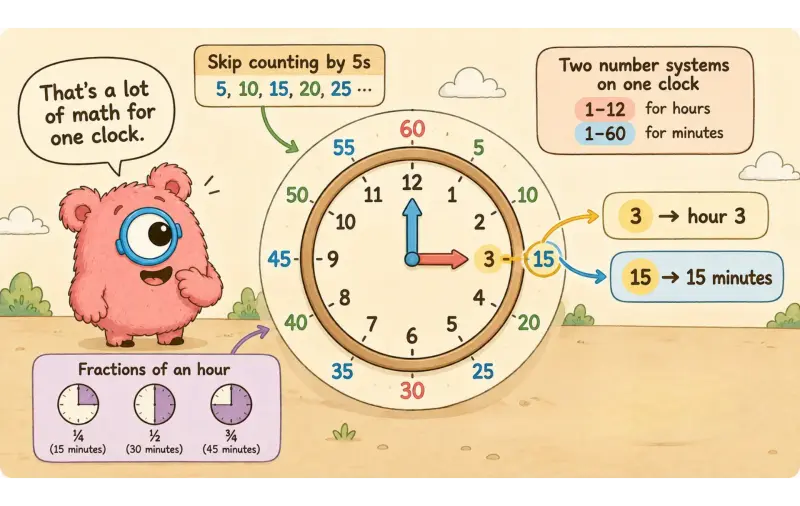
Reason two: time perception is its own skill
Knowing what the clock says and having a feel for how long twenty minutes lasts are different abilities. Both can matter when children need to plan their day, finish activities on time or follow a routine.
For some children managing time is genuinely hard. In a study comparing matched groups of children aged 9 to 15, children with ADHD had significantly lower time processing ability and daily time management than typically developing children. Their parent-rated daily time management was lower even than that of children with intellectual disability. The researchers also found considerable variation within the ADHD group, ranging from skilled to struggling, so this is a tendency rather than a rule.
The encouraging part is that these difficulties can respond to targeted support. In a randomised trial of a time-focused intervention with children aged 9 to 15 with ADHD, those receiving time-skills training alongside individualized time-assistive tools improved their time-processing ability significantly more than controls. Parents also reported better daily time management, although the children's own ratings did not show a significant change. The findings are promising, but the trial was small.
Clock work isn't the only route into this, but it's a natural one, because it gives you something to point at while you talk about duration.
Reason three: the rooms without phones
The least intellectual argument is the one that bites soonest. Exam halls, classrooms with phone bans, swimming pools, and any situation where a device has been confiscated or has run out of battery. A child who can't read the wall clock in a timed test is at a real and immediate disadvantage.
Small thing. Easy to prevent.
A Reason that's not valid
You'll often read that teaching analog clocks makes children better at math. That's a causal claim, and we couldn't find convincing experimental evidence for it.
The correlation is real, and the researchers are strikingly cautious about it. They describe it as only moderate, and note that in grades one and two, when children are learning the basic landmarks, the correlation with mathematics achievement is rather weak.
What their study does show is that clock-reading difficulties and mathematics difficulties often occur together, particularly as clock-reading tasks become more complex. That's a reason to pay attention when clock reading goes wrong, not evidence that teaching it will improve arithmetic.
Nobody has shown which way the arrow points. Children who are good at math may simply find clocks easy, or both may reflect general number ability.
So teach clocks because clocks are worth knowing, not as a back door to arithmetic. If your child needs help with math, work on math.
If your child finds Clock-reading hard
The difficulty becomes particularly visible at a specific point.
In that same study of 725 children across grades 1 to 6, clock reading problems in children with mathematics difficulties became obvious in grade three, when more complex five-minute and one-minute times are introduced. Hours and half-hours often go fine. It's the five-minute jump that separates children out, because that's the point where the five times table and the two-scales problem both arrive at once.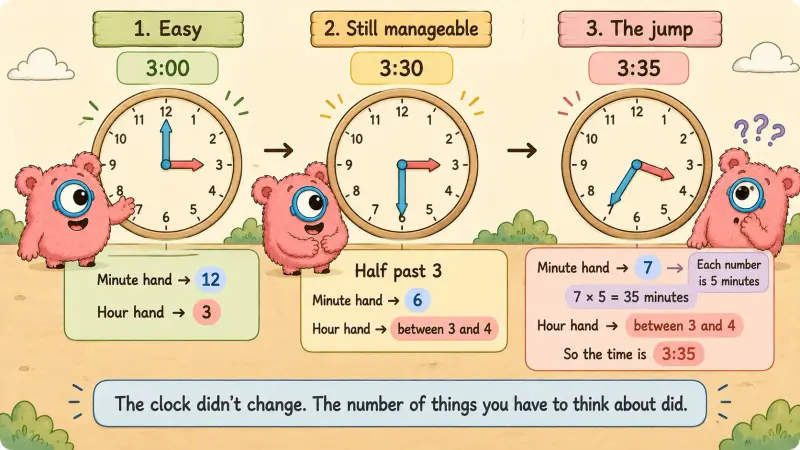
A few things that help:
Separate the hands. Confusing the hour and minute hands is the single most common error. When researchers examined where third graders at risk of dyscalculia were going wrong, most of the 20 children they interviewed confused the hour and minute hands. Cover the minute hand entirely for a week and do nothing but hours. Then swap.
Do the five times table first. Not alongside, first. Counting round the clock face in fives should be automatic before minutes are introduced, otherwise your child is doing two hard things simultaneously.
Use a real clock with a second hand. Watching the minute hand move is what connects the dial to actual duration, which a static worksheet can't do.
Don't teach "quarter to" early. Counting backwards from the hour is a separate skill and it undoes children who were coping fine with "past."
If clock reading is one of several things that feel unusually hard, it can be an early flag worth paying attention to, and our parent's guide to dyscalculia covers what else to look for.
So, teach it or not?
Teach it, for the reasons above, and hold it loosely.
It's in the curriculum, it's a good piece of mathematical thinking, and it costs an hour a week for a term. If your child takes to it, they've gained something genuinely interesting. If they don't, you have not damaged their future, and pushing a struggling child through it at the cost of their confidence in math is a bad trade.
What you might want to keep regardless of how the clock work goes is the time perception side. Asking "how long do you think that took?" and then checking costs nothing and matters more than the dial.
FAQs:
Do children still need to learn to read analog clocks?
Not out of necessity, since digital displays are everywhere. But analog clock reading is still in the Common Core and the England national curriculum, so children are assessed on it, and it's a useful backup in exam halls and classrooms where phones aren't allowed.
At what age should a child be able to tell the time?
Under the Common Core, children tell time to the hour and half-hour in first grade, to the nearest five minutes in second grade, and to the nearest minute in third grade. Many children take longer than this, and the five-minute stage is where difficulties usually first appear.
Does learning to read a clock improve math skills?
There's no good evidence that it does. Clock reading and math achievement are correlated in every year of primary school, but the researchers who measured that correlation describe it as only moderate, and no trial has shown that teaching clock reading improves math.
Why does my child confuse the hour and minute hands?
Because it's the hardest part, and it's the most common error children make. The same numeral means different things depending on which hand points at it. Covering one hand entirely and practising the other alone for a week or two usually sorts it faster than practising both together.
Is difficulty telling the time a sign of dyscalculia?
It can be one sign among several, but on its own it isn't diagnostic. Children with math difficulties tend to cope with hours and half-hours and then struggle when five-minute and one-minute times arrive, typically around third grade. If clock reading is one of several math areas causing trouble, it's worth looking into further.
How can I help my child get better at judging how long things take?
Ask them to estimate before and check after: how long will brushing teeth take, how long was that car journey. Time-focused training has been shown to improve time processing in children with ADHD, so this is a skill that responds to practice rather than something a child either has or doesn't.
References:
Burny, E., Valcke, M., & Desoete, A. (2012). Clock reading: An underestimated topic in children with mathematics difficulties. Journal of Learning Disabilities, 45(4), 351–360. https://biblio.ugent.be/publication/1086471/file/6744674.pdf
Mutlu, Y., & Korkmaz, E. (2020). Investigating clock reading skills of third graders with and without dyscalculia risk. International Online Journal of Primary Education, 9(1), 97–110. https://files.eric.ed.gov/fulltext/EJ1258500.pdf
Janeslätt, G., et al. (2026). Time-processing, daily time management, and autonomy in school-age children with ADHD. Children, 13(1), 143. https://pmc.ncbi.nlm.nih.gov/articles/PMC12839942/
Wennberg, B., Janeslätt, G., Kjellberg, A., & Gustafsson, P. A. (2018). Effectiveness of time-related interventions in children with ADHD aged 9–15 years: A randomized controlled study. European Child & Adolescent Psychiatry, 27(3), 329–342. https://d-nb.info/1146191820/34
Hawani, A., et al. (2023). Enhancing time reading and recording skills in first-grade children with learning difficulties using the "Clock Motor Game". Children, 10(11), 1748. https://www.mdpi.com/2227-9067/10/11/1748