TL;DR: An IQ score turns out to be a loose guide to how they'll do in a math lesson, especially for children with ADHD. If your child handles math calmly at home but struggles on timed tests, look at the processing speed part of the report and consider asking the school for extra time.
Assessment reports are strange documents. You come home with a Full Scale IQ, four index scores, a scattering of percentiles, and a strong sense that all of it means something important without being told quite what.
The question underneath is usually simple. Does this tell me how my child is going to do at school?
For math there's a reasonable research answer, and it's a narrower one than the report's presentation suggests. For children with ADHD in particular, there's also a specific reason the score and the school results so often fail to line up.
The pattern parents notice first
A child who clearly understands math brings home poor math results anyway. It's one of the most common things parents of children with ADHD describe, and it looks like inconsistency or lack of effort from the outside.
A study of adolescents with ADHD pinned down what's happening. Researchers matched 30 teenagers with ADHD against 39 peers of the same age and IQ, then gave both groups two kinds of math test. On untimed calculation, the two groups performed no differently, but the ADHD group scored significantly lower on timed math fluency.
The size of that gap is the striking part. On untimed work the ADHD group averaged a standard score of 107, comfortably above average. On the timed version, the same teenagers averaged 88.
Same children, same math, nineteen points apart depending on whether a clock was running. That's worth sitting with before concluding a child hasn't grasped something. If most of their math work is timed, the score may be telling you how fast they are rather than how much they know.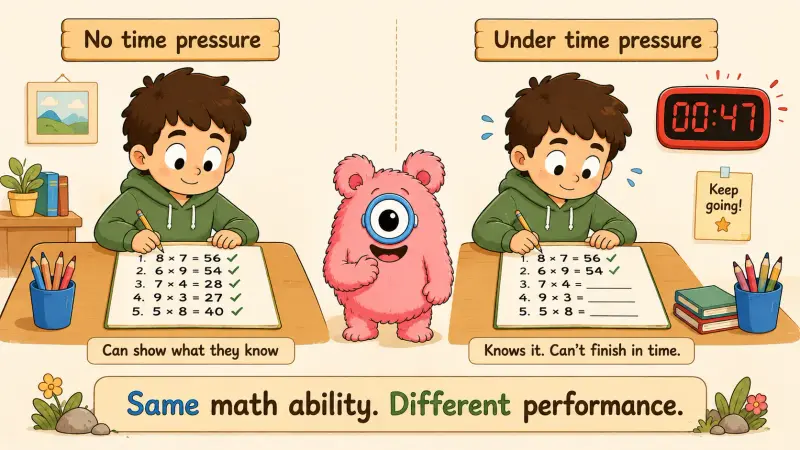
Speed and understanding are different skills
Why does the gap appear only when a clock is running? The same study points at an answer, and it's sitting in the IQ report.
Most reports include a processing speed index. It measures how quickly a child takes in simple information and responds to it, roughly how fast you can name things you already know. It says nothing about how well they reason.
The teenagers with ADHD were slower on two tasks measuring exactly that. On working memory, which is holding information in mind while you use it, the two groups were no different at all.
That combination is what makes it interesting. Keeping information in mind wasn't where these teenagers struggled. The pace of the basic mechanics was. The researchers also point out that a fluency test means jumping between operations, an addition problem then a subtraction then a multiplication, and that switching costs time of its own.
A larger study of 504 children with ADHD found that slower processing speed was linked to how inattention affected math performance, while the same link wasn't found for reading. Slower processing speed was also linked to greater difficulty holding information in mind.
One possible explanation is that slower processing keeps cognitive resources occupied for longer, leaving less opportunity to refresh information held in working memory. That could be especially relevant during multi-step math, where a child often needs to hold an intermediate result in mind while working through the next step.
Which gives you something concrete to look for at home. If math is the subject that suffers while reading holds up reasonably well, the obstacle may be time rather than the math itself. And a child who already understands the concept won't be helped by more practice on the concept. They'll be helped by more time. Our guide to how ADHD affects math learning goes into that interaction further.
So what does the score actually tell you?
It tells you how your child performed on a set of structured tasks, one-to-one with an adult, in a quiet room, on a single day. Though it is real information, it's a much narrower thing than the report's presentation makes it feel.
A 2024 review brought the research on this together. Of the three school subjects it examined, math was the one most closely tied to Full Scale IQ, ahead of reading and written language.
Even that link is weak, though. Children with the same IQ score often end up with very different math results.
The same review found something more specific to ADHD: IQ scores tracked achievement less closely in these children than has been reported in the general population.
That makes sense once you picture the two settings side by side. An assessment is one adult, short tasks, a quiet room, few distractions. A math lesson is thirty children, a full period of sustained attention, and a great deal more to manage at once. A child can look quite different in each, and the assessment room is by far the easier of the two.
So the honest answer is this. An IQ score describes what your child can do under close to ideal conditions. School rarely offers ideal conditions, and for a child with ADHD the distance between those two settings is wider than usual. Which is why the researchers conclude that other things need weighing alongside the score, naming motivation as one of them.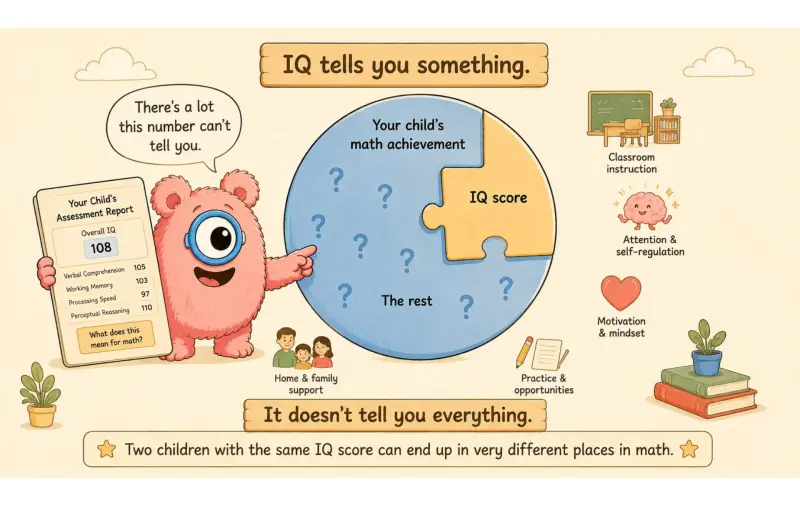
What to do with the report
Read the index scores, not just the headline. Full Scale IQ is an average of the parts, and an average can hide the thing that matters most. A child with strong verbal comprehension and weak processing speed has a very particular profile, and one blended number tells you less than either score does alone.
Find the processing speed index and see where it sits. If it's well below the rest of the profile, that's the finding to bring to the school. A low score there affects how much work your child can get onto the page in the time available. It has no bearing on what they're able to learn.
Ask for extra time, and ask early. The researchers behind the 504-child study recommend precisely this: that children with ADHD "be provided with additional time to process assignments and tests," and receive important material in advance so they have longer with it. A child who knows the math but runs out of time has a solvable problem.
Stop reading timed tests as a measure of understanding. If your child works through problems calmly at home and crashes under a timer, that's a documented pattern with research behind it. It isn't carelessness, and it isn't a lack of trying.
Treat a low score as a description of now. These figures describe groups, not individuals, and they leave most of the variation unexplained. If math sits well below everything else in the profile, a specific math learning difficulty may be worth ruling in or out. Our parent's guide to dyscalculia covers what that looks like.
If your child is autistic
Much less is known here, and it's worth being upfront about that. The 2024 review found too few studies on autistic children to draw pooled conclusions - only a handful existed, covering a small number of children between them.
What those few studies suggest is that a different part of the report may matter more. An IQ test breaks into several sub-scores, and one of them covers visual and spatial reasoning - puzzles with patterns, blocks and shapes, rather than words or numbers. On your child's report it's usually labelled perceptual reasoning, or visual spatial on newer editions of the test. In one study of autistic children, that was the sub-score most closely linked to math.
Treat that as a hint rather than a finding. For now the practical position is the same one that applies to any child, only more so: the report describes one morning in a quiet room, and what you notice week to week at home and at school will tell you more.
The number is a starting point
The reviewers' own conclusion is a good one to hold onto: Wechsler scales are valuable in predicting academic achievement in ADHD and autism, but other factors also should be considered.
The score is real and it means something. It also leaves most of the story unwritten, and the unwritten part is the part that teaching, time, and how math has been made to feel can still change.
FAQs
Does a high IQ mean my child will be good at math?
Not reliably. In children with ADHD, IQ and math achievement overlap by roughly a quarter, which leaves most of the difference between children unexplained. High IQ scores alongside math difficulties are common enough in ADHD to be expected rather than surprising.
What does processing speed mean on my child's report?
It measures how quickly your child takes in simple information and responds, not how well they think or reason. A low processing speed score alongside otherwise strong results often shows up as a child who understands the work but can't finish it in the time allowed.
My child understands math but does badly on timed tests. Is that normal?
It's a well-documented pattern. One study of adolescents with ADHD found no difference from matched peers on untimed calculation, but a large gap on timed math fluency, alongside slower processing speed. Knowing math and producing it quickly are genuinely separate skills.
Should I ask for an IQ test to find out if my child will struggle with math?
An IQ test isn't built to answer that and won't answer it well on its own. If math specifically is the worry, an assessment that measures math skills directly and screens for a specific learning difficulty will tell you considerably more.
References
Marinopoulou, M., Åsberg Johnels, J., Bornehag, C.-G., Unenge Hallerbäck, M., & Billstedt, E. (2024). Do Wechsler intelligence scales predict academic achievement in children with ADHD or autism? A systematic review and meta-analysis. Applied Neuropsychology: Child, 15(1), 92–106. https://www.tandfonline.com/doi/full/10.1080/21622965.2024.2361022
Capodieci, A., & Martinussen, R. (2017). Math error types and correlates in adolescents with and without attention deficit hyperactivity disorder. Frontiers in Psychology, 8, 1801. https://www.frontiersin.org/journals/psychology/articles/10.3389/fpsyg.2017.01801/full
Hulsbosch, A.-K., Van der Oord, S., & Tripp, G. (2025). Academic achievement in children with ADHD: The role of processing speed and working memory. Research on Child and Adolescent Psychopathology, 53(10), 1469–1484. https://link.springer.com/article/10.1007/s10802-025-01346-6