TL;DR: Yes. Dyslexia and math difficulty often travel together, but they're separate things, and plenty of dyslexic children are strong at math. Where math does suffer, some skills may be much harder than others, particularly those that place demands on language.
Your child has a dyslexia diagnosis, and reading has had all the attention. Then the math homework starts going wrong too, and a new worry arrives: is this the same thing spreading, or something separate? And is there any version of this where your child turns out to be good at math?
There is. But the answer is more specific than a simple yes, and the specifics are what tell you what to do.
The short answer
Yes, your child can be good at math. Dyslexia makes math difficulty more likely than for a child without Dyslexia, but the two don't come as a package deal.
One Dutch study drew on data from more than 19,000 children, looking at dyslexia, dyscalculia and ADHD together. Children who had any one of the three were two to three times more likely to have a second one as well. Still, of all the children with any of these three conditions, 77% had just that one. One usually doesn't bring the others along.
Another group of researchers tested 75 dyslexic children across a whole range of math skills. A third of them showed no math difficulties, and those children scored like children without dyslexia on almost every task.
Those 75 kids were seen at a specialist clinic, so don't read "a third" as a national figure. And having no math difficulty is a long way from loving math. Even so, plenty of dyslexic children are simply fine at math, and nobody should be surprised when yours turns out to be one of them.
Why reading and math get tangled together
Math often suffers because chunks of school math run on language, and dyslexia reaches exactly those chunks. Dyslexia itself is no more a math condition than it ever was.
Researchers who reviewed this overlap point out that phonological processing and reading comprehension feed directly into several parts of math: reading and writing numerals, multiplication, and every kind of word problem.
Multiplication facts and word problems. If you've been watching your child closely, those two may already be the exact places things fall apart, and now you know why. Multiplication facts are mostly learned and retrieved as verbal associations, and trouble pulling arithmetic facts out of long-term memory is common in dyslexia. Word problems require reading before any math can start. Both lean on the skills dyslexia tends to make harder, which is a rough deal when the task is supposed to be about numbers.
Which means a lot of what looks like a math problem is really a reading problem, and the two need different help.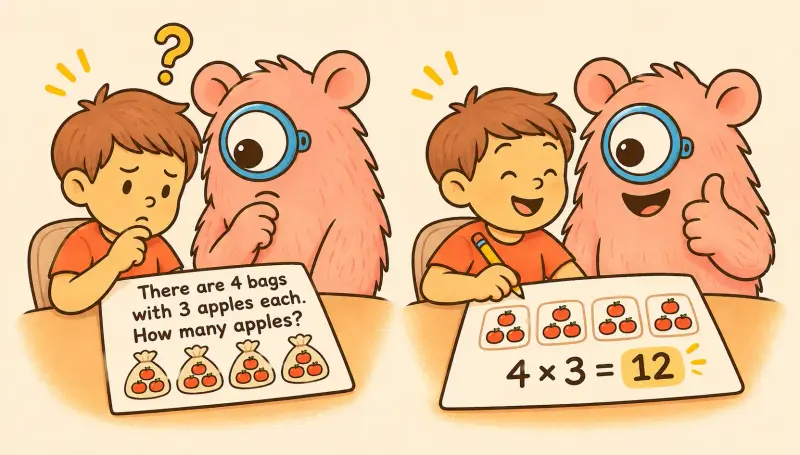
The four places dyslexia tends to show up in math
When math is hard for a dyslexic child, the trouble usually clusters in particular parts of the subject while the rest holds up.
Researchers testing 75 children with dyslexia looked at four separate areas of math ability. Times tables and multi-step procedures were the two most common places difficulty showed up. Shape and space was the least common. The researchers sorted each child by their main weakness; outside a study a child can easily struggle in two, so use the list to know where to look and expect some overlap.
Times tables. Your child knows what 7 × 8 means and can work it out, but can't pull "56" out of memory on demand.
Multi-step procedures. Long multiplication, column subtraction with borrowing, long division. Your child can understand exactly what division is and still lose their place halfway down the page.
Numbers themselves. Reading and writing numbers, place value, comparing quantities. These are foundational, so trouble here tends to show up across other topics too.
Shape and space. Geometry and visual reasoning, including making sense of diagrams and models.
Getting a sense of which one you're looking at is worth doing before you change anything, because the fix is different for each. A child stuck on times tables and a child losing track of long division will both bring home a page of wrong answers, and the page won't tell you which is which.
What helps
Read the problem aloud and watch what changes. Take a word problem your child got stuck on, read it to them, and see whether it gets easier. If it suddenly clicks, the reading was probably part of what made it hard, and that's worth mentioning to their teacher. If they're still stuck with the words handled, something in the math itself likely needs attention, whether that's the reasoning, the vocabulary, or the concept underneath. Try it across several problems before you draw a conclusion.
Don't let the times tables gate everything else. If fact retrieval is the sticking point, the worst move is holding back new material until the facts are memorized, because for a dyslexic child that wait can be very long. Teach the derived strategies instead: secure 2s, 5s and 10s plus the squares, then reach the rest by doubling or adding and subtracting a group, so 7 × 8 becomes 7 × 7 and one more seven. Our guide to building multiplication from skip counting to arrays walks through that sequence. Let them keep a chart on the table during long multiplication. That counts as an accommodation, and a sensible one.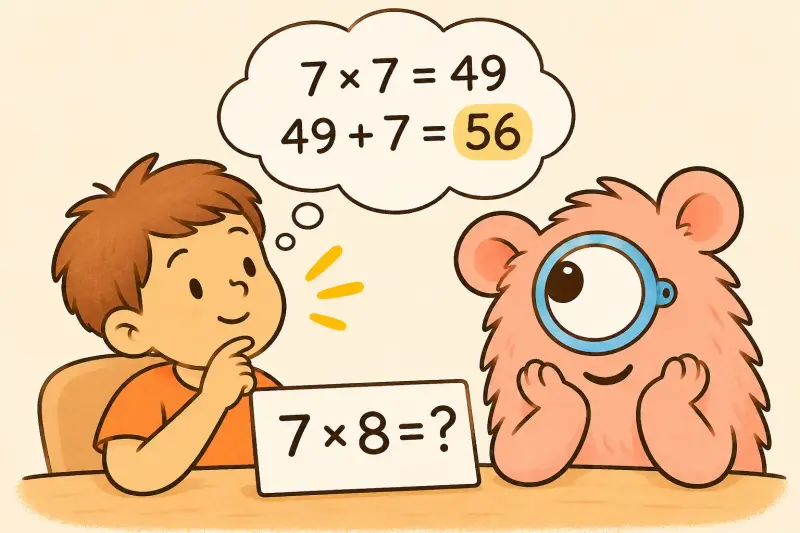
Put the steps on paper for procedural work. If the difficulty is in the multi-step algorithms, your child may be losing their place even though they understand the concept underneath. A written reference card for the steps of long division, kept beside them while they work, takes the memory load off while leaving all of the math in place. Fade it once they stop reaching for it, however long that takes.
Ask for accommodations aimed at the reading load. Problems read aloud, extra time on word-problem sections, and a scribe for written explanations all address the language demand specifically. These let a teacher see what your child knows about math once reading speed is out of the picture, and a word problem about trains is largely a reading-speed test.
Keep the math and the reading separate in your own head. Dyslexia is being treated already. If math needs work too, give it its own plan; folded into the reading support, it tends to become an afterthought.
When it might be dyscalculia as well
Sometimes math difficulty really is its own condition sitting alongside the dyslexia. The two overlap well above chance in both directions, and around 40% of children with math learning difficulties also have reading difficulties.
One signal worth watching for is trouble with the number basics themselves, beyond the language-heavy parts. If your child is shaky on which of two numbers is larger, on place value, on estimating whether an answer is remotely sensible, or on telling time and handling money, that's worth raising with the school and asking specifically for a math assessment; another reading assessment won't find this. Dyscalculia can also show up in calculation and fact recall, so this isn't the only sign, but it's the one the reading can't explain away. Our post on how schools miss dyscalculia in bright or verbal kids covers why these assessments get skipped so often.
Where that leaves you
A dyslexia diagnosis tells you something real about how your child learns, and nothing at all about whether they'll be good at math.
If math is going badly, two questions will get you further than wondering whether your child is a math person: which of those four areas is causing it, and whether things get easier when somebody else does the reading. Both have practical answers you can act on.
FAQs
Can a dyslexic child be good at math?
Yes. Dyslexia and math difficulty co-occur more often than chance, but they're separate conditions, and most children with dyslexia, dyscalculia or ADHD have only one of the three. In one study of 75 children with dyslexia at a specialist clinic, a third showed no math difficulties, and those children scored like children without dyslexia on almost every task. A dyslexia diagnosis describes how your child processes language and leaves the math question open.
Why does my dyslexic child struggle with times tables but understand math concepts?
Times tables are mostly stored and recalled as verbal sequences, which draws on the same language system dyslexia affects, and trouble retrieving them from memory was one of the two most common math difficulties in a clinic sample of dyslexic children. Understanding what multiplication means is a different skill and often stays intact. Teaching derived strategies, where a known fact gets you to an unknown one, routes around the retrieval problem.
Is dyslexia the same as dyscalculia?
No. Dyslexia affects reading and language processing, while dyscalculia affects math specifically. They co-occur more often than chance would predict, and one large study found evidence that shared genetic factors help explain why the conditions often occur together. A child can have either one alone or both together.
How can I tell if my child's math problem is really a reading problem?
Read the questions aloud and see whether their performance changes. If problems get noticeably easier once somebody else handles the words, reading demands are likely part of the difficulty. If they're still stuck with the reading removed, the math itself needs attention. Try it across several problems, since a single example can point either way.
Should my dyslexic child be assessed for dyscalculia too?
It's worth asking if the difficulties extend to the number basics, such as comparing quantities, place value, estimation, telling time or handling money. Reading-focused assessments won't pick up a separate math difficulty, so you may need to request a math evaluation specifically.
References
Pedemonte, B., Pereira, C. W., Borghesani, V., Ebbert, M., Allen, I. E., Pinheiro-Chagas, P., De Leon, J., Miller, Z., Tee, B. L., & Gorno-Tempini, M. L. (2024). Profiles of mathematical deficits in children with dyslexia. npj Science of Learning, 9, 7. https://doi.org/10.1038/s41539-024-00217-x
Starling-Alves, I., Peters, L., & Wilkey, E. D. (2025). Beyond the sum of their parts: A multi-dimensional approach to dyscalculia-dyslexia comorbidity integrating studies of the brain, behavior, and genetics. Developmental Cognitive Neuroscience, 72, 101510. https://doi.org/10.1016/j.dcn.2025.101510
van Bergen, E., de Zeeuw, E. L., Hart, S. A., Boomsma, D. I., de Geus, E. J. C., & Kan, K. J. (2025). Co-occurrence and causality among ADHD, dyslexia, and dyscalculia. Psychological Science, 36(3), 204–217. https://doi.org/10.1177/09567976241293999