TL;DR : Math intervention apps work best when they are grounded in what the research actually supports: visual and concrete-to-abstract progression, immediate corrective feedback, adaptive difficulty, and low-pressure practice. Apps built around timers, leaderboards, and competitive streaks tend to help confident learners and frustrate struggling ones. This guide covers six apps worth considering for K–5 children who are behind in math - including those with dyscalculia, ADHD, or other learning differences - and explains exactly what each one does well and where it falls short.
Finding a math app for a struggling learner is easy. Finding one that actually works is harder than it looks. Most popular math apps are designed for children who are keeping up - they practice what kids already know and make it faster. That's useful, but it's not intervention.
Intervention means meeting a child at the point where their understanding broke down and rebuilding from there. That requires a different kind of design: visual models, adaptive difficulty, corrective feedback, and a low-pressure environment where getting something wrong is part of the process rather than a signal to move on.
This guide covers six apps that get meaningful things right for struggling learners, based on what the research supports. For the broader picture of what makes any math program neurodivergent-friendly, our guide to the best online math programs for neurodivergent kids is a useful companion read.
What Makes a Math App Genuinely Interventional?
Before getting into individual apps, it helps to know what to look for - because the gap between a practice app and an intervention app is significant.
The most robustly studied framework in math intervention is the Concrete–Representational–Abstract (CRA) sequence, where children move from hands-on or visual manipulation of quantities, to pictorial representations, to abstract symbols. A recent meta-analysis of 30 studies found a statistically significant and very large overall effect size for Concrete–Representational–Abstract (CRA) instruction. The findings add to a growing body of evidence supporting CRA as an effective mathematics intervention for students with learning difficulties and disabilities. Apps that start with visual models - number lines, ten frames, dot arrays, place value blocks - before moving to symbols are doing something the research supports. Apps that go straight to abstract numerals are skipping the most important layer.
Feedback timing also matters. Research using the ASSISTments platform found that tutor-mode feedback - hints, scaffolding, guided reattempts, and real-time error correction - was particularly beneficial for students with low prior knowledge compared with test-mode practice. Rather than simply marking an answer incorrect, effective feedback helps students understand why an error occurred and provides a pathway toward a correct solution.
The Apps
1. Monster Math – From Concrete Gameplay to Abstract Thinking
Monster Math transitions kids from visual gameplay to mental reasoning. Learners solve game-based missions where visuals gradually fade into symbolic representations, aligning with the CRA model. The app covers addition, subtraction, multiplication, and division through a story-driven adventure format - the math is embedded in the play, not bolted on as a reward for it. The non-timed, story-driven design keeps engagement high and anxiety low - well suited to children who need a scaffolded bridge between manipulatives and abstract problem solving.
One feature that matters for struggling learners is that Monster Math lets parents and teachers choose exactly which topic the child works on, instead of moving them through a fixed grade-level sequence. If a second-grader has solid addition but struggles with subtraction, you can let the child start directly from subtraction. If multiplication is the wall this term, you can stay there. That control is genuinely useful when a child's gaps don't match their age - and it puts the adult, who knows the child best, in charge of what they practise.
For struggling learners specifically, the absence of timed drills and competitive leaderboards matters. Timed pressure and competitive comparison increase cognitive load and math anxiety in children who are already behind - a pattern that shows up distinctly across autism, ADHD, and dyscalculia. Monster Math removes that pressure while keeping engagement high through narrative and character progression.
Best for: K–3 children who need a gentle, scaffolded bridge from concrete visuals to symbolic and abstract thinking through fun, pressure-free gameplay.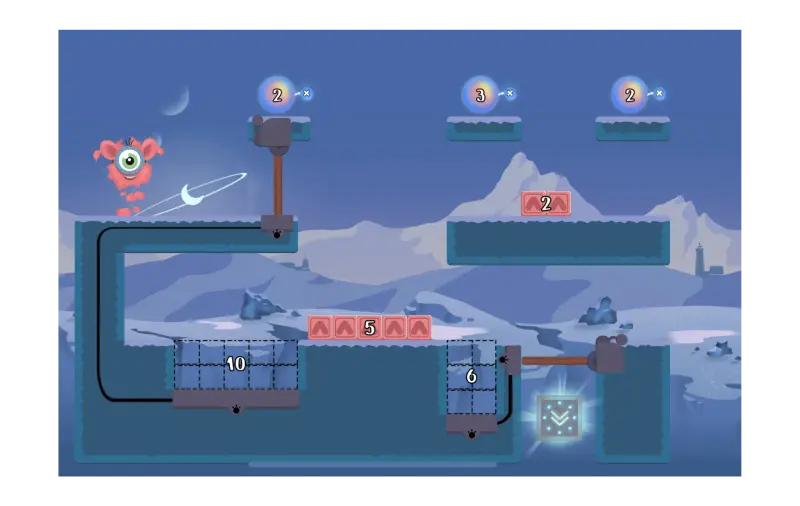
2. ST Math – Visual, Language-Free Concept Building
ST Math, developed by the nonprofit MIND Research Institute, teaches math entirely through animated visual puzzles - no written instructions, no verbal explanations. Children figure out the underlying mathematical rule by observing what happens when they interact with the puzzle. For a struggling learner who freezes around numerals or written word problems, that language-free entry point is a meaningful unlock.
A large-scale randomised trial in high-poverty Southern California schools found ST Math students achieved statistically significant gains in mathematics achievement compared to control schools, earning the program an ESSA Tier 1 (Strong Evidence) rating. The approach also draws on the well-documented connection between spatial reasoning and math performance - a 2023 randomized controlled trial confirmed that spatial visualization training produces meaningful transfer to math performance in elementary-age children.
Best for: Visual learners, and children who shut down at the sight of numerals.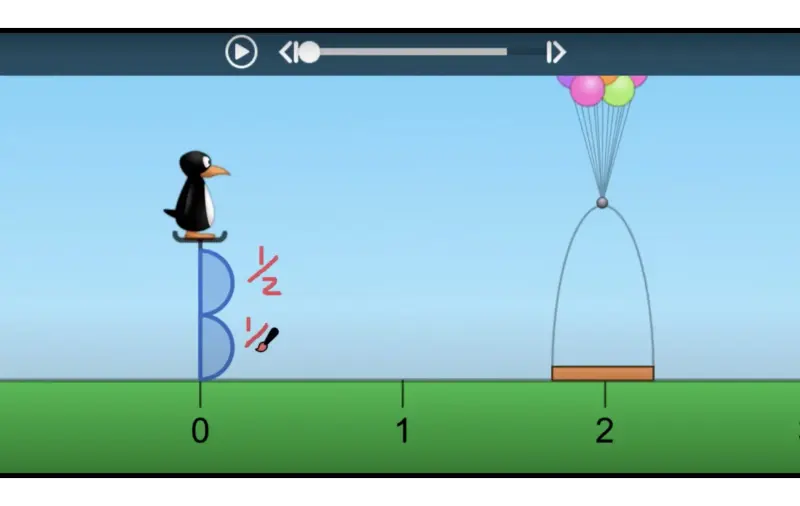
3. Smartick – Adaptive Daily Sessions with Diagnostic Depth
Smartick uses AI to generate personalised 15-minute daily sessions that adjust difficulty in real time based on each child's performance. It assesses what the child actually knows rather than assuming grade level, which makes it well-suited to children whose gaps don't match their age. The short, fixed-length sessions also work well for children with ADHD who find longer practice overwhelming.
A 2024 study evaluated the Smartick program with children with reading and mathematical difficulties and noted its strong pedagogical foundation relative to most learning apps in the category. Parent and teacher dashboards give detailed visibility into which specific skills were practised and where errors occurred.
Best for: Children with dyscalculia, ADHD, or significant gaps who need structured daily practice with adult visibility.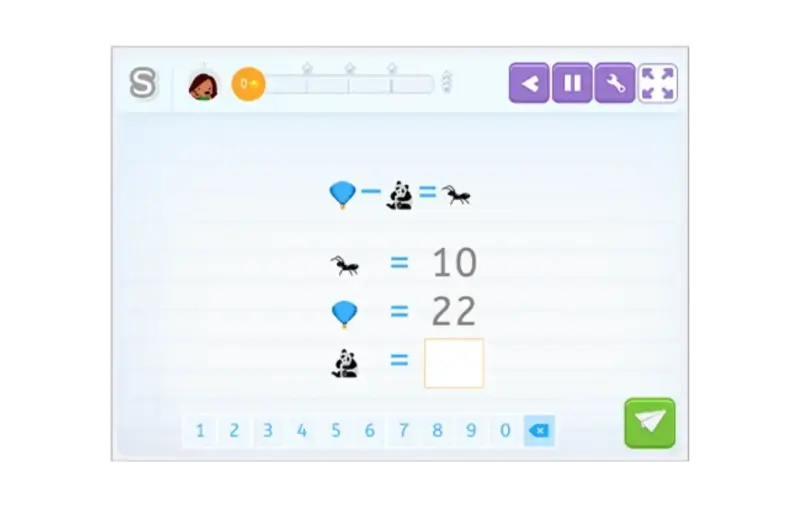
4. Kahoot! DragonBox – Concept-First Through Visual Discovery
The DragonBox series introduces mathematical structure through visual manipulation long before any numerals appear. Kahoot! Numbers (ages 4–8) uses characters called Nooms to represent quantities visually. Kahoot! Big Numbers (ages 6–9) teaches multi-digit addition, subtraction, carrying, and borrowing through a resource-management game. Kahoot! Algebra (ages 5+) introduces equation-solving through pure visual gameplay long before letters or symbols appear.
For struggling learners, the value is that the math is genuinely embedded in the play rather than bolted on as a quiz interruption. Reviewers consistently note that the apps work well for children who freeze around traditional math notation, because the core gameplay relies on visual cards and characters rather than numerals or operation symbols.
Best for: Children with foundational gaps in number sense or those who avoid traditional math notation.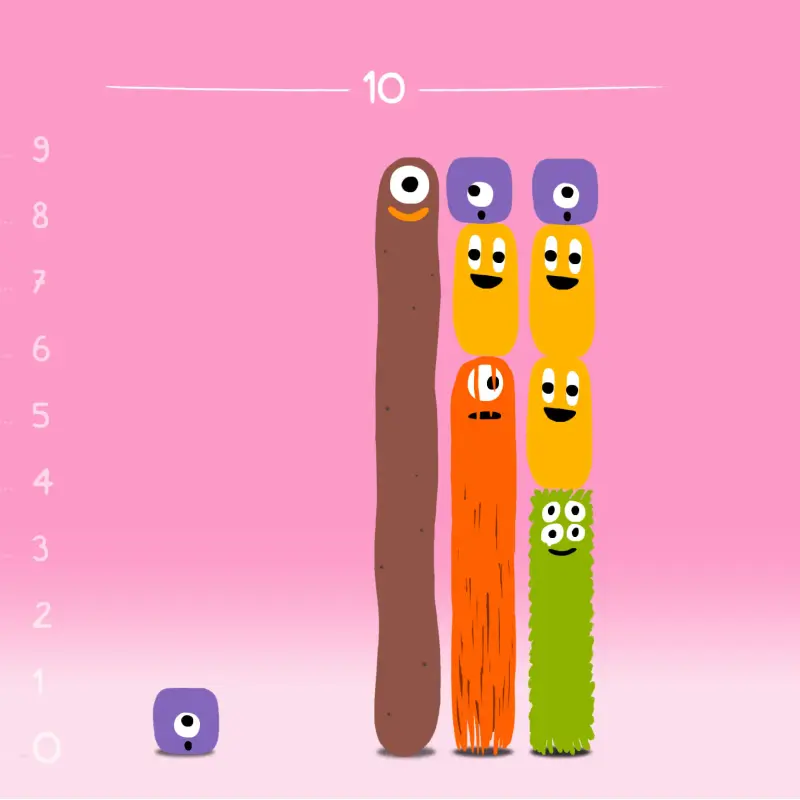
5. My Math Academy – Adaptive Foundational Math for Early Learners
My Math Academy, from Age of Learning, is an adaptive game-based program built specifically for Pre-K through 2nd grade. A game-based placement assessment creates an individualised learning path, and the program dynamically adjusts difficulty and scaffolding within each activity based on real-time performance. It covers number sense, counting, comparing quantities, addition and subtraction strategies, fact fluency, and place value.
The program is built for intervention use - and is deployed as a Tier 2 and Tier 3 support in MTSS frameworks in US schools. A peer-reviewed efficacy study found that students using My Math Academy made significant learning gains compared to a control group, with the greatest impacts among children with the lowest starting levels of math knowledge.
Best for: Pre-K through 2nd grade children with foundational gaps in number sense and early arithmetic. Currently distributed through schools and districts; home access typically requires going through your child's school.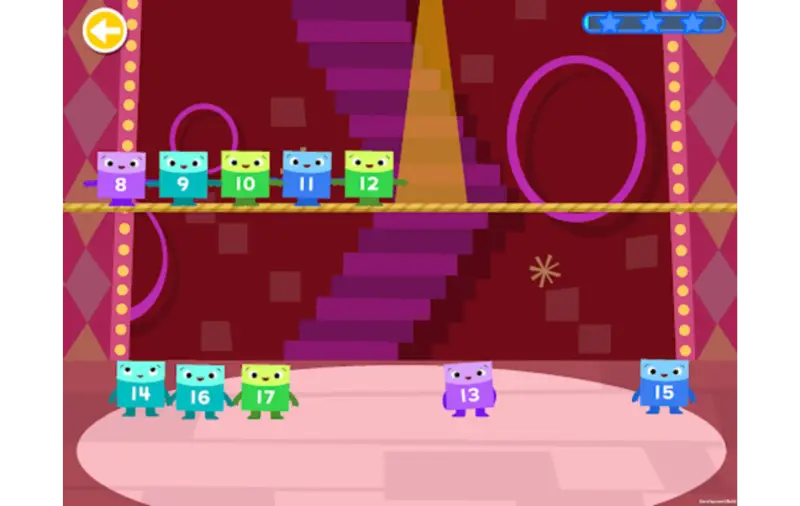
6. Reflex – Adaptive Math Fact Fluency for Intervention
Reflex, from ExploreLearning, is designed specifically to build math fact fluency. It teaches related facts as connected fact families (such as 8+3, 3+8, 11−8, and 11−3) and continuously adapts practice based on each student's performance. As students master particular facts, the program shifts attention toward facts that still require practice, helping keep instruction targeted and efficient.
Reflex is particularly useful for students who understand addition and subtraction concepts but have not yet developed automatic recall of basic facts. By focusing on fact relationships and personalized practice, it helps bridge the gap between conceptual understanding and fluent retrieval. It is designed as an RTI solution and serves students at all intervention tiers, with more than a decade of impact studies showing significantly larger math achievement growth for Reflex users compared to non-users - including at-risk students and those with special needs.
Best for: Grades 2-6 children who have the underlying concepts but need to build automaticity.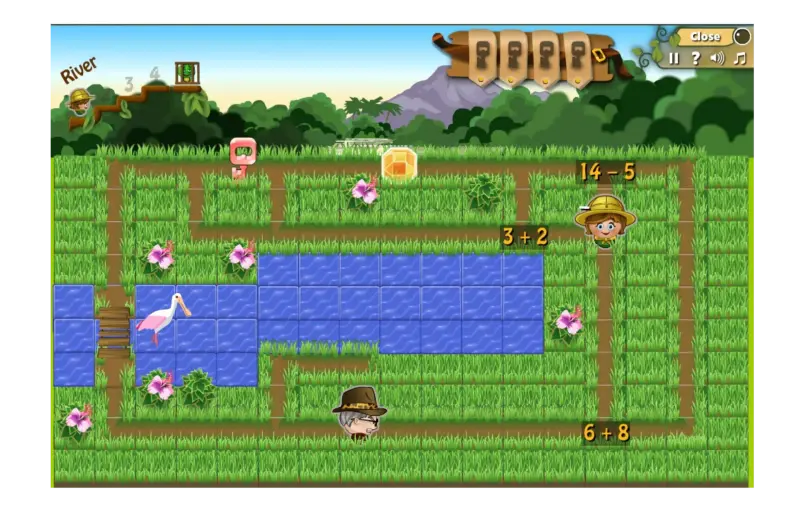
FAQs:
Can an app replace a math tutor for a struggling learner?
For children with mild gaps, a well-chosen app used consistently can close ground meaningfully. For children with diagnosed dyscalculia or more than a year behind grade level, an app alone is unlikely to be sufficient. The research on dyscalculia intervention consistently points to the need for structured, multi-sensory instruction with a skilled adult who can respond to the child's specific conceptual gaps in real time. An app works best as a complement to that support - providing consistent practice between sessions - rather than as a standalone replacement.
How much time should my child spend on a math intervention app each day?
Most research trials use 15-30 minutes of focused practice, three to five times per week. Shorter, consistent sessions - even just 10–15 minutes daily - outperform long, infrequent ones for skill consolidation.
My child refuses to use any math app. What should I try?
Refusal is usually a signal that the app feels like school - and school has been a place of struggle. Start with something that does not look like a math app at all: a board game involving counting, a cooking activity with measuring. Once the emotional association between math and failure softens, structured apps tend to be accepted more readily.
Are there math intervention apps specifically for ADHD?
No app is designed exclusively for ADHD, but certain design features align well with how ADHD brains tend to work: short task segments, varied interaction types, immediate feedback, and a clear sense of progress within each session. Monster Math and Smartick both score well on these features. Avoid apps with long instruction sequences before any interaction, or formats where progress feels slow and unrewarding.
What is the difference between a math intervention app and a math practice app?
A practice app helps children who already understand a concept become faster and more fluent through repetition. An intervention app helps children build understanding they do not yet have - by diagnosing where their understanding breaks down, presenting visual models, adjusting difficulty dynamically, and giving corrective feedback. Most apps lean toward practice. Smartick and ST Math lean most clearly toward intervention. Many families spend months on practice apps wondering why nothing is improving, when what their child needed was to work further back in the skill sequence.
References
Ebner, S., MacDonald, M. K., Grekov, P., & Aspiranti, K. B. (2025). A meta-analytic review of the Concrete-Representational-Abstract math approach. Learning Disabilities Research and Practice, 40(1), 31–42. https://journals.sagepub.com/doi/10.1177/09388982241292299
Razzaq, R., Ostrow, K. S., & Heffernan, N. T. (2020). Effect of immediate feedback on math achievement at the high school level. In Artificial Intelligence in Education (pp. 263–267). Springer. https://pmc.ncbi.nlm.nih.gov/articles/PMC7334720/
Bang, H. J., Li, L., & Flynn, K. (2023). Efficacy of an adaptive game-based math learning app to support personalized learning and improve early elementary school students' learning. Early Childhood Education Journal, 51(4), 717–732.
https://link.springer.com/article/10.1007/s10643-022-01332-3Lowrie, T., & Logan, T. (2023). Spatial visualization supports students' math: Mechanisms for spatial transfer. Journal of Intelligence, 11(6), 127. https://pmc.ncbi.nlm.nih.gov/articles/PMC10299554/
Corona-González, C. E., Ramos-Flores, M., Alonso-Valerdi, L. M., Ibarra-Zarate, D. I., & Issa-Garcia, V. (2024). Psychophysiological evaluation of the Smartick method in children with reading and mathematical difficulties. Frontiers in Human Neuroscience, 18, 1287544. https://pmc.ncbi.nlm.nih.gov/articles/PMC11024347/