TL;DR: What matters most for an autistic child is whether you can control the sensory environment, mute the audio, avoid timers, and get the same layout every session. Very few math apps let you do all of that, and this roundup is honest about what each one does right.
There's a widespread assumption that autistic children are naturally good at math. It shapes what parents expect and what schools look for, and it's mostly wrong.
When researchers assessed autistic adolescents alongside peers matched for age and IQ, 22% of the autistic group showed math achievement indicative of a mathematics learning disability while only 4% showed mathematical giftedness. The authors note directly that the scarcity of research on math in autism may partly stem from a widely-held belief in mathematical giftedness "despite emerging evidence to the contrary." Our post on whether autistic kids are really good at math profiles a few genuine autistic math prodigies and explains why they're the exception rather than the pattern.
So if your autistic child finds math hard, that's common rather than surprising. Here's what to look for in an app, and the five worth your time.
What actually matters when choosing an app
Most "best apps" lists rank on content quality. For an autistic child, content quality is necessary but nowhere near sufficient. Four things matter more.
Can you turn the sound off? This is the single most useful filter, and it eliminates a surprising number of apps. Auditory filtering, the ability to focus on relevant sounds when other auditory information competes for attention, is an area where autistic children showed significantly greater sensory processing challenges than typically developing peers in a study of 69 children aged 6 to 10. An app with cheerful background music playing under every question may therefore be adding an unnecessary sensory demand.
Is it predictable? Autistic children in one study showed markedly higher intolerance of uncertainty than their peers, and intolerance of uncertainty and anxiety together explained roughly half the variance in autistic children's sensory sensitivities. Apps that reshuffle their layout, or use randomised reward mechanics, are working against that. Same screen, same buttons, same order is a feature.
Are there timers? Speed pressure adds a demand that has nothing to do with math understanding. Look for apps where a child can sit with a problem.
Can it hook into a special interest? A review of 20 studies covering 91 autistic children found that every one reported gains in educational attainment or social engagement when a child's restricted interests were built into teaching. In practice, few apps let you swap in your child's particular obsession, so this one usually works better around the app than inside it. The app handles the practice; you do the counting, sorting and comparing with the trains, the dinosaurs, or whatever it currently is.
Now the uncomfortable part. Almost no math app meets all four.
So rather than pretend there's a perfect option, here are five worth a look, ordered roughly by how close they get.
1. Monster Math
Cost: Free tier with daily limits, then $59.99 a year with a 7-day trial on upgrade.
Ages: Grades K to 3, roughly 5 to 9.
Monster Math is a game-based math fact fluency program for grades K-3, with problems woven into the gameplay rather than interrupting it. The approach is strategy-first, teaching children ways to make problems friendlier instead of drilling flashcards.
On the criteria above it does well. Sound can be muted entirely, so the whole audio layer comes off in one step rather than leaving narration running underneath. There are no timers, so a child can take as long as a problem needs. The design deliberately avoids loud sounds and flashy animation, patterns stay consistent between sessions, and when a child gets stuck there are hints available and the option to retry a level with no penalty. It's also ESSA Tier IV certified for research-based design.
2. Khan Academy Kids
Cost: Free, no ads, no subscription.
Ages: 2 to 8.
Khan Academy Kids is a free early-learning app covering reading, math and social-emotional skills, built as a library of books, videos and games guided by five animal characters. The curriculum was developed with learning experts at Stanford and aligns to Common Core, with math spanning counting, addition and subtraction, shapes, measurement and telling time.
It has the best accessibility documentation of any app here, and it names the things autistic parents actually care about. The statement confirms that background music can be turned off in lessons, navigation is predictable and simple, and the design avoids excessive gamification and busy visual displays.
You can also hide entire sections. Switching off the Create and Video tabs narrows the app to learning content and removes two whole categories of distraction.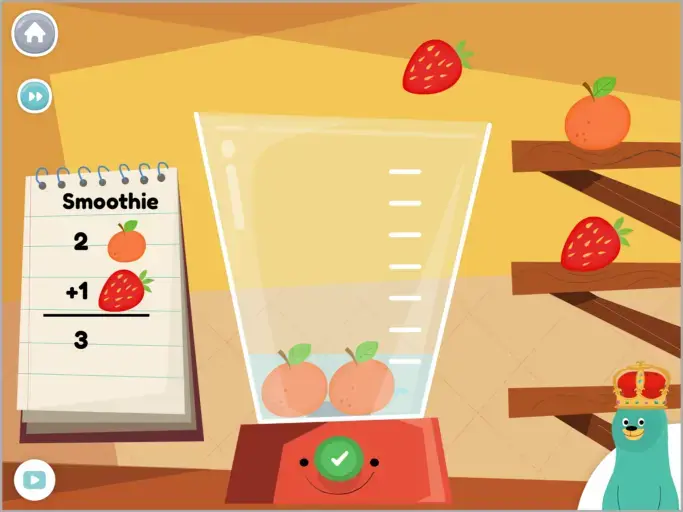
3. ST Math
Ages: PreK to Grade 8.
ST Math is a PreK-8 visual puzzle program where children work through wordless puzzles with JiJi the penguin, figuring out how the math behaves rather than being told a rule and practising it.
It teaches with almost no text at all. The company states that ST Math is designed with minimal written text and aims for a learning environment with optimal visual complexity, reducing the cognitive load and working memory required. For a child who finds language a barrier, or who's learning in a second language, that is genuinely rare.
One issue for families though is that it is only available as a school subscription (though it can be accessed for free for homeschooling, until further notice).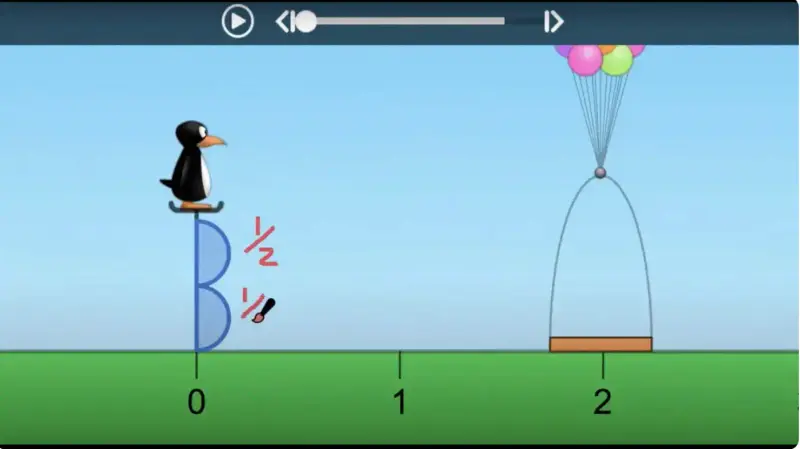
4. Happy Numbers
Cost: $99 per student per year, $49 for each additional child.
Ages: PreK to Grade 5.
Happy Numbers places your child with a short assessment, then builds an individual pathway of guided tasks. Sessions run about fifteen minutes.
What it does better than anything else here is handle getting stuck. Rather than marking an answer wrong and moving on, a guide character breaks the problem into smaller steps and walks your child through it mid-attempt. For a child who finds being wrong hard to recover from, that timing matters more than it sounds. The teaching follows a concrete-pictorial-abstract progression at each grade with virtual manipulatives throughout, and instructions stay light enough on text that a pre-reader can work independently. It holds an ESSA Tier 3 "Promising Evidence" rating.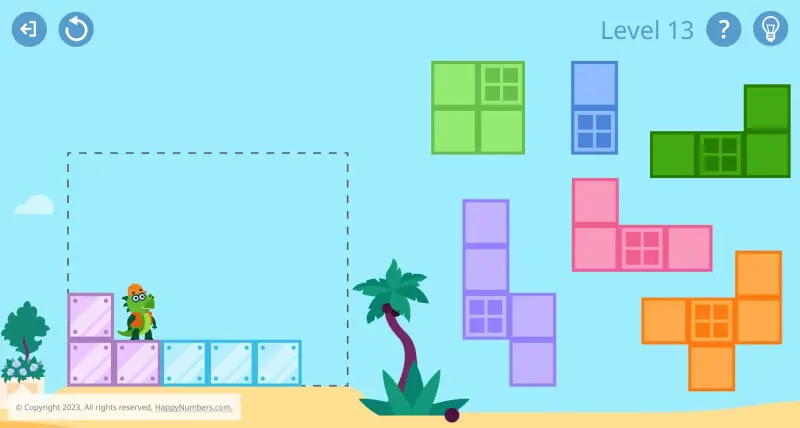
5. Todo Math
Cost: Free to download with in-app purchases; Apple lists annual subscriptions from $49.99 to $99.99.
Ages: Pre-K to Grade 2.
Todo Math is a collection of more than twenty games for Pre-K to Grade 2, covering counting, number tracing, addition, subtraction, multiplication and telling time. Children can follow curated missions or pick freely.
Enuma built it on the Universal Design for Learning framework, and its published design document backs that up with options the others don't document: a left-handed mode that flips the layout so a left-handed child isn't reaching across their own work, the OpenDyslexic font, a keypad input mode, and a Help Button that lets a stuck child reveal an answer they've already attempted rather than waiting for an adult.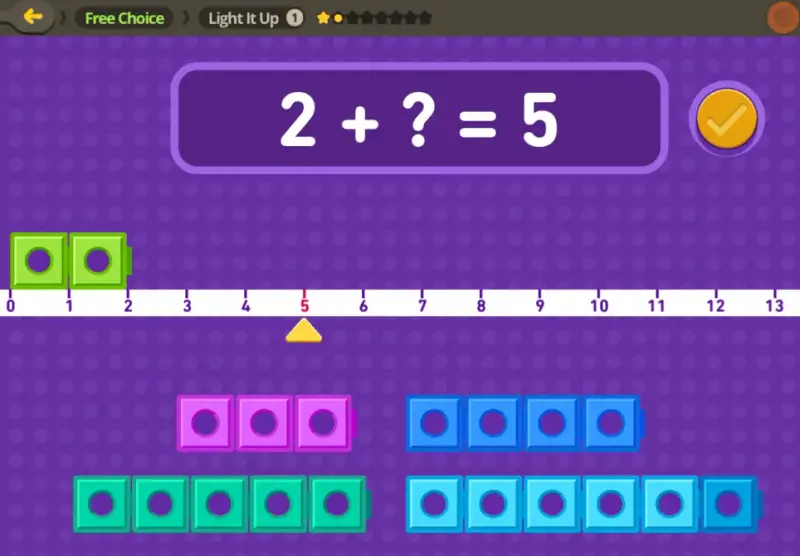
Setting up any app for an autistic child
Whichever you choose, five minutes of setup before your child first opens it is worth more than the choice itself.
Go into settings yourself and turn off everything that can be turned off, starting with music. Do this before the first session, because taking away a sound a child has already got used to is much harder than never introducing it.
Then agree on what a session looks like and keep it identical. Same place, same device, same rough time, a set number of levels rather than a set number of minutes. A finish line your child can see is easier than one that depends on a clock.
Preview the app yourself once, all the way through a level. You're looking for the thing that will bother your child specifically, which might be a sound effect, a character's voice, or a failure animation. Better to find it before they do.
And keep an offline option running alongside. Screens are not the only route, and our sensory-friendly math games for autistic kids covers activities that work for children who've had enough of worksheets and screens both.
Summary
FAQs
What is the best math app for an autistic child?
No single app suits every autistic child, and none of the ones here meets every criterion. What matters is which thing your child actually struggles with: a full mute if sound is the issue, a wordless app if reading is the barrier, mid-problem scaffolding if being wrong is what derails a session.
Are autistic children naturally good at math?
No. That's a stereotype rather than a finding. In one study of autistic adolescents matched with peers on age and IQ, 22% showed math achievement indicative of a mathematics learning disability and only 4% showed mathematical giftedness. Autistic children's math ability varies enormously, as it does for any group.
Why does turning off sound matter so much?
Auditory filtering, meaning the ability to focus on something while background sound competes, is an area where autistic children show greater difficulty on average than typically developing peers. Background music during a math task asks a child to manage sensory input and mathematics at the same time. Removing it removes one of those demands entirely.
My autistic child gets upset when they get something wrong. What should I look for?
Check how each app handles incorrect answers before your child uses it. Some respond with an animation demonstrating why the attempt failed, which certain children find distressing. Look for apps that answer a wrong answer by adding support and slowing down rather than by dramatising the error.
References
Oswald, T. M., Beck, J. S., Iosif, A.-M., McCauley, J. B., Gilhooly, L. J., Matter, J. C., & Solomon, M. (2016). Clinical and cognitive characteristics associated with mathematics problem solving in adolescents with autism spectrum disorder. Autism Research, 9(4), 480–490. https://escholarship.org/content/qt0555k2gx/qt0555k2gx.pdf
Crasta, J. E., Salzinger, E., Lin, M.-H., Gavin, W. J., & Davies, P. L. (2020). Sensory processing and attention profiles among children with sensory processing disorders and autism spectrum disorders. Frontiers in Integrative Neuroscience, 14, 22. https://www.frontiersin.org/journals/integrative-neuroscience/articles/10.3389/fnint.2020.00022/full
Neil, L., Olsson, N. C., & Pellicano, E. (2016). The relationship between intolerance of uncertainty, sensory sensitivities, and anxiety in autistic and typically developing children. Journal of Autism and Developmental Disorders, 46(6), 1962–1973. https://link.springer.com/article/10.1007/s10803-016-2721-9
Gunn, K. G. M., & Delafield-Butt, J. T. (2016). Teaching children with autism spectrum disorder with restricted interests: A review of evidence for best practice. Review of Educational Research, 86(2), 408–430. https://strathprints.strath.ac.uk/54357/20/Gunn_Delafield_Butt_RER_2015_Teaching_children_with_autism_spectrum_disorder_with_restricted_interests.pdf