TL;DR: A child who can calculate but freezes on word problems isn't being careless. Word problems ask for several things that aren't math, and your child is usually stuck on just one of them. Working out which one tells you what to practice.
Your child multiplies three-digit numbers in their head. They know the times tables cold. Then they hit "Sam has 5 apples and gives 2 to his sister," and everything stops.
It's a strange thing to watch, and it's easy to read it as not trying, or not paying attention. Usually it's neither. The two tasks look related but ask for almost entirely different things.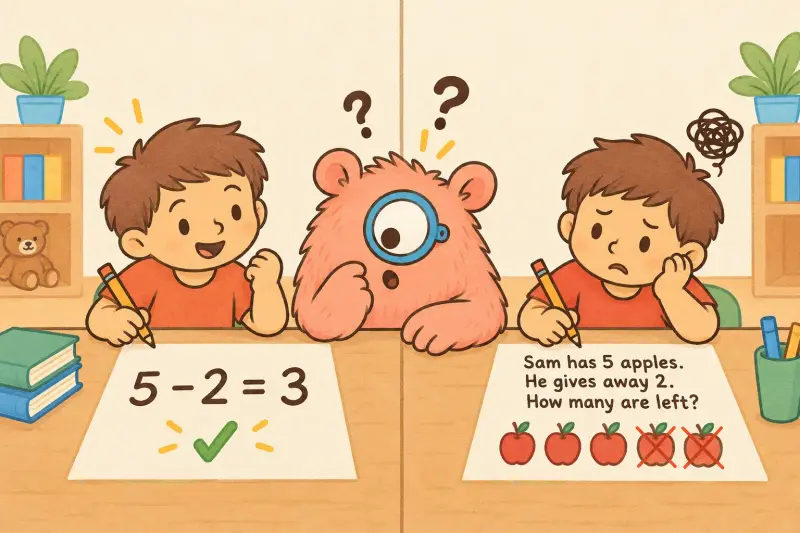
What makes a word problem hard
Knowing how to calculate and knowing what to calculate are two different skills. A child can be fluent at one and stuck on the other.
Researchers gave eight word problems to autistic children aged six to twelve and to non-autistic classmates matched for age and school. More than twice as many autistic children answered two or fewer problems correctly: 57%, compared with 23% of their classmates.
That doesn't mean every autistic child struggles with word problems. Some performed just as well as their non-autistic peers. But in this small study, a significantly larger proportion of autistic children fell into the lowest-scoring group.
And not every word problem is equally difficult.
One study looked at more than 28,000 eighth graders taking a national math test. It compared autistic students only against classmates who were already at the same math level, so the comparison wasn't about who was better at math overall. Autistic students did better and faster on picture-based problems, like identifying shapes, but worse on word problems with complicated language or a social situation in them.
A real example from that test helps. One of the questions autistic students struggled with asked them to work out the distance between two towns on a map. Others in the same group involved comparing two gym membership plans, and reading a graph of pets that classmates had at home. Each one asks a child to build a picture of a real situation involving other people before any math begins.
A separate study found the same strength from the other direction. Looking at what predicted autistic adolescents' success on applied math problems, visual and spatial reasoning came out as the strongest predictor, ahead of verbal ability. So a problem your child can see is working with their strength, and one they have to assemble in their head from a story is working against it.
So rather than assuming your child struggles with all word problems, look at what makes the difficult ones different. Is it the language? The real-world situation? Or figuring out which calculation to use?
Word problems ask for a pile of things that aren't math
Here's everything your child has to get through before any arithmetic happens.
Read the sentences. Hold them in mind while reading the next one. Decide which details matter and which are scenery. Draw on everyday knowledge about apples and sisters and sharing. And work out what the question actually wants, which is almost never stated directly.
Only then do they reach the part they're good at.
A bare calculation skips all of it. The holding alone is a real load, and our guide to working memory covers why that step alone trips up so many children.
It's not only about understanding the words
A child can read every word in a problem, know what each one means, and still not know what to do with it.
In one study, researchers looked at why some autistic children aged six to twelve did better on word problems than others. Three skills were linked to how well they performed: understanding language, resisting the urge to respond too quickly, and understanding what someone else is thinking or wanting.
That third skill is called theory of mind. The researchers describe its connection to word-problem solving as a new finding.
It sounds like an odd skill to need for math. But a word problem is always someone asking for something without quite saying what. Before any arithmetic happens, your child has to work out what that person is after.
A second study found that autistic teenagers did about as well as their classmates on straightforward word problems, and fell behind on the ones that needed them to plan an approach and check whether it made sense.
So the sticking point often isn't the arithmetic. And it's rarely only the reading.
Here's a problem that shows what that looks like.
Tom has 12 stickers. Ben has 4. Tom wants them both to have the same number. How many stickers should Tom give Ben?
Every word is easy. The math is easy. But plenty of children will answer 8, because 12 minus 4 is 8 and those are the numbers on the page. The answer is 4. Getting there means working out what Tom is trying to do before touching the numbers at all.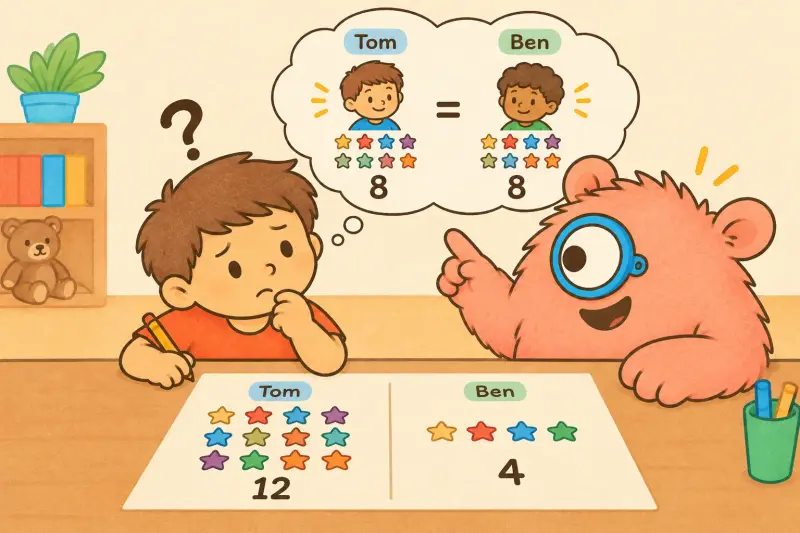
How to find out which part is hard for your child
This takes one sitting. Use problems well inside your child's computation level, so arithmetic is never what's in the way.
1. Test the two separately
Write five bare calculations, then five word problems using those exact same calculations. If one sum is 12 minus 5, one word problem should also come out to 12 minus 5. Keeping the numbers identical takes difficulty off the table, so any difference you see has to be the wrapping rather than the math.
If the bare ones come out right and the worded ones don't, the gap is in how the problem is presented, and the next four steps will narrow down where. If some of the bare ones are wrong too, that's worth knowing. It means the calculations need work first, because word problems will stay hard until those are solid.
Do this even if you're sure you know the answer. Fluent calculation can sit on top of gaps, and it's where parents are most often surprised.
2. Read it out loud to them
Take a word problem they just got wrong and read it aloud while they look at it.
If they solve it now, reading was the bottleneck, and that's one of the easier things to work around. If they still can't start, reading was never the issue, and no amount of text-to-speech will help. This single question saves people months of working on the wrong thing.
3. Ask what the question wants, and don't let them solve it
This is the most informative step, and based on the research it's the one most likely to find your answer. Be patient with it.
Read the problem and ask: "What are they asking you to find out?" Not the answer. Just the question. If your child says "how many he has left," they've understood it. If they say "five and two," or go quiet, or start computing immediately, they're pattern-matching on the numbers without having worked out the request.
Try four or five problems before concluding anything, since one miss could be anything. A consistent pattern here points straight at the thing the studies keep landing on.
4. Swap the social frame for a plain one
This step tests the specific finding from the eighth-grade data, and it's quick.
Take a problem with people and intentions in it: "Sam has 5 apples and gives 2 to his sister." Now write the same math with the people removed: "There are 5 apples. Take away 2." Then try a visual version, with five circles drawn and two crossed out.
If your child manages the plain or visual version and not the social one, you've found it, and it's a specific enough target to actually work on. Keep a few of each kind around so you can retest in a month.
5. Check what extra detail does
Give a problem with one irrelevant fact in it. "Sam has 5 apples. His sister is 7 years old. He gives her 2 apples."
Plenty of children will try to use the 7. If yours does, filtering is the skill to build, and the short-term fix is simple. Cross out the irrelevant sentence together before starting, until they begin doing it on their own.
What to do once you know
Each result points somewhere different, which is the whole reason for checking.
If reading was the barrier, read problems aloud and let them re-read as often as they like. If working out the request was the barrier, teach the problem types explicitly, the handful of shapes most problems come in, and name out loud what each one is asking for. If the social framing was the barrier, strip it out for now and add it back gradually once the math is secure. If the computation underneath turned out shaky, that's the real work, and it's better news than it feels like.
Our earlier guide to why autistic kids struggle with word problems has more of the day-to-day supports for each of these.
What to take away
Your child isn't being inconsistent or careless. Being strong at one part of math and stuck on another is what math usually looks like in autistic children.
The stuck part is also probably smaller than it feels right now. It may not be word problems as a whole. It may be one specific moment: working out what the question is asking them to do.
That's a skill, which means it can be taught. The place to start is finding out whether it's really what's going on for your child, using the steps above.
FAQs
Why can my autistic child do hard calculations but not simple word problems?
Because the two ask for different things. A calculation needs arithmetic. A word problem needs reading, holding information in mind, filtering irrelevant detail, everyday knowledge, and working out what's being asked, all before the arithmetic starts. Research comparing autistic students with peers at the same math level found the gap showed up specifically on word problems with complex language or social context, not on math itself.
Is it normal for autistic children to have an uneven math profile?
Yes. A study of 121 autistic children in mainstream classrooms found a profile of strengths, average abilities and weaknesses across different areas of math rather than one consistent level. Uneven is the norm. What differs between children is where the strong and weak spots fall.
Is it the reading that's the problem?
Sometimes, but often it’s not the whole story. The quickest way to check is to read a word problem aloud to your child while they look at it. If they can solve it once they've heard it, reading was the bottleneck. If they still can't begin, the difficulty is in working out what the question wants, which is where the research most often points.
Are autistic children naturally good at math?
Less often than the stereotype suggests. In a study of autistic adolescents with average IQ scores, 22% met criteria for a mathematics learning disability while only 4% were mathematically gifted. Fluent calculation and a strong interest in numbers can both look like talent without reflecting a solid grasp of the concepts underneath.
My child is obsessed with numbers. Does that mean they'll be good at math?
Not by itself. About 36% of autistic children develop an intense interest in numbers, often by around 30 months, and research found those same children showed lower number competence than comparison groups despite the higher interest. The interest is a real strength to build on, and it isn't evidence of skill on its own.
Should I teach keyword tricks for word problems?
Be careful with them. Rules like "altogether means add" work on simple problems and fail on anything that breaks the pattern, and they let a child produce correct answers without understanding the question. Since the evidence points at question comprehension as the sticking point, a trick that bypasses comprehension is working against you.
References
Cohen, O., & Sukenik, N. (2026). Mathematical proficiency in adolescents with ASD. Journal of Autism and Developmental Disorders, 56(4), 1382–1397. https://link.springer.com/10.1007/s10803-024-06645-3
Ostrolenk, A., Gagnon, D., Boisvert, M., Lemire, O., Dick, S.-C., Côté, M.-P., & Mottron, L. (2024). Enhanced interest in letters and numbers in autistic children. Molecular Autism, 15, 26. https://pmc.ncbi.nlm.nih.gov/articles/PMC11170776/
Oswald, T. M., Beck, J. S., Iosif, A.-M., McCauley, J. B., Gilhooly, L. J., Matter, J. C., & Solomon, M. (2016). Clinical and cognitive characteristics associated with mathematics problem solving in adolescents with autism spectrum disorder. Autism Research, 9(4), 480–490. https://escholarship.org/uc/item/0555k2gx
Polo-Blanco, I., Suárez-Pinilla, P., Goñi-Cervera, J., Suárez-Pinilla, M., & Payá, B. (2024). Comparison of mathematics problem-solving abilities in autistic and non-autistic children: The influence of cognitive profile. Journal of Autism and Developmental Disorders, 54(1), 353–365. https://pmc.ncbi.nlm.nih.gov/articles/PMC10791875/
Titeca, D., Roeyers, H., Loeys, T., Ceulemans, A., & Desoete, A. (2015). Mathematical abilities in elementary school children with autism spectrum disorder. Infant and Child Development, 24(6), 606–623. https://backoffice.biblio.ugent.be/download/5855802/5855804
Wei, X., Zhang, S., Zhang, J., & Yu, J. (2023). Mathematics performance, response time, and enjoyment of eighth-grade autistic students and their general education peers. Autism, 27(8), 2518–2529. https://jihongzhang.org/research/publications/2023/Mathematics%20performance%2C%20response%20time%2C%20and%20enjoyment%20of%20eighth-grade%20autistic%20students%20and%20their%20general%20education%20peers.pdf