TL;DR: Children with both autism and ADHD (sometimes called AuDHD) face a unique tangle of math challenges - the working memory and attention difficulties of ADHD layered on top of autism's rigidity and sensory sensitivities. But this combination also brings real strengths, including strong pattern recognition and the capacity for deep focus. Supporting these kids means reducing working memory demands with visual tools, building predictable routines that still leave room for movement and variety, and leaning into their interests to make math feel worth the effort.
If your child has both autism and ADHD, you already know that advice designed for one condition doesn't always fit. The ADHD parenting book says "keep things novel and exciting." The autism guide says "stick to a routine." Your kid needs both, somehow, at the same time.
Math class is where this tension shows up fast. The subject demands sustained attention (hard with ADHD), flexible thinking across different problem types (hard with autism), and a working memory strong enough to hold numbers in your head while you figure out what to do with them (hard with both). Around 40 to 70 percent of autistic children also meet criteria for ADHD - so this is far from a rare combination. Understanding how the two conditions interact, specifically around math, is the first step toward actually helping.
Why AuDHD Creates a Distinct Math Profile
Autism and ADHD each affect math learning, but when they co-occur, the difficulties don't just add up - they interact in ways that can be hard to untangle.
Working memory has to work extra hard. In a 2024 study, autistic students scored lower than typically developing students across several math tasks, including arithmetic facts, mental calculation, math reasoning, and problem solving. The interesting part was that their arithmetic-fact performance depended more strongly on verbal ability and verbal working memory than it did for their peers. In typical development, math facts usually become more automatic over time, which reduces the load on working memory. But in this study, autistic students seemed to rely more on verbal resources to retrieve those facts, suggesting the facts were less automatic for them.
For an AuDHD child, that can make multi-step math especially tiring. If working memory is already a weak spot, and basic facts still need active mental effort, there is less brain space left for the actual problem: choosing a strategy, remembering the steps, and checking the answer. So the issue may not be that the child “doesn’t know math.” It may be that too much of their working memory is being used up before they even get to the main task.
Executive function challenges don’t split neatly into “ADHD problems” and “autism problems.” You might think ADHD mainly affects impulse control, while autism mainly affects switching between tasks. But a 2024 meta-analysis found that children with ADHD and children with autism looked very similar on executive function tests. Both groups had more difficulty than typically developing children, and the differences between ADHD and autism were not clear across areas like inhibition, flexibility, working memory, planning, and problem solving.
The same study also found that children with both ADHD and autism had more executive function difficulty than children with autism alone, and their pattern looked more like ADHD. For parents, the takeaway is simple: an AuDHD child may not be facing two separate sets of challenges. The difficulties can overlap and become harder to manage, especially in multi-step math, where the child has to remember information, stay focused, and change strategies when needed.
Sensory and attention needs can pull in opposite directions. An autistic child might need a quiet, low-stimulation environment to focus. But that same child's ADHD brain might need some level of novelty or movement to stay engaged. A completely silent room can feel under stimulating for the ADHD side; a busy, colorful classroom can overwhelm the autistic side. Finding the middle ground matters enormously for math, where sustained, focused thinking is the whole game.
The Strengths AuDHD Brings to Math
It would be a mistake to frame this only as a deficit story. Many AuDHD kids have genuine mathematical strengths that get overlooked when the focus stays on what's hard.
Autistic pattern recognition is well-documented. Studies using tasks like Raven's Progressive Matrices have found that autistic spectrum individuals show a significant advantage on tasks requiring them to identify rules and relationships within complex visual patterns, scoring well above what standard IQ tests would predict. That kind of thinking - spotting the underlying structure - is exactly what algebra, geometry, and data analysis reward. The ADHD side of the equation can contribute too: hyper focus, when it kicks in on a topic that genuinely interests the child, can produce surprisingly deep engagement with mathematical problems.
The key is creating conditions where these strengths can actually show up, instead of being buried under working memory overload and sensory distress.
Practical Strategies for Supporting AuDHD Math Learners
Separate checklists for autism and ADHD won't cut it. These kids need a math learning environment designed for the whole child, and that means strategies that account for both at once.
Reduce working memory load with external visuals. Since both conditions tax working memory, anything that moves information out of the child's head and onto paper or screen helps. Step-by-step checklists for multi-step problems. Color-coded operations (green for addition, red for subtraction). Worked examples they can reference while solving similar problems. The 2024 study on autistic math learners specifically recommended using visual aids to support students in remembering procedures and focusing on relevant aspects of problems, and that recommendation applies doubly when ADHD is also in the mix.
Build a predictable routine with variation inside it. The autism side of your child's brain craves similarity. The ADHD side gets bored if it's the same thing every day. The solution: a consistent structure with rotating content. For example, math time always starts with a 2-minute warm-up, then a short lesson, then practice - but the warm-up rotates between estimation games, pattern puzzles, and number talks. The container stays the same; what's inside it changes. This gives both the predictability and the novelty your child needs.
Make the sensory environment work for both brains. Experiment to find your child's sweet spot. Noise-cancelling headphones can help with auditory overload, while a fidget tool or wobble cushion gives the ADHD brain something to do with excess energy. Keep the visual workspace clean - one problem visible at a time, not a sheet of 30. If your child does math at home, let them choose a spot that works: some AuDHD kids do best standing at a whiteboard, others curled up in a beanbag with a clipboard. Our guide on neurodivergent math learning strategies covers sensory environment tweaks in more depth.
Use interests as on-ramps. If your child is obsessed with trains, dinosaurs, Minecraft, or weather systems, those passions are not distractions from math - they're leverage. Word problems about train schedules, graphing dinosaur lengths, calculating Minecraft block volumes - these feel like playing, not work. For an AuDHD child who struggles to initiate boring tasks but can lock in for hours on something that sparks their interest, this kind of contextualization is the difference between "I can't do math" and "I didn't even notice I was doing math."
Break problems into explicit, named steps.Multi-step problems are where AuDHD kids most often get lost. The ADHD side loses track of where they are; the autism side struggles when the problem requires a mid-course shift in strategy. Teach them to name each step aloud or write it down: "Step 1: Read the problem. Step 2: Underline the numbers. Step 3: Decide the operation." This externalizes the executive function process that their brain finds hard to run silently. Over time, these scaffolds can be faded, but there's no rush. Our guide on visual organizers for multi-step math has specific templates you can start with.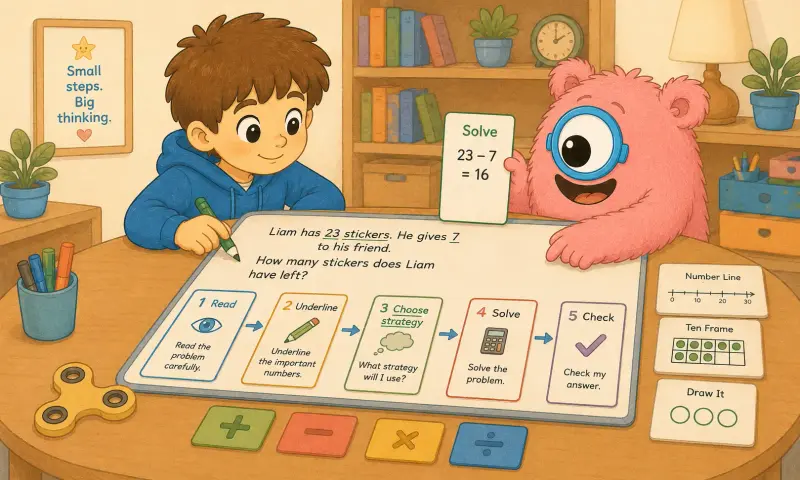
Ditch timed drills. Timed math tests are a lose-lose for AuDHD kids. The time pressure spikes anxiety for the autistic brain, while the ADHD brain struggles to regulate attention under stress - rushing through some problems and freezing on others. Neither side gets to show what it actually knows. Research has found that autistic boys performed worse and reported higher worry and emotional arousal than non-autistic peers under time pressure, and math anxiety hits neurodivergent learners especially hard. Untimed practice that builds accuracy first - and lets speed develop naturally - is the way to go.
When to Seek Additional Support
If your child is consistently struggling despite these adjustments, a psycho educational evaluation can clarify whether a specific math learning disability like dyscalculia is also present. The overlap among autism, ADHD, and dyscalculia is real - and knowing what you're dealing with shapes the intervention. An IEP or 504 plan can formalize accommodations like extended time, use of calculators, and reduced problem sets, which take the edge off math for AuDHD kids and let their actual understanding show.
You don't have to wait for perfect conditions to start helping. Small changes - one visual checklist, one sensory tweak, one word problem about their favorite topic - add up. The research is clear that these kids have genuine mathematical potential. The challenge is building an environment where it can surface.
FAQs:
How common is it to have both autism and ADHD?
Quite common. Estimates vary by study, but around 40 to 70 percent of autistic children also meet criteria for ADHD. The DSM-5, published in 2013, was the first edition to allow a dual diagnosis, so our understanding of the overlap has deepened significantly in the past decade.
Will my AuDHD child always struggle with math?
Not necessarily. Many AuDHD kids have strong pattern recognition, logical reasoning, and the capacity for deep focus - all assets in math. The struggles tend to come from working memory overload, sensory issues, and poorly matched instruction, not from a lack of mathematical ability. With the right supports, many AuDHD children do well in math and some genuinely excel.
Should I prioritize autism strategies or ADHD strategies for math?
Neither exclusively. The two conditions interact, so strategies need to account for both. A predictable routine (autism) with built-in variety (ADHD), a quiet workspace (autism) with a fidget tool (ADHD), explicit step-by-step instruction (autism) broken into short chunks (ADHD). Think of it as designing for the whole child, not treating two separate conditions.
Does AuDHD increase the risk of dyscalculia?
Research on dyscalculia specifically in AuDHD populations is still thin. We do know that both autism and ADHD independently raise the risk of math learning difficulties, and that the executive function challenges common to both conditions - especially working memory - are the same cognitive skills that underpin mathematical learning. If your child is struggling significantly despite good instruction and support, a dyscalculia evaluation is worth pursuing.
Are math apps helpful for AuDHD kids?
They can be, when designed well. Game-based math apps like Monster Math provide the novelty and immediate feedback that the ADHD brain responds to, within a structured, predictable format that suits the autistic brain. The key is choosing apps that build understanding rather than just drilling speed, and that allow the child to work at their own pace without time pressure.
References
Tonizzi, I. & Usai, M.C. (2024). Cognitive correlates of math abilities in autism spectrum disorder. PLOS ONE, 19(9), e0310525. https://journals.plos.org/plosone/article?id=10.1371/journal.pone.0310525
Ceruti, C., Mingozzi, A., Scionti, N. & Marzocchi, G.M. (2024). Comparing Executive Functions in Children and Adolescents with Autism and ADHD - A Systematic Review and Meta-Analysis. Children, 11(4), 473. https://www.mdpi.com/2227-9067/11/4/473
Martinez, S., Stoyanov, K. & Carcache, L. (2024). Unraveling the spectrum: overlap, distinctions, and nuances of ADHD and ASD in children. Frontiers in Psychiatry, 15, 1387179. https://www.frontiersin.org/journals/psychiatry/articles/10.3389/fpsyt.2024.1387179/full
Lievore, R. & Mammarella, I.C. (2024). Trait and state mathematics anxiety in autistic and non-autistic school-aged boys. Autism, 29(5), 1209–1223. https://pmc.ncbi.nlm.nih.gov/articles/PMC12038072/
Soulières, I., Dawson, M., Gernsbacher, M.A. & Mottron, L. (2011). The Level and Nature of Autistic Intelligence II: What about Asperger Syndrome? PLOS ONE, 6(9), e25372. https://journals.plos.org/plosone/article?id=10.1371/journal.pone.0025372