TL;DR: A good math IEP goal names a specific skill, the exact condition the child will work under, and a measurable criterion - not "will improve in math." Below are 50 sample goals organized by grade band and skill area, covering number sense, computation, fractions, and pre-algebra. Use them as starting points and rewrite the condition and criterion to match your child's actual present levels, not as goals to copy-paste as-is.
If you've ever sat in an IEP meeting and heard "will improve math skills" read out as an annual goal, you already know the problem. A goal like that can't be measured, can't be disproven, and gives the teacher no real target to teach toward. Even experienced teachers write better IEP goals once they're trained specifically on how to do it. Writing a goal that's actually useful isn't a skill people just pick up on their own.
This list exists to make that easier. Fifty sample math goals, grouped by grade band and skill, written in a format you can adapt in minutes rather than build from scratch. They're meant for parents prepping for an IEP meeting, teachers building a goal bank, or anyone who wants to see what "specific and measurable" actually looks like in math.
What makes a math IEP goal actually work
Every goal below follows the same basic shape: condition, behavior, criterion. That means each goal spells out what materials or support the child has (condition), exactly what they'll do (behavior), and how you'll know they've met it (criterion, usually an accuracy percentage across a set number of trials or sessions).
That structure isn't just a formatting habit. A meta-analysis of math interventions for students with learning disabilities found the strongest programs were the ones that targeted specific, well-defined skill deficits rather than general math ability. A goal that just says "improve math" can't be targeted that way - there's nothing specific for instruction to aim at. Naming the exact skill (regrouping in subtraction, unit rates, whatever it is) is what lets a teacher actually plan for it.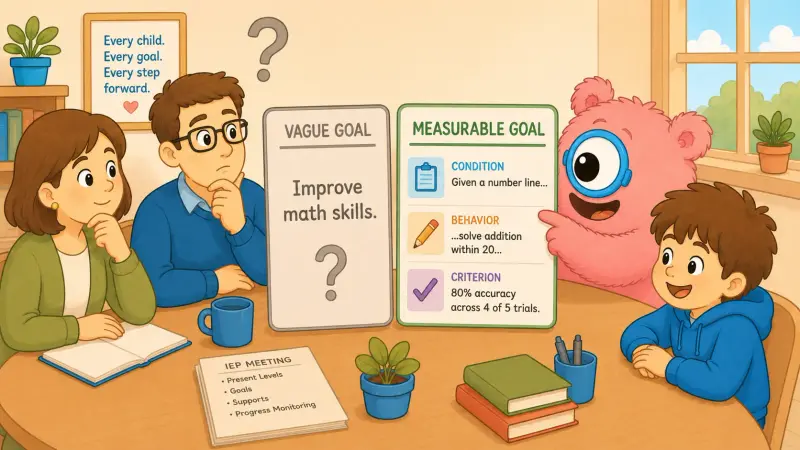
How to use this list
None of these goals should go into an IEP word-for-word. The grade bands and criteria here are typical starting points, not a fit for any particular child. Before you use one, check it against three things: your child's actual present level (what can they do right now, with what support), the timeframe your team is realistic about, and whatever progress-monitoring tool the school already uses. Our guide on building a math IEP that actually helps covers how present levels, goals, and accommodations should connect to each other - worth a read before your next meeting if you haven't already tied those three pieces together.
Grades K–2: Building number sense
Grades 3–5: Multiplication, division, fractions, and geometry
Grades 6–8: Ratios, integers, pre-algebra, and data
Making these goals neurodivergent-friendly
The criteria above are deliberately generic - "80% accuracy across 3 of 4 trials" is a starting point, not a fixed rule. What matters more for a neurodivergent learner is often how the child gets to that answer, not just the accuracy number attached to it.
For kids with dyscalculia, the struggle is not a lack of effort or general intelligence. Research points to differences across brain systems involved in number sense, mapping written symbols to quantities, visuospatial working memory, memory retrieval, and cognitive control. This can make basic quantities, number symbols, and mathematical problem-solving unusually difficult, even when a child is otherwise capable and engaged. That's a strong argument for writing the condition of a goal carefully -"using base-ten blocks" or "using a number line" isn't a crutch, it's often the actual accommodation that makes the skill accessible in the first place.
One instructional sequence worth building directly into a goal's condition is concrete-representational-abstract, or CRA: a child works with physical objects first, then pictures, and only later moves to numbers and symbols alone. In explicit-instruction studies, students taught with the CRA sequence showed stronger gains in both understanding and retention than students taught with symbols alone. If a goal in this list feels like too big a jump for a particular child, adding a concrete or representational step to the condition - rather than lowering the accuracy target - is usually the better fix.
Tracking progress without a full CBM toolkit
A goal is only as useful as the way you check it. You don't need a formal curriculum-based measurement system to track most of these - a two-minute weekly probe, a checklist, or a simple chart the child fills in themselves works for most classroom and home settings.
Self-monitoring especially helps kids who struggle with working memory and sustained attention, since it turns "did I get this right" into something the child tracks themselves rather than something that only happens at review time. Our post on goal-setting and self-monitoring for young mathematicians with ADHD walks through simple checklist and charting systems that pair well with any of the goals above - useful whether or not ADHD is part of the picture.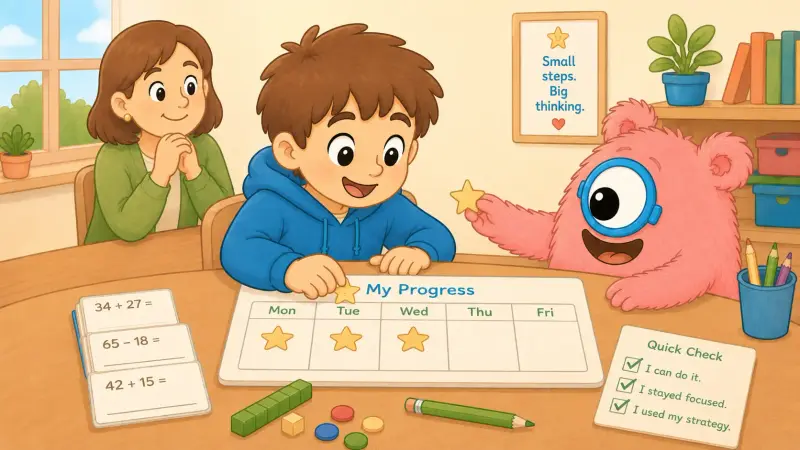
From goal bank to working IEP
A list like this is a shortcut for the writing part of goal-setting, not a replacement for the thinking part. The goal that actually helps a child is the one written after someone has looked closely at what that specific student can and can't yet do, in what conditions, and why. Start with present levels, borrow the structure and language from whichever goals above are closest to your child's real skill gaps, then adjust the condition, timeframe, and criterion until the goal describes progress that's both realistic and worth working toward.
FAQs:
How many math goals should be in an IEP?
There's no fixed number, but most IEP teams focus on two to four well-written math goals rather than a long list of vague ones. A smaller set of specific, measurable goals is easier to actually teach toward and track than a long list that spreads instruction too thin.
What's the difference between a goal and an objective?
A goal describes what a student should be able to do by the end of the IEP year. Objectives (when a team uses them) are the smaller, sequential steps that build toward that goal - for example, solving addition within 10 before addition within 20.
Can I use these goals exactly as written?
You can use them as a starting template, but the condition, criterion, and timeframe should always be adjusted to match your child's current present levels. A goal copied without that adjustment risks being either too easy to be meaningful or too hard to be realistic.
Why do IEP goals use "80% accuracy across 3 trials" so often?
That phrasing gives a goal a clear, observable finish line - a specific percentage and a specific number of times the student has to hit it, so mastery isn't based on a single lucky day. The exact numbers can and should be adjusted based on the skill and the student.
What if my child's math goals keep getting missed year after year?
That's usually a sign the goal, the instruction, or the accommodations need to change - not that the child isn't trying. Bring data from progress monitoring to the next IEP meeting and ask specifically what's changing about the approach, not just the goal's wording.
Do these goals work for both IEPs and 504 plans?
These are written as IEP annual goals, which 504 plans don't typically include - a 504 plan focuses on accommodations rather than measurable goals. That said, the skill breakdowns here can still help a parent or teacher get specific about what a child needs, even outside a formal IEP goal.
References:
Pretti-Frontczak, K., & Bricker, D. (2000). Enhancing the Quality of Individualized Education Plan (IEP) Goals and Objectives. Journal of Early Intervention. https://files.eric.ed.gov/fulltext/EJ609760.pdf
Gersten, R., et al. (2009). Mathematics Instruction for Students with Learning Disabilities or Difficulty Learning Mathematics. Center on Instruction. https://files.eric.ed.gov/fulltext/ED521890.pdf
Kaya, S., & Guner Yildiz, N. (2023). Using the Concrete–Representational–Abstract Sequence to Teach Math Skills to a Student with Autism Spectrum Disorder in a General Education Classroom. International Journal of Developmental Disabilities, 70(8), 1398–1409. https://pmc.ncbi.nlm.nih.gov/articles/PMC11660403/
Menon, V., Padmanabhan, A., & Schwartz, F. (2020). Cognitive Neuroscience of Dyscalculia and Math Learning Disabilities. In Oxford Handbook of Developmental Cognitive Neuroscience. Oxford University Press. https://med.stanford.edu/content/dam/sm/scsnl/documents/MenonPadmanabhanSchwartz_Cognitive-neuroscience-of-dyscalculia-and-math-learning-disabilities.pdf