TL;DR: By the end of third grade, most kids can multiply and divide fluently within 100, understand fractions as equal parts of a whole, find the area of a rectangle by tiling and multiplying, round numbers, and solve two-step word problems using all four operations. Third grade is the year math shifts from adding and counting to multiplying and reasoning about parts of a whole - a genuinely different way of thinking, not just bigger numbers. Steady progress across the year matters more than hitting every skill by a set date.
Second grade was about getting fast and flexible with addition and subtraction. Third grade asks a child to build an entirely new operation on top of that - and then use it to understand a completely different kind of number. Multiplication isn't just repeated addition dressed up in a new symbol; division isn't just multiplication in reverse until a child has actually made that connection themselves; and fractions ask a child to accept that 1/2 is a single number, not two numbers stacked on top of each other. Each of those is a real conceptual jump on its own, and third grade asks for all three in the same nine months - which is why sometimes a child who breezed through second grade can suddenly hit a wall here, and why sometimes another child who struggled before sometimes can sometimes find their footing once the material stops being purely about speed.
No two kids will move through this list in the same order. A child might nail multiplication facts by Halloween and still be puzzling over what 3/4 means in April, or the reverse. Neurodivergent kids especially tend to land on these skills out of sequence - strong in one area well ahead of grade level, still building foundations in another - and that pattern on its own isn't cause for concern.
What third grade actually covers
Third grade math in the US, like most grades, follows the national math standards that most U.S. states build their curriculum around. Four things get the bulk of the attention this year: multiplying and dividing fluently within 100, understanding fractions - especially unit fractions like 1/3 or 1/4 - as numbers in their own right, connecting area to multiplication, and describing two-dimensional shapes by their properties. What each of those actually looks like day to day is below.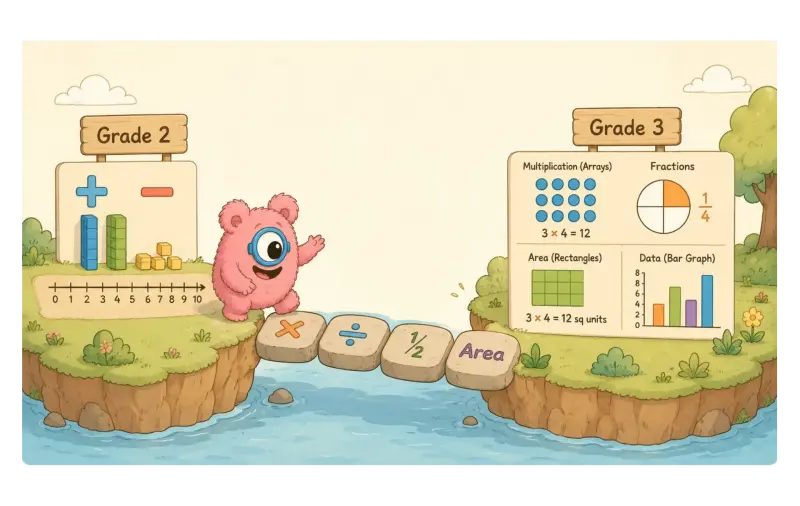
The multiplication and division leap
Nothing else this year carries as much weight as this. By end of the year, most third graders can:
Interpret products of whole numbers - understanding 5 x 7 as the total number of objects in 5 groups of 7 objects each
Interpret whole-number quotients - understanding 56 ÷ 8 as the number of objects when 56 objects are partitioned into 8 equal groups, or the size of each group when 56 objects are partitioned into groups of 8
Use multiplication and division within 100 to solve word problems in situations involving equal groups, arrays, and measurement quantities
Determine the unknown number in a multiplication or division equation relating three whole numbers (like 8 x ? = 48)
Apply properties of operations as strategies to multiply and divide - understanding, for instance, that 6 x 7 can be found from knowing 6 x 5 = 30 and 6 x 2 = 12, then adding 30 + 12
Understand division as an unknown-factor problem, connecting it directly back to multiplication
Fluently multiply and divide within 100, and know all products of two one-digit numbers from memory by the end of the year
Solve two-step word problems using all four operations, representing them with equations and assessing whether the answer is reasonable
The biggest trap here is treating multiplication as something to memorize before it's understood. A child who can recite that 6 x 7 is 42 without any sense of what that means - six groups of seven things - tends to hit a wall the moment a problem doesn't look exactly like a flashcard. Our full walkthrough of multiplication and division strategies for a third grader covers a more effective order than the usual 1-to-12 grind - starting with the easiest, most patterned facts (2s, 10s, 5s) and building the harder ones (3s, 7s, 9s) from strategies a child can actually reason through, rather than raw memorization.
There's a real reason it's worth getting this automatic rather than leaving it half-learned. Working memory - the mental workspace a child uses to hold information while solving a problem - has to do double duty in a multi-step problem: keep track of an intermediate answer while also figuring out the next step. Research on how working memory supports math learning has found that visuospatial working memory in particular becomes an increasingly important, and increasingly vulnerable, resource as math problems grow more complex. In practical terms: a child who has to consciously calculate 7 x 8 every time is spending working memory on a fact instead of on the two-step word problem it's embedded in. That's the actual reason fact fluency is worth the practice time this year, not just so a worksheet gets done faster.
Fractions: a genuinely new kind of number
Up to now, every number a child has met has followed the same rule: more digits, bigger number. Fractions break that rule outright, and third grade is where kids meet them for the first time as real numbers rather than a way of describing pizza slices. By the end of the year, a child working at grade level can typically:
Understand a fraction 1/b as the quantity formed by one part when a whole is partitioned into b equal parts
Understand a fraction a/b as a parts of size 1/b
Represent fractions on a number line, understanding a fraction as a point on the line rather than just a shaded shape
Recognize and generate simple equivalent fractions, like 1/2 = 2/4, and explain why they're equal using a visual model
Express whole numbers as fractions, and recognize fractions equivalent to whole numbers (like 3/1 = 3)
Compare two fractions with the same numerator or the same denominator, using the fact that comparisons are only valid when the fractions refer to the same whole
The confusion usually starts with exactly that rule-breaking: 1/8 is smaller than 1/2, and no amount of "the bottom number is bigger" logic from whole numbers prepares a kid for that. If you're looking for a tool to help it click, our roundup of a strong fractions app for kids who find the concept especially hard covers why that rule-breaking trips up so many third graders and recommends a game built around introducing fractions as points on a number line, rather than only ever as slices of pie.
Area, shapes, and the rest of the year
Less headline-grabbing than multiplication or fractions, but a real chunk of the year's work. By the end of the year, most third graders can:
Understand area as the amount of space a shape covers, measured in unit squares
Find the area of a rectangle by tiling it, and recognize that this gives the same result as multiplying its side lengths
Use area models to represent the distributive property (understanding, for instance, that a 7-by-8 rectangle can be split into a 7-by-5 and a 7-by-3 piece)
Solve real-world problems involving perimeter, including finding an unknown side length
Round whole numbers to the nearest 10 or 100
Add and subtract within 1000 using strategies based on place value
Classify shapes by their attributes - understanding that shapes in different categories (like rhombuses and rectangles) can still share attributes (like having four sides)
Partition shapes into equal areas and express each part as a unit fraction of the whole
Generate measurement data and display it in scaled bar graphs and pictographs
Area deserves a second look, because it's the moment multiplication stops being purely about counting groups and starts being spatial. A child who's only ever multiplied to solve "3 groups of 4 apples" problems can be genuinely thrown by "how many unit squares fit inside this rectangle" - even though it's the same operation underneath. Building both models side by side, rather than treating area as an unrelated new topic, tends to make the connection click faster.
Here's the same list broken down by its Common Core code, useful if you want to line it up against what a teacher or IEP references directly:
What actually helps at home
Researchers tracked parents' daily involvement in their child's math homework and everyday math activities over 12 days, then assessed the child's math motivation and achievement again a year later. They found that parental involvement during math homework tended to involve more negative emotion than involvement during everyday math activities. Children whose parents showed more affectively negative involvement -particularly during homework - were more likely to have lower math motivation and achievement one year later.
What this suggests isn't to back off from helping - it's that the tone of the help matters more than the amount of it. Sitting down calmly with a child on a tricky multiplication word problem is very different from hovering with visible frustration over a page of times tables. If homework tends to end in tension in your house, moving some of that practice into lower-stakes moments - counting out groups while setting the table, splitting a snack into fractions, timing a board game - builds the same skills without the friction that seems to be doing the real damage.
When to look closer
Fractions especially will produce genuine unevenness this year, and most of it resolves with time. A shorter list of signs is worth a direct conversation with a teacher instead:
Still relying on counting by ones or repeated addition for every multiplication fact, with no movement toward faster strategies
Can't explain what 1/4 means using objects or a drawing, even after repeated instruction
Consistently can't connect a division problem back to multiplication ("what times 6 equals 42?")
Strong anxiety or shutdown specifically around math tasks, more than other subjects
What makes this particular year worth paying close attention to is how far its effects seem to reach. A large longitudinal study tracking students from elementary school into high school found that knowledge of fractions and division in elementary school uniquely predicted students' algebra knowledge and overall math achievement in high school five to six years later, even after accounting for IQ, reading ability, working memory, and family income. A single confusing homework session with fractions isn't a signal on its own. Real, lasting confusion about what a fraction actually represents, held over several months, is the kind of thing worth raising with a teacher directly rather than waiting to see if it sorts itself out.
Our guide to signs your child may have dyscalculia is a good next stop if the list above feels familiar, and you think your child is struggling despite trying their best.
The bottom line for this year
Multiplication, division, area, and fractions look like four separate topics on a curriculum map, but they're really one skill wearing different clothes: reasoning about groups and parts instead of counting things one by one. That shift is the actual work of third grade, more than any individual fact or formula on the list above. A kid who's still counting on fingers in October, or still picturing fractions only as pizza slices in January, isn't behind in any lasting sense - this is simply one of the bigger ideas elementary math asks kids to build, and it rarely arrives all at once. What matters is whether the thinking is moving forward month over month, not whether every box gets checked on schedule.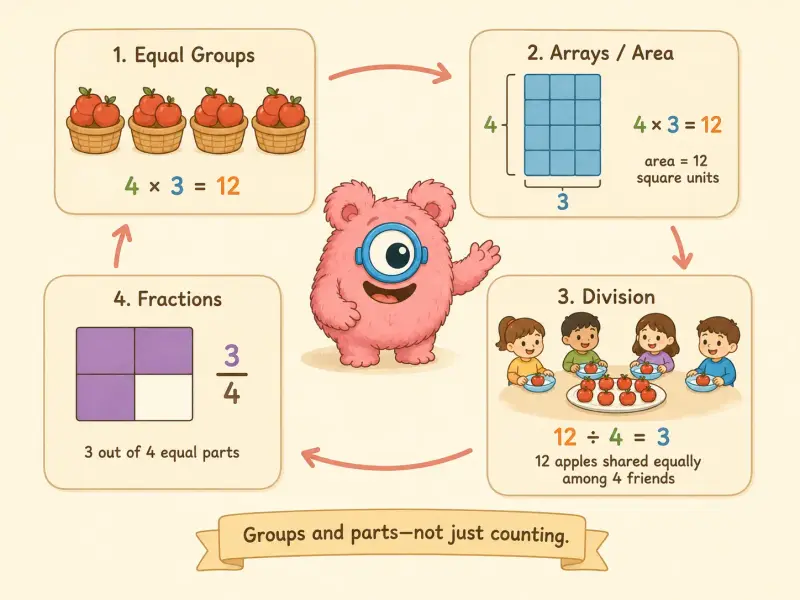
FAQs:
What math skills should a 3rd grader know by the end of the year?
By June, most third graders can fluently multiply and divide within 100 (including knowing single-digit multiplication facts from memory), solve two-step word problems using all four operations, understand fractions as equal parts of a whole and place them on a number line, find the area of a rectangle by tiling and multiplying its side lengths, and round numbers to the nearest 10 or 100.
Why is multiplication so much harder for kids than addition was?
Multiplication asks a child to reason about groups of things rather than individual items, which is a genuinely different kind of thinking than addition or subtraction. It also introduces new facts to memorize on top of a new concept to understand at the same time, which is why rushing straight to memorization before the concept is solid tends to backfire later.
My child still counts on their fingers for multiplication - is that a problem?
Occasionally reasoning through a hard fact by counting groups is normal even for kids who are otherwise fluent. The pattern worth watching is a child who has no faster strategy at all for most facts, months after classroom instruction has introduced them - that's worth mentioning to a teacher.
Why do fractions feel like such a big jump for third graders?
Up to this point, kids have learned that bigger digits mean a bigger number. Fractions break that rule - 1/8 is smaller than 1/2 - which means kids have to build a genuinely new mental model for what a number can be, rather than extending the one they already have.
Does helping with math homework at home actually make a difference?
It can help, but the research suggests how you help matters more than how often. Calm, low-pressure involvement is linked to better outcomes than frustrated or tense help, so working lower-stakes math practice into everyday moments can be more useful than a tense nightly homework battle.
When should I actually be concerned about a math learning difficulty in 3rd grade?
Watch for a cluster of signs that doesn't budge over months rather than a single rough patch: no movement toward faster multiplication strategies, real difficulty explaining what a fraction like 1/4 means, trouble connecting division back to multiplication, and math-specific distress out of proportion to other subjects. That combination, held over time, is worth bringing to a teacher.
References
Wu, J., Barger, M. M., Oh, D., & Pomerantz, E. M. (2022). Parents' daily involvement in children's math homework and activities during early elementary school. Child Development, 93(5), 1347–1364. https://pmc.ncbi.nlm.nih.gov/articles/PMC9542134/
Siegler, R. S., Duncan, G. J., Davis-Kean, P. E., Duckworth, K., Claessens, A., Engel, M., Susperreguy, M. I., & Chen, M. (2012). Early predictors of high school mathematics achievement. Psychological Science, 23(7), 691–697. https://files.eric.ed.gov/fulltext/ED552898.pdf
Menon, V. (2016). Working memory in children's math learning and its disruption in dyscalculia. Current Opinion in Behavioral Sciences, 10, 125–132. https://pmc.ncbi.nlm.nih.gov/articles/PMC10785441/