TL;DR:By the end of second grade, most kids can add and subtract fluently within 20 from memory, add and subtract within 100 using place-value strategies, understand three-digit numbers as hundreds, tens, and ones, skip-count by 5s, 10s, and 100s, tell time to the nearest five minutes, work with money, and read simple bar graphs and line plots. Second grade is where addition and subtraction stop being separate skills and start becoming one flexible system built on place value. Steady progress across the year matters more than hitting every item by a fixed date.
If first grade was about learning that 47 is four tens and seven ones, second grade is about actually using that idea to do things - adding 47 and 26 without counting on fingers, subtracting 100 from 350 in your head, figuring out how much change is left from a dollar. It's a year that asks kids to hold more in their heads at once, which is exactly why it can feel like the year math either "clicks" or starts to feel hard.
Treat this as a map rather than a scoreboard. Some kids will have regrouping down cold by winter break and still be shaky on telling time in May; others will move the opposite way. That unevenness is ordinary, and it shows up even more for neurodivergent kids, who often build skills in a different order than the curriculum assumes they will.
What "on track" actually means in second grade
Most U.S. states base their curriculum on the same national math standards, and for second grade those standards concentrate on four areas: getting addition and subtraction facts within 20 to automatic recall, extending that fluency to two- and three-digit numbers using place value, understanding what the digits in a three-digit number actually represent, and applying all of it to time, money, and simple data. The sections below unpack what each of those looks like in practice - the kind of detail that would come up if you sat down with a teacher.
Counting and number sense
This is the foundation everything else in second grade sits on. By the end of the year, a child should be able to:
Count within 1000, starting from any number
Skip-count by 5s, 10s, and 100s
Read and write numbers up to 1000 using digits, number names, and expanded form (like writing 325 as 300 + 20 + 5)
Compare two three-digit numbers using greater than, less than, or equal to
Tell whether a group of up to 20 objects is odd or even, and write an equation showing an even number as two equal addends (like 8 = 4 + 4)
Skip counting deserves special mention here, because it's easy to treat as a warm-up exercise rather than what it actually is - a rehearsal for multiplication. Our guide to what skip counting is and how to teach it covers why fluency with counting by 2s, 5s, and 10s in particular sets kids up for the times tables that arrive the following year.
Number fluency is also worth watching closely this year specifically, not just generally. A longitudinal study tracking children across second and third grade found that kids with poor arithmetic fact mastery showed remarkably little growth on timed number facts over the two years, even while making normal progress in other areas of math - and that this specific gap tended to stick around rather than close on its own, largely independent of a child's reading ability or IQ. In practice, fact fluency rarely closes the gap on its own. It tends to be the one piece of math that needs deliberate, separate practice, even when everything else is progressing normally.
Addition and subtraction within 100 (and beyond)
This is the headline work of the year. By June, most second graders can:
Fluently add and subtract within 20 using mental strategies - and know all one-digit addition facts from memory
Fluently add and subtract within 100 using strategies based on place value, properties of operations, or the relationship between addition and subtraction
Add up to four two-digit numbers using place-value strategies
Add and subtract within 1000 using concrete models, drawings, or a written method - understanding that sometimes it's necessary to compose or decompose a ten or hundred (regrouping)
Mentally add or subtract 10 or 100 from a number between 100 and 900, without having to count
Solve one- and two-step word problems involving addition and subtraction within 100, with the unknown in any position
Use arrays with up to 5 rows and 5 columns to find a total, writing an equation as a sum of equal addends - an early foundation for multiplication
Explain why an addition or subtraction strategy works, using place value or properties of operations
"Fluently" for facts within 20 means from memory by the end of the year - not derived every time, even quickly. For facts within 100, fluency means using an efficient place-value strategy rather than counting by ones. The bridge between the two is usually a strategy like Make 10, which most kids first meet in first grade but lean on constantly here: 47 + 6 becomes 47 + 3 + 3, or 50 + 3 = 53. Our guide to teaching the Make 10 strategy with ten-frame visuals walks through exactly how that move works and why it directly prepares kids for the regrouping this year introduces.
Place value: hundreds, tens, and ones
This is where second grade asks kids to extend an idea they built in first grade - and it's often the concept that separates a shaky year from a solid one. By the end of the year, a child working at grade level can typically:
Explain that a three-digit number like 706 represents 7 hundreds, 0 tens, and 6 ones
Understand 100 as a bundle of ten tens - a "hundred"
Recognize that 100, 200, 300, and so on represent 1 to 9 hundreds with 0 tens and 0 ones
Use place value understanding, not just memorized steps, to explain why regrouping (composing or decomposing a ten or hundred) is necessary in a given problem
If place value still feels shaky by mid-year, more worksheets rarely move it. What tends to help is rebuilding the concept with physical materials, letting it live in something a child can touch (or at least visualize) before it's expected to work as symbols on paper. Our free place value exploder tool lets a child watch a number break apart into hundreds, tens, and ones on screen, and our step-by-step guide to teaching place value with base-ten blocks walks through that same progression hands-on.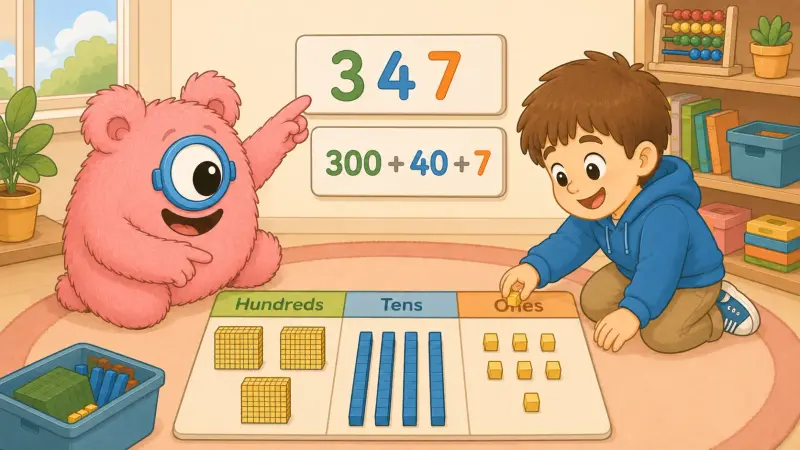
Measurement, time, money, data, and geometry
Less headline-grabbing than addition, but still a real chunk of the year's work. By the end of the year, most second graders can:
Measure an object's length using an appropriate tool - a ruler, yardstick, meter stick, or measuring tape
Measure the same object twice with different-sized units, and describe how the unit size affects the measurement
Estimate lengths in inches, feet, centimeters, and meters
Solve word problems involving length using addition and subtraction within 100, including on a number line
Tell and write time from an analog or digital clock to the nearest five minutes, using a.m. and p.m.
Solve word problems involving dollar bills, quarters, dimes, nickels, and pennies, using $ and ¢ symbols
Make a line plot from measurement data, and draw or read a picture graph or bar graph with up to four categories
Identify and draw shapes by their attributes - triangles, quadrilaterals, pentagons, hexagons, and cubes
Partition a rectangle into equal-size rows and columns of squares and count the total
Partition circles and rectangles into halves, thirds, or fourths, and describe the whole as two halves, three thirds, or four fourths
Money and time both lean heavily on the skip counting built earlier in the year - counting coins by 5s and 10s, or reading five-minute intervals on a clock face - so a child who's still shaky on skip counting will usually feel it here too.
For reference, here's the same checklist mapped to its official Common Core code, in case you want to compare notes with a teacher or IEP:
What actually helps at home
Here's a finding: a study of 8-year-olds - a mix of second and third graders - looked at what specific kind of home math practice actually moved the needle on arithmetic skills, and it wasn't casual number chat. The researchers found that home numeracy practices were linked to stronger arithmetic calculation and fluency only when those activities were formal and pitched above what the child could already comfortably do.
The practical takeaway here is to aim a notch above comfortable, rather than simply drilling harder. If a child has 47 + 26 solid, a worksheet of similar problems is unlikely to move fact fluency much further; a problem that stretches into regrouping across hundreds, or a slightly trickier word problem, is doing more work. That's a different job than the everyday math talk that's genuinely valuable for building number sense earlier on - by second grade, arithmetic fluency specifically seems to respond more to practice that's a little bit hard.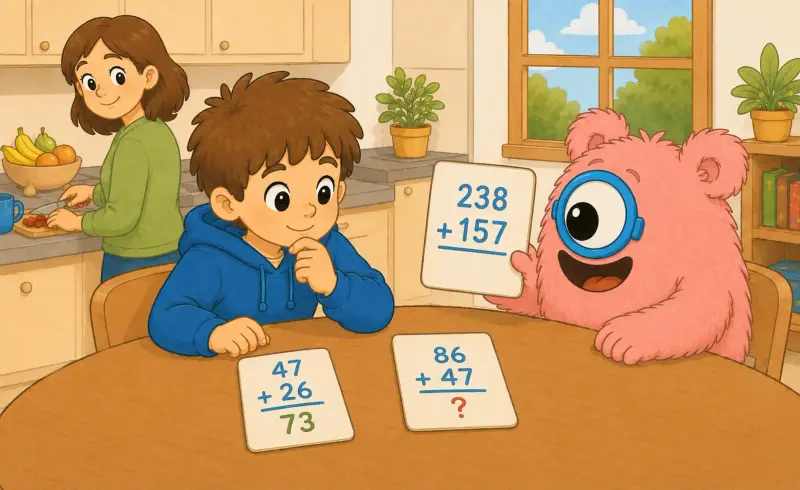
When to look closer
Some unevenness is completely normal in second grade, especially with place value, which is genuinely one of the harder conceptual jumps in early elementary math. But a few patterns are worth flagging to a teacher rather than waiting out:
Still counting by ones to solve facts within 20, with no movement toward faster strategies
Consistently can't explain what the digits in a number like 342 represent, even with base-ten blocks in front of them
No progress on regrouping (borrowing/carrying) after repeated practice with concrete models
Strong anxiety or shutdown specifically around math tasks, more than other subjects
These patterns are worth taking seriously because second grade specifically is a point where research has traced real, long-reaching consequences. A study that followed children from second and third grade all the way to eighth grade found that gaps in a child's number knowledge at ages 7 and 8 predicted the specific kinds of errors they were still making on math tests six years later, in eighth grade - early misconceptions about whole numbers were linked to slower, less accurate, and more error-prone computation well into middle school.
One shaky week doesn't warrant alarm. A pattern that's held for months does, and it's worth acting on now rather than assuming time alone will resolve it. If several of the signs above sound familiar, our guide to signs your child may have dyscalculia walks through what to look for next and how to talk to your child's teacher about it.
The bottom line for this year
If you take one thing from this list, make it place value - nearly everything else on it is that idea showing up in a new outfit, whether that's regrouping in a subtraction problem, skip-counting by hundreds, or reading a three-digit number off a hundred chart. A child who's still assembling that concept in November isn't behind for good; place value is genuinely one of the harder ideas kids meet this early, and it tends to click at its own pace once it's been built with hands-on materials rather than rushed on paper. Watch the trend across the year, not any single week.
FAQs:
What math skills should a 2nd grader know by the end of the year?
By June, most second graders can add and subtract fluently within 20 from memory, add and subtract within 100 using place-value strategies, understand three-digit numbers as hundreds, tens, and ones, skip-count by 5s, 10s, and 100s, tell time to the nearest five minutes, solve money word problems, and read simple bar graphs and line plots.
Why does place value matter so much in 2nd grade?
Second grade is when place value stops being background knowledge and starts being the tool a child actually needs - to add two-digit numbers, to regroup in subtraction, to compare three-digit numbers, and to make sense of skip counting by 100s. A shaky grasp of place value tends to show up as difficulty everywhere else in the curriculum, not just in place-value lessons themselves.
What's the difference between "knowing" a math fact and being "fluent" in it?
Knowing a fact means a child can eventually get to the right answer, often by counting or working it out. Fluency means they can produce it quickly and with far less mental effort - either from memory (for facts within 20) or using an efficient strategy (for facts within 100).
Is it a problem if my second grader still uses their fingers sometimes?
Not by itself. The distinction to watch is what the fingers are doing: tapping out 6 + 7 once in a while while everything else is fluent is a habit, not a warning sign. Falling back to fingers for most facts within 20, months after classroom instruction has moved past that stage, is the pattern worth a conversation with the teacher.
How much formal math practice does a second grader need at home?
Based on the research above, the useful kind is practice that's slightly harder than what already feels easy - not simply more of what a child is already comfortable with. A handful of problems that push just past a child's comfort zone a few times a week does more for arithmetic fluency than a long nightly worksheet pitched at what they've already mastered.
When should I actually be concerned about dyscalculia?
Watch for a cluster of signs that doesn't budge over months, rather than any single rough patch: no movement on regrouping despite hands-on practice, real difficulty explaining what a number's digits mean, and math-specific distress that's out of proportion to other subjects. That combination, held over time, is worth bringing to a teacher.
References:
Jordan, N. C., Hanich, L. B., & Kaplan, D. (2003). Arithmetic fact mastery in young children: A longitudinal investigation. Journal of Experimental Child Psychology, 85(2), 103–119. https://pmc.ncbi.nlm.nih.gov/articles/PMC2791329/
Girard, C., Bastelica, T., Léone, J., Epinat-Duclos, J., Longo, L., & Prado, J. (2021). The relation between home numeracy practices and a variety of math skills in elementary school children. PLoS ONE, 16(9), e0255400. https://pmc.ncbi.nlm.nih.gov/articles/PMC8452026/
Mazzocco, M. M. M., Murphy, M. M., Brown, E. C., Rinne, L., & Herold, K. H. (2013). Persistent consequences of atypical early number concepts. Frontiers in Psychology, 4, Article 486. https://www.frontiersin.org/journals/psychology/articles/10.3389/fpsyg.2013.00486/full