TL;DR: By the end of first grade, most kids can add and subtract fluently within 10 (and solve problems within 20), understand two-digit numbers as tens and ones, measure and compare lengths, and describe basic shapes. Counting on fingers sometimes is normal, not a red flag. What matters more than hitting every item on a fixed date is steady progress and whether a skill "clicks" with practice - if a child is stuck in the same place for months despite support, that's worth a closer look.
First grade is where math stops being mostly about counting and starts being about relationships between numbers - how 8 and 2 make 10, how 47 is four tens and seven ones, how a pencil is longer than a paperclip but shorter than a desk. For a parent, it's also the year report cards start using words like "fluency" and "place value," which can feel like a foreign language if nobody hands you the map.
This checklist isn't a race. Kids move through these skills at different speeds, and that's especially true for neurodivergent kids, who might be ahead in some areas and need more time in others. Use it to know what's coming, not to panic over a single skill that hasn't landed yet.
What "on track" actually means in first grade
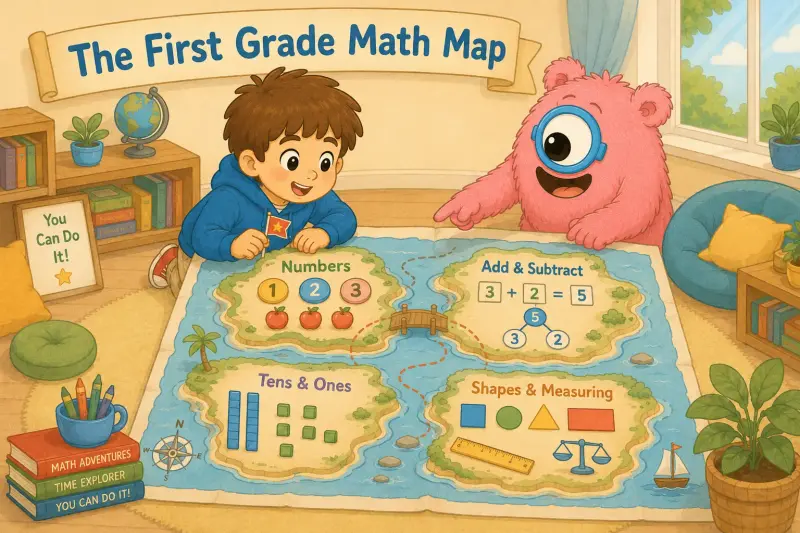
The national math standards used by most U.S. states put the weight of first grade on four things: addition and subtraction within 20, understanding tens and ones, measuring length, and working with basic shapes. Everything below breaks those four areas into what you'd actually notice at home or in a teacher conference.
Counting and number sense
This is the foundation everything else sits on. By the end of first grade, a child should be able to:
Count to 120, starting from any number (not just from 1)
Read and write numbers up to 120, and match them to a quantity of objects
Compare two-digit numbers using more than, less than, or equal to
Mentally find 10 more or 10 less than a two-digit number, without having to count
Number sense is worth paying attention to precisely because it doesn't stay contained to "just counting." Researchers who followed a group of kids from kindergarten into first grade found that how comfortably a child could count and compare numbers back in kindergarten was one of the clearest early clues to how well they'd do at arithmetic by the end of first grade. So if counting and comparing numbers still feel shaky, that's exactly the skill worth shoring up first.
Addition and subtraction within 20
This is the headline skill of the year. By June, most first graders can:
Add and subtract within 10 fluently - meaning quickly and mostly without counting on fingers
Solve addition and subtraction problems within 20 using a strategy (counting on, making a ten, using known facts)
Solve simple word problems with the unknown in different positions ("Sam has some apples. He gives away 4 and has 5 left. How many did he start with?")
Solve word problems that add three numbers together, as long as the total is 20 or less
Use a known fact as a shortcut for a related one - like knowing 8 + 3 gives the same answer as 3 + 8
Count on or count back to solve a problem (for example, counting on 2 from 6 by saying 7, 8)
Understand that addition and subtraction are related - 10 − 8 = ? means the same thing as "what number plus 8 makes 10?"
Understand what the equal sign means, and tell whether an equation like 4 + 1 = 5 + 2 is true or false
Find the missing number in an equation like 8 + ? = 11
"Fluent" doesn't mean instant recall of every fact by September - it means a child has moved past counting one-by-one on fingers toward faster strategies like making a ten. Our full walkthrough of addition and subtraction strategies for a first grade child covers exactly what that progression looks like and how to support it at home.
Place value: tens and ones
This is where a lot of first graders hit their first real wall, because it asks them to hold two ideas about the same number at once. By the end of the year, a child working at grade level can typically:
Explain that a number like 17 is "one ten and seven ones"
Use tens and ones to compare two two-digit numbers
Add a two-digit number and a one-digit number, or a two-digit number and a multiple of 10, using what they know about place value
Subtract one multiple of 10 from another, both between 10 and 90 (like 90 − 30)
If place value feels shaky, base-ten blocks or bundles of ten straws are worth more than another worksheet - this concept needs to be built, seen, and touched before it's just symbols on paper. Our free place value exploder tool lets a child watch a number break apart into hundreds, tens, and ones right on screen, and our step-by-step guide to teaching place value with base-ten blocks walks through that same progression in more depth.
Measurement, data, and geometry
Less headline-grabbing than addition, but still part of the year's core work. By the end of the year, most first graders can:
Order three objects by length and describe the difference ("the pencil is shorter than the crayon")
Measure an object's length using same-size units laid end to end (paperclips, blocks)
Tell time to the hour and half hour on an analog and digital clock
Identify and describe basic 2D and 3D shapes, and put shapes together to make new ones
Split a circle or rectangle into two or four equal shares, and describe them as halves, fourths, or quarters
Read simple data sorted into up to three categories, and answer questions like how many more are in one group than another
For reference, here's the same checklist mapped to its official Common Core code, in case you want to compare notes with a teacher or IEP:
What actually helps at home
Parents often ask whether they need to run drills every night. The honest research-backed answer: probably not in the way you're picturing. A large research review found that the link between what families do at home around math and kids' math achievement is real, but modest overall - and the type of activity matters more than the amount of it. Everyday, informal math talk (splitting a snack evenly, checking how much change is left, counting stairs) showed a stronger link with achievement than formal worksheet-style practice at home.
Practically, that means the highest-value thing you can do most days isn't a flashcard set - it's narrating the math that's already happening. "We need 3 more forks for the table." "You're 6, your sister is 9 - how much older is she?" Five minutes of that, woven into a normal afternoon, beats twenty minutes of forced drilling for most kids.
When to look closer
Some unevenness is completely normal in first grade. But a few patterns are worth flagging to a teacher rather than waiting out:
Still can't reliably tell which of two numbers is bigger without counting both out
Consistently loses track partway through counting, even small sets
No progress on moving past finger-counting after months of practice
Strong anxiety or shutdown specifically around math tasks, more than other subjects
These patterns are worth taking seriously because early math difficulty tends to persist rather than resolve on its own. One review of early numeracy research highlights how persistent early math difficulties can be: children who scored below the 10th percentile in math across kindergarten were at high risk of remaining far behind later in elementary school, with one cited estimate putting that risk around 70% by fifth grade.
The flip side is genuinely encouraging: quick screening can work well. A newly validated game-based preschool math screener caught every child identified as at risk by a standard math assessment, while also showing good accuracy overall. It did flag some extra children, but for a screener, that is often preferable to missing children who may need support. A short, playful check like that can flag a child worth a closer look without a lengthy formal assessment, and catching a risk pattern early gives a lot more room to act on it than waiting until it's an entrenched struggle. If several of the signs above sound familiar, our guide to signs your child may have dyscalculia walks through what to look for next and how to talk to your child's teacher about it.
The bottom line for this year
First grade math is really just four skills wearing a lot of different outfits: fluent-ish facts within 10, working problems within 20, understanding tens and ones, and describing the world in length and shape. Kids arrive at "solid" on different timelines, and a slow start on one skill in October rarely predicts where a child lands in May. What's worth your attention isn't a single missed milestone - it's whether a child is moving, even slowly, with the right support in place.
FAQs:
What math skills should a 1st grader know by the end of the year?
By June, most first graders can add and subtract fluently within 10, solve addition and subtraction problems within 20 using a strategy, understand two-digit numbers as tens and ones, measure and compare lengths, tell time to the half hour, and describe basic 2D and 3D shapes.
Is it a problem if my first grader still counts on fingers?
Not on its own. Finger-counting is a normal stepping stone, especially early in the year. It's more worth watching if a child is still relying on it exclusively for facts within 10 by the spring, with no movement toward faster strategies like making a ten.
How much math practice does a first grader actually need at home?
Short, frequent, and woven into normal life beats long formal sessions. A few minutes a day of real-world math talk - measuring while cooking, splitting snacks, checking a scoreboard - tends to matter more than nightly worksheets.
What's the difference between "knowing" a math fact and being "fluent" in it?
Knowing a fact means a child can eventually get to the right answer, often by counting. Fluency means they can produce it quickly and with far less mental effort, usually because they've internalized a strategy or committed the fact to memory.
When should I actually be concerned about dyscalculia?
One shaky skill isn't a red flag. Multiple, persistent signs together - no progress off finger-counting for months, real trouble comparing quantities, strong math-specific anxiety - are worth raising with a teacher, since early support has the biggest impact.
My child seems ahead of these milestones - what should I do?
Let them go deeper rather than just faster. Puzzles, pattern-based games, and real-world problem solving (splitting a bill, planning a budget for a small purchase) build reasoning in a way that skipping ahead to bigger numbers alone doesn't.
References:
Hornung, C., Schiltz, C., Brunner, M., & Martin, R. (2014). Predicting first-grade mathematics achievement: the contributions of domain-general cognitive abilities, nonverbal number sense, and early number competence. Frontiers in Psychology, 5, Article 272. https://www.frontiersin.org/journals/psychology/articles/10.3389/fpsyg.2014.00272/full
Daucourt, M. C., Napoli, A. R., Quinn, J. M., Wood, S. G., & Hart, S. A. (2021). The Home Math Environment and Math Achievement: A Meta-Analysis. Psychological Bulletin, 147(6), 565–596. https://pmc.ncbi.nlm.nih.gov/articles/PMC8634776/
Raghubar, K. P., & Barnes, M. A. (2017). Early numeracy skills in preschool-aged children: A review of neurocognitive findings and implications for assessment and intervention. The Clinical Neuropsychologist, 31(2), 329–351. https://pmc.ncbi.nlm.nih.gov/articles/PMC6208324/
Chatzaki, M.-A., Skillen, J., Ricken, G., & Seitz-Stein, K. (2024). Exploring the potential of a game-based preschool assessment of mathematical competencies. Frontiers in Education, 9, Article 1337716. https://www.frontiersin.org/journals/education/articles/10.3389/feduc.2024.1337716/full