TL;DR
The best games are simple and number-based. Linear number board games, card games like War, and dice games build number sense, comparing, and addition and subtraction facts.
Short and often beats long and rare. Ten to fifteen minutes of play a few times a week, spread out over days, fits what memory research shows about spaced practice.
Calm matters as much as content. Math anxiety shows up as early as 1st grade, so low-pressure, untimed games help, especially for kids with ADHD, dyscalculia or attention and working-memory differences.
If your 1st grader groans at the sight of a worksheet, you are not alone. Short, playful math games at home can build the same skills, and research suggests games often hold young children's attention better while doing it. Below are 12 low-prep first grade math games you can play with cards, dice, the kitchen, and a bit of floor space, or even some with no props on a car trip. Each one targets a real 1st grade skill, from counting to 120 to adding and subtracting within 20.
Why do so many 1st graders hate math worksheets?
Many 1st graders resist worksheets because a page of 20 problems asks a six-year-old to sit still, focus alone and get answers right on the first try, with no fun in between. For a child who is still building number sense, that can feel like a test, not practice.
There is also an emotional side. In a study of 154 first and second graders, children who reported more math anxiety had lower math achievement, and the link was strongest for kids with higher working memory. Worry seems to use up the mental "workspace" kids need to do math.
Parents matter here too. Researchers found that parents' own math anxiety predicted lower math learning and more math anxiety in their children, but only when those parents often helped with math homework. However, that is not a reason to step back. It is a reason to make math time feel relaxed and playful, for both of you.
Why do math games work better than worksheets for many 1st graders?
Math games give kids the same practice as worksheets, but with turns, chance, conversation and a reason to care about the answer. That keeps them engaged longer and makes mistakes feel low-stakes.
The research behind this is strong for young children:
Board games build number sense. In a classic study, low-income preschoolers who played a simple 1–10 number board game improved their number-line estimates, and children who played the same game with colors instead of numbers did not. A related study by Ramani and Siegler (2008) found that playing a linear number board game in four 15- to 20-minute sessions over two weeks improved counting, comparing numbers, number-line estimation and numeral recognition, with gains still visible nine weeks later.
Card games help with comparing numbers. A War-style magnitude comparison card game, played in four 15-minute sessions, improved low-income preschoolers' ability to compare written numbers.
Guided play beats both lectures and free play for early math. A meta-analysis of guided play studies by Skene and colleagues (2022) reviewed 39 studies of children aged 1 to 8 and found that guided play had a greater positive effect than direct instruction on early math skills (g = 0.24) and shape knowledge (g = 0.63). Guided play means the adult sets up the activity with a learning goal, but the child stays in charge of the play, an idea described by Weisberg, Hirsh-Pasek and colleagues.
Home math matters. Studies of the home numeracy environment show that children who do more number activities at home tend to have stronger math skills, and that formal activities like practising sums link to symbolic number skills while informal ones like games link to other early number skills. A 2025 systematic review of math games in early childhood concluded that games played with parents, peers and teachers support math learning from preschool to grade 3.
One caveat: most of the board game and card game studies were done with preschoolers. The skills they build, such as number sense and comparing, are still core 1st grade skills, so the games adapt well when you raise the numbers.
If you want a refresher on the number sense, our guide to what number sense is and why it matters in K–3 is a good starting point.
What math should a 1st grader know?
By the end of 1st grade, most US children are expected (under the Common Core State Standards, which many states use or adapt) to count to 120, add and subtract within 20, know addition and subtraction facts within 10 fluently, understand tens and ones, compare two-digit numbers, measure and compare lengths, tell time to the hour and half hour, and work with basic shapes and simple word problems.
Here is how the 12 games below map to those skills.
12 math games for 1st grade at a glance
The 12 games
1. Number Line Race
Skill: Number sense to 120, counting on.
You need: Paper, a pen, one die, two small tokens.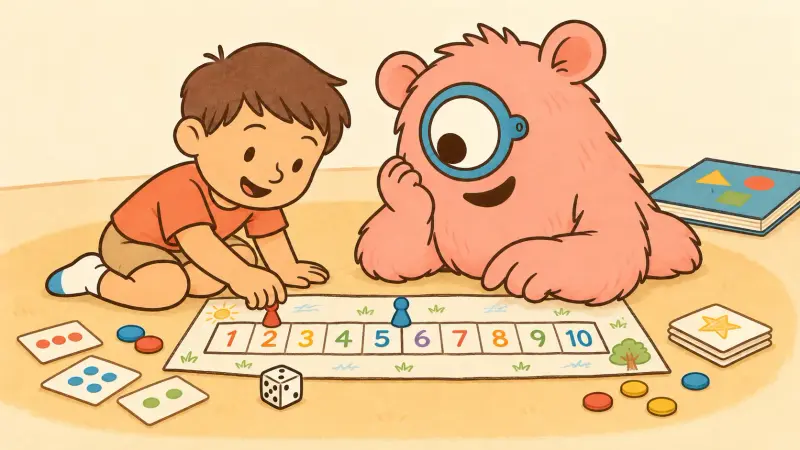
How to play:
Draw a straight track of boxes and number them 1 to 30 (or higher later).
Take turns rolling the die and moving your token.
Say each number out loud as you land on it ("12, 13, 14").
First to the end wins.
Easier: Use a 1–10 track. Harder: Extend the track to 120, or use two dice and add them first.
Why it works: This is the type of game used in the Siegler and Ramani studies. The key is a straight track with numbers in equal boxes, and saying the numbers aloud. In a follow-up study, linear boards helped while circular ones did not, likely because a straight line matches how numbers increase on a number line.
2. Addition War
Skill: Adding within 20, comparing numbers.
You need: A deck of cards with face cards removed (Aces = 1).
How to play:
Split the deck between two players.
Each player flips two cards and adds them.
The bigger total wins all four cards.
If it's a tie, flip again.
Easier: Play classic War with one card each, so it is only "which is bigger?" Harder: Flip three cards, or flip two and subtract the smaller from the bigger.
Why it works: It is a fun way to practise "which is more?" over and over. A War-based card game improved young children's number comparison skills in just four short sessions.
3. Make 10 Go Fish
Skill: Number bonds to 10 (fact fluency).
You need: A deck of cards, Ace to 9 plus the 10s.
How to play:
Deal five cards each.
Instead of asking for matches, ask for the card that "makes 10" with one of yours ("Do you have a 3?" if you hold a 7).
Lay down pairs that make 10. Draw from the pile if you hear "Go fish."
Most pairs wins.
Easier: Leave cards face up so your child can see their options. Harder: Play "Make 20" using two cards plus a 10.
Why it works: Knowing the pairs that make 10 is a building block for adding within 20 (8 + 5 is 8 + 2 + 3).
If your child's school talks about "number bonds," our explainer on what number bonds are and why schools teach them will help you speak the same language.
4. Race to 100
Skill: Place value (tens and ones).
You need: Two dice, plus pennies and dimes (or single Lego bricks and 10-brick towers).
How to play:
Roll both dice and add them. Take that many ones.
When you have 10 ones, trade them for one ten.
Say your total each turn ("3 tens and 4 ones is 34").
First to 100 wins.
Easier: Race to 50. Harder: Start at 100 and race back to 0, "breaking" a ten when you need to.
Why it works: Trading 10 ones for a ten makes place value physical. Our guide to what place value is and why it matters explains why this idea is so important for later math.
5. Double Trouble
Skill: Doubles and near doubles.
You need: Two dice.
How to play:
Roll one die. Your child doubles the number ("4 and 4 is 8").
Roll a second die. If it is one more than the first, try the near double ("4 + 5 is 8 + 1").
Score a point for each correct answer.
Easier: Use only doubles up to 5 + 5. Harder: Use a 10-sided die for doubles to 20.
Why it works: Short bursts of recall, repeated over days, fit what memory research calls spaced retrieval practice. A meta-analysis of spaced retrieval practice found a strong benefit (g = 0.74) for spreading practice out over time instead of cramming it into one session. In a classroom study, second graders who practised multiplication facts with retrieval (flashcard-style recall) became more fluent than when they simply chanted the facts aloud. The same principle applies to 1st grade addition facts.
6. Hop the Number Line
Skill: Counting on and counting back, adding and subtracting within 20.
You need: Chalk outside or masking tape on the floor.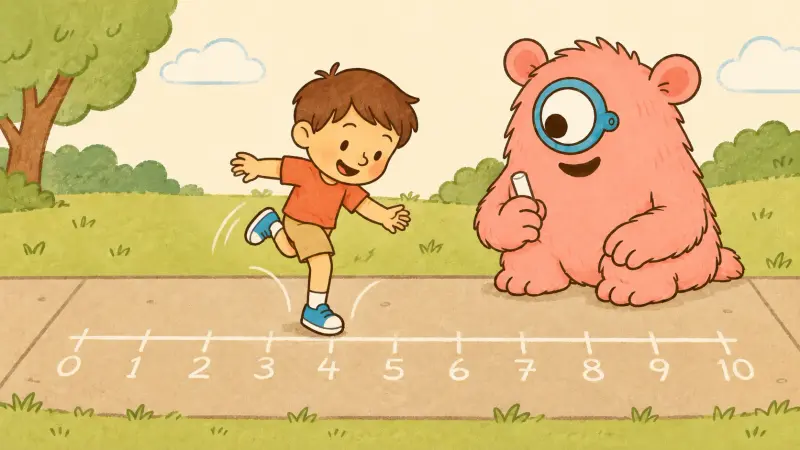
How to play:
Draw or tape a number line from 0 to 20.
Call out a problem ("Stand on 7. Hop 5 forward.").
Your child hops and counts each jump out loud.
Where they land is the answer.
Easier: Only add 1, 2 or 3. Harder: Call out two-step problems ("Hop 6 forward, then 3 back").
Why it works: Moving the body with the math, not just next to it, seems to matter. In one study, preschoolers who did physical activity built into their numeracy lessons performed better than children who did unrelated exercise, watched the movement, or learned sitting down. This is a great choice for wiggly kids and many children with ADHD.
7. Snack Shop Stories
Skill: Simple word problems.
You need: A few snacks (crackers, grapes), some coins, a "shop" counter.
How to play:
Your child runs the shop. You are the customer.
Tell mini stories: "I have 6 grapes. I eat 2. How many are left?"
Your child acts it out with the real snacks, then answers.
Swap roles so they invent the story problem.
Easier: Keep numbers under 10. Harder: Add two steps ("I buy 5, then 4 more, then share 3 with you").
Why it works: Story problems make math talk part of everyday life. In a large study of 587 first graders, families who used the Bedtime Math story app saw math gains, and children of math-anxious parents who got the math app were almost three months ahead of the reading-app group by the end of the year.
Note that the study had its critics, and it was funded by a foundation linked to Bedtime Math, so treat it as promising, not proof.
8. Noodle Measure-Off
Skill: Measuring and comparing length.
You need: Dry spaghetti or penne, a few household objects (spoon, shoe, book).
How to play:
Each player picks an object.
Guess how many pasta pieces long it is.
Line up pasta end to end with no gaps and count.
Closest guess wins a point. Then put all the objects in order from shortest to longest.
Easier: Compare just two objects. Harder: Measure with two different units (pasta and paper clips) and talk about why the numbers differ.
Why it works: 1st graders learn to measure using same-size units lined up with no gaps, and real objects make that idea concrete. Guessing first adds a fun estimation challenge.
9. Clock Detective
Skill: Telling time to the hour and half hour.
You need: An analog clock (a paper plate clock works).
How to play:
A few times a day, ask "Detective, what time is it?"
Your child checks the clock and reads it.
Link it to a real event: "At 6:30 we eat dinner. Is it dinner time yet?"
Easier: Only practise o'clock times. Harder: Ask "What time will it be in one hour?"
Why it works: Short, repeated questions tied to daily routines spread practice across the day. Wondering whether clocks still matter? Read our take on whether kids need clock reading skills in 2026.
10. Shape Detective
Skill: 2D and 3D shapes.
You need: Your home.
How to play:
Pick a shape ("rectangle").
Set a timer for two minutes and hunt for as many as you can.
For each one, ask "How do you know it's a rectangle?" (four sides, four square corners).
Try odd examples too: a long thin rectangle is still a rectangle.
Easier: Hunt for circles and squares. Harder: Hunt for 3D shapes (cylinders, cubes) or cut a sandwich into halves and fourths.
Why it works: This is guided play. In one study, 4- and 5-year-olds who learned shapes through guided play understood shape properties better than kids taught by direct instruction or left to free play, and the effect lasted at least a week.
11. License Plate Math
Skill: Reading and comparing numbers, adding small numbers.
You need: A car trip.
How to play:
Each player picks a car ahead and reads the digits on its plate.
Add the first two digits. Bigger total gets a point.
Or read a two-digit number from the plate and ask "Is that more or less than 50?"
Easier: Just find numbers in order, 1, 2, 3, up to 10. Harder: Add more than 2 digits on the plate.
Why it works: It turns dead time into quick, low-stakes number talk. Car games also need no pencils, no table and no "sit still" rules.
12. Bears in the Cave
Skill: Subtraction and missing numbers within 10.
You need: Ten small objects (toy bears, buttons) and a cup.
How to play:
Count out a set, say 8 bears.
While your child closes their eyes, hide some under the cup.
Your child counts the bears left and works out how many are "in the cave."
Lift the cup to check.
Easier: Use 5 objects. Harder: Use up to 20, or write the number sentence (8 − ? = 3).
Why it works: It builds the link between addition and subtraction with real objects and an instant check, so mistakes feel like part of the game. It is a calm, quiet choice for anxious kids.
How long should my 6-year-old practise math each day?
For most 1st graders, 10 to 15 minutes of math play a day, or even a few times a week, is plenty. In Siegler and Ramani's (2008) board game study, four 15-minute sessions over two weeks (about 30 games in total) were enough to close the gap in number-line estimation between low-income and middle-income preschoolers. In the Bedtime Math app study, using the app about once a week was linked with significantly more math growth for children of math-anxious parents than minimal use. Stop while your child is still having fun.
Here is a simple weekly game plan.
What if my child has math anxiety, ADHD or dyscalculia?
Games are often a better fit for neurodiverse kids than worksheets, but the details matter. A few tips:
Drop the timer. Speed pressure can raise anxiety. Untimed games let kids think.
Keep sessions short. Five focused minutes beats 20 frustrated ones.
Add movement. Games like Hop the Number Line give restless bodies a job.
Use real objects. Cards, dice and counters lighten the load on working memory.
Watch for attention, not just answers. In a small study of a computer-based math program, students with more inattention made slower progress, so it pays to keep tasks short and engaging.
Our article on math anxiety in autism, ADHD and dyscalculia goes deeper on what is different for each group. If your child struggles a lot despite regular practice, talk to their teacher or a specialist about screening for dyscalculia.
Where does a math app fit in?
A good math app can be one more tool, not a replacement for playing together. A meta-analysis of digital interventions for children with math learning difficulties by Benavides-Varela and colleagues (2020) found a medium positive effect overall (d = 0.55), though results varied a lot between studies. It also found no evidence that video games did better than digital drill or tutoring, so the quality of the practice matters more than the bells and whistles.
That is where Monster Math may help. It is a game-based math fact fluency app for grades 1 to 3, designed with neurodiverse learners in mind. Kids practise skills like addition and subtraction within 10 and doubles within 20 using visual models, with no timers and no competition. It works well on busy days when you cannot sit down for a card game, or as a calm daily dose of fact practice.
If that sounds like a fit for your child, you can start a free trial of Monster Math and see whether they enjoy it.
FAQ
How can I make math fun for my 1st grader?
Turn practice into a game with turns, chance and a small "win." Use cards, dice, snacks and movement, keep sessions to 10–15 minutes, and play alongside your child. Games like Addition War and Hop the Number Line build the same skills as worksheets with far less resistance.
What math should a 1st grader know?
Most 1st graders work toward counting to 120, adding and subtracting within 20, knowing facts within 10 fluently, understanding tens and ones, comparing two-digit numbers, measuring length, telling time to the half hour, and naming basic shapes.
Are math games better than worksheets?
For many young children, yes, as a main way to practise. Research on guided play shows it can beat direct instruction for early math skills, and number board and card games improve number sense. Worksheets still have a place for some practice, but games tend to be more engaging and less stressful.
How long should my 6-year-old practise math each day?
About 10 to 15 minutes is enough for most 6-year-olds. Short, regular sessions spread across the week work better than long, rare ones, and in Siegler and Ramani's studies, just four 15-minute sessions of board game play over two weeks improved number skills.
What are good math games for kids with ADHD?
Choose short, active, untimed games. Hop the Number Line, Addition War and Double Trouble are quick and hands-on. Movement-based math has research support for young children, and breaking play into five-minute bursts helps with focus.
What if my child has math anxiety?
Lower the stakes. Drop timers, celebrate effort, play cooperative games, and keep your own tone relaxed, since parents' math anxiety can rub off when they help with math. Quiet, hands-on games like Bears in the Cave are a gentle place to start.
Do math apps actually work for 1st graders?
Some do. Research shows digital math interventions can help children who struggle with math, but flashy game features alone do not guarantee results. Look for apps that build understanding, avoid time pressure, and give clear, kind feedback, such as Monster Math.
What are the best free math games for 1st grade at home?
The best free math games use things you already have. A deck of cards (Addition War, Make 10 Go Fish), two dice (Double Trouble, Race to 100) and a hand-drawn number track (Number Line Race) cover most 1st grade skills.
References
Benavides-Varela, S., Zandonella Callegher, C., Fagiolini, B., Leo, I., Altoè, G., & Lucangeli, D. (2020). Effectiveness of digital-based interventions for children with mathematical learning difficulties: A meta-analysis. Computers & Education, 157, 103953. https://www.sciencedirect.com/science/article/pii/S0360131520301512
Berkowitz, T., Schaeffer, M. W., Maloney, E. A., Peterson, L., Gregor, C., Levine, S. C., & Beilock, S. L. (2015). Math at home adds up to achievement in school. Science, 350(6257), 196–198. https://doi.org/10.1126/science.aac7427
DePascale, M., & Ramani, G. B. (2025). The role of math games for children's early math learning: A systematic review. Journal of Numerical Cognition, 11, Article e14897. https://jnc.psychopen.eu/index.php/jnc/article/download/14897/14897.html?inline=1
Fisher, K. R., Hirsh-Pasek, K., Newcombe, N., & Golinkoff, R. M. (2013). Taking shape: Supporting preschoolers' acquisition of geometric knowledge through guided play. Child Development, 84(6), 1872–1878. https://templeinfantlab.com/wp-content/uploads/sites/2/2019/06/Fisheretal-2013-Child_Development.pdf
Herzog, M., & Casale, G. (2024). Inattention negatively moderates the effectiveness of a mathematics intervention in low performing primary school students. Frontiers in Education, 9. https://www.frontiersin.org/journals/education/articles/10.3389/feduc.2024.1276741/full
Latimier, A., Peyre, H., & Ramus, F. (2021). A meta-analytic review of the benefit of spacing out retrieval practice episodes on retention. Educational Psychology Review, 33(3), 959–987. http://www.lscp.net/persons/ramus/docs/EPR20.pdf
LeFevre, J.-A., Skwarchuk, S.-L., Smith-Chant, B. L., Fast, L., Kamawar, D., & Bisanz, J. (2009). Home numeracy experiences and children's math performance in the early school years. Canadian Journal of Behavioural Science, 41(2), 55–66. https://doi.org/10.1037/a0014532
Maloney, E. A., Ramirez, G., Gunderson, E. A., Levine, S. C., & Beilock, S. L. (2015). Intergenerational effects of parents' math anxiety on children's math achievement and anxiety. Psychological Science, 26(9), 1480–1488. https://sites.temple.edu/cognitionlearning/files/2013/09/Maloney-et-al-in-press.pdf
Mavilidi, M. F., Okely, A., Chandler, P., Domazet, S. L., & Paas, F. (2018). Immediate and delayed effects of integrating physical activity into preschool children's learning of numeracy skills. Journal of Experimental Child Psychology, 166, 502–519. https://doi.org/10.1016/j.jecp.2017.09.009
Ophuis-Cox, F. H. A., Catrysse, L., & Camp, G. (2023). The effect of retrieval practice on fluently retrieving multiplication facts in an authentic elementary school setting. Applied Cognitive Psychology, 37(6), 1463–1469. https://onlinelibrary.wiley.com/doi/10.1002/acp.4141
Ramani, G. B., & Siegler, R. S. (2008). Promoting broad and stable improvements in low-income children's numerical knowledge through playing number board games. Child Development, 79(2), 375–394. http://drum.lib.umd.edu/bitstream/1903/10061/1/Ramani%20&%20Siegler,%202008.pdf
Ramirez, G., Gunderson, E. A., Levine, S. C., & Beilock, S. L. (2013). Math anxiety, working memory, and math achievement in early elementary school. Journal of Cognition and Development, 14(2), 187–202. https://sites.temple.edu/cognitionlearning/files/2013/09/Ramirez-et-al-2013.pdf
Scalise, N. R., Daubert, E. N., & Ramani, G. B. (2018). Narrowing the early mathematics gap: A play-based intervention to promote low-income preschoolers' number skills. Journal of Numerical Cognition, 3(3), 559–581. https://pmc.ncbi.nlm.nih.gov/articles/PMC8455118/
Siegler, R. S., & Ramani, G. B. (2008). Playing linear numerical board games promotes low-income children's numerical development. Developmental Science, 11(5), 655–661. https://siegler.tc.columbia.edu/wp-content/uploads/2019/02/sieg-ram08.pdf
Siegler, R. S., & Ramani, G. B. (2009). Playing linear number board games—but not circular ones—improves low-income preschoolers' numerical understanding. Journal of Educational Psychology, 101(3), 545–560. https://doi.org/10.1037/a0016701
Skene, K., O'Farrelly, C. M., Byrne, E. M., Kirby, N., Stevens, E. C., & Ramchandani, P. G. (2022). Can guidance during play enhance children's learning and development in educational contexts? A systematic review and meta-analysis. Child Development, 93(4), 1162–1180. https://pmc.ncbi.nlm.nih.gov/articles/PMC9545698/
Skwarchuk, S.-L., Sowinski, C., & LeFevre, J.-A. (2014). Formal and informal home learning activities in relation to children's early numeracy and literacy skills: The development of a home numeracy model. Journal of Experimental Child Psychology, 121, 63–84. https://doi.org/10.1016/j.jecp.2013.11.006
Weisberg, D. S., Hirsh-Pasek, K., Golinkoff, R. M., Kittredge, A. K., & Klahr, D. (2016). Guided play: Principles and practices. Current Directions in Psychological Science, 25(3), 177–182. https://templeinfantlab.com/wp-content/uploads/sites/2/2017/12/Guided-Play-Principles-and-Practices.pdf